

Changing The Way We Think About Mother’s Day
May 7, 2015 by Asaf Rosenheim via Gays With Kids

Our family belongs to a gay synagogue, so most of the parents who attend the children’s services with their kids are gay. One Yom Kippur our rabbi asked for a show of hands. “Who has two moms?” she asked. “Who has two dads? Who lives with a grandparent or an aunt or uncle? Who has only one mom? One dad?” And so on. The kids kept on raising their hands, one group after another, sometimes giggling, sometimes saying something proud like “ME!” Finally, rabbi Weiss asked: “Who has a mom and a dad?” All the (mostly gay and lesbian) parents in the room raised their hands. And then it hit me: while we are trying to provide our children with alternative views of families, the families we grew up in are almost always the traditional nuclear mom-and-dad model; for most of us, this was and still is our parenting experience.
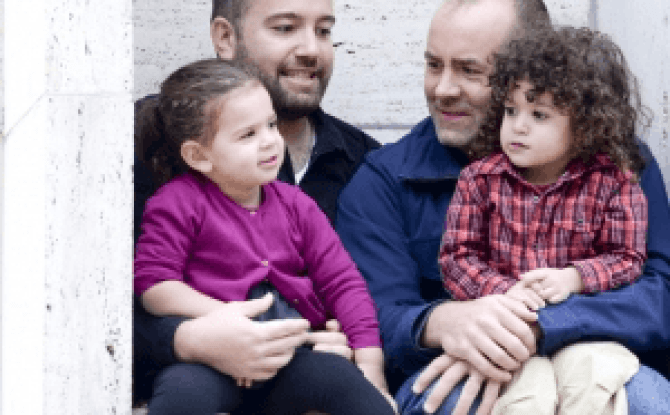
In our family there are two dads, and a daughter and son (twins) who turned 3 just a few months ago. When I’m asked, it is very easy for me to affirmatively state: Our kids have two dads or, as we say at home, an aba and a daddy. But people always wonder, and people sometimes (especially kids) are brave enough to ask: Do they have a mom?
Technically they don’t, our kids were born with the help of a gestational surrogate, which means that we received an anonymous egg donation which together with our sperms was used to create embryos, which were subsequently carried by our friend, who served as the children’s surrogate. Over the years, friends, family and many strangers have suggested that one of these two women must be “the mother.” We answered politely that we call one the egg donor and the other the surrogate, but mostly they seemed unsatisfied by these answers. Usually I think this is just a matter of educating them on our family structure, but sometimes I do attributed it to being insensitive, homophobic, dad-phobic, or mother-centric depending on the person asking and his or her tone. Many people think it is just fine for a same-sex couple to have kids but still believe that a mother is necessary for the healthy development of a child. Others have pointed out that children born using anonymous sperm or egg donation will always wonder about their genetic parent, and that we are depriving them of a right to know their biological mother.
My friends in similar family settings have tried to address these issues in many admirable ways: I have seen fathers asking their children, “Do you have a mom?” just to demonstrate how the kids answer so clearly, “No, I do not; I have two dads!” Others have created strong bonds with women in their lives that the children could identify with as the equivalent of a mother figure: an aunt, grandmother, the surrogate herself, or sometimes a caregiver. When asked, many of us will gladly point you to solid research indicating that children of same-sex couples are just as happy and healthy as children who grow up with a mother and dad. I would be grateful if someone could show this information to my 3-year-old, who was at that moment extremely unhappy about a variety of things: from not being able to play on my iPhone to having to take a bath.
For example, in her book “Modern Families: Parents and Children in New Family Forms,” Dr Susan Golombok says that children of same-sex couples do just as well as children in traditional families. The problems some children face come from outside the family rather than within it and depend very much on where they live. She argues that schools should make an active effort to combat the stigmatization of children in different families. Dr Golombok is currently carrying out a study of children with gay dads who were born with the help of a surrogate. The study should be completed this summer, and the very much anticipated findings will be available shortly after.
In spite of these positive research results, it’s hard not to wonder about the effects of growing up without a mom, and not only that, but with no mother ever having existed. My husband Eric sometimes points out that women used to die in childbirth with terrible frequency, and that even his grandmother never knew her own mother because of this common tragedy. While she was raised by her father and grandmother, she still knew that a woman who was her mother had at least lived at one time and had been known by the people in her life. Our kids wouldn’t be able to imagine a mother. The idea of our kids having nothing but a void where a mother would normally be sometimes kept me up at night.
Click here to read the entire article.