
Egg Donors Challenge Pay Rates

Egg Donors Challenge Pay Rates, Saying They Shortchange Women


On their websites, next to glossy pictures of babies, some fertility clinics and egg-donor agencies refer to eggs as a “priceless gift” from caring young women who want to help people with fertility problems. There is a price tag for eggs, though, and it is now the subject of a legal battle. In a federal lawsuit, a group of women or egg donors, are challenging industry guidelines that say it is “inappropriate” to pay a woman more than $10,000 for her eggs. The women say the $10,000 limit amounts to illegal price-fixing, and point out that there is no price restriction on the sale of human sperm. A federal judge has certified the claim as a class action, which will most likely go to trial next year.

The guidelines do not have the force of law, though they have been widely followed. But demand for eggs has increased and put pressure on their price. So some high-end fertility clinics and egg-donor agencies are ignoring the guidelines and paying far more — on rare occasions in the six figures — while donors are shopping around to get the best price. The case could shake up the $80 million egg-donor market by spurring more negotiation. It is a potent reminder that egg donation is a big business, though one with many more inherent ethical issues than others.

“The lawsuit is raising awareness of the commodification of the whole thing, and that’s good,” said Sierra Poulson, 28, a lawyer in Nebraska not involved with the case, and a founder of the online forum We Are Egg Donors. “The guidelines are skewed toward the intended parents, toward the industry making more money and business,” Ms. Poulson said. “We’re in America — the market would take care of itself, without guidelines.”

Ms. Poulson, a three-time donor, is an example of how the market works. She was paid $3,000 for each of her first two donations, in Kansas, but $10,000 in Chicago for the last. “The third time I donated, the only reason was for the money,” she said.

As women wait longer to start their families, and find their fertility has waned, the demand for eggs from young donors — typically, donors are in their 20s — has risen rapidly. Women trying to get pregnant, along with surrogates hired by gay men to carry their children, used donor eggs in nearly 20,000 monthly cycles in 2012, compared with fewer than 12,000 a decade earlier, according to the Centers for Disease Control and Prevention, which collects statistics on assisted reproduction.

While many other countries limit egg donation, and the compensation that is allowed, egg donation is essentially unregulated in the United States. But in 2000, the American Society for Reproductive Medicine established the guidelines for how much women should be paid. They say that compensation over $5,000 requires “justification,” and that more than $10,000 is “beyond what is appropriate.” The amounts have never been adjusted.

Click here to read the entire article.


New York Times – October 16, 2015 by Tamar Lewin
11 Things Not to Say to Gay Parents

Gay Parents Just Don’t Want To Hear This . . .

Even though my partner and I had met in a Chelsea bar, we’d confided that we’d happily trade in martinis and margaritas for play clothes and playgrounds. Eight years later, we fretted over how to start a family: use a surrogate, ask a favor of someone we know, or adopt. When we chose domestic adoption, upon becoming gay parents, I imagined being let down by people’s naïve comments, since we’d be the only nontraditional clan in our New York City apartment building. As expected, they didn’t disappoint.

Over the last decade — our daughter just turned 10 — my now-husband and I have endured a Tonka truckload of bumpy interactions. Rarely have they been funny like Mitch, Cam, and Lily’s antics on Modern Family. At dinner parties, strangers have approached us in the same way they might prod a foreign object with a stick. Unless we’re on Facebook, I don’t like to be poked.

But I get it. Gay parenting’s relatively new to the scene. To keep my sanity, I’ve learned when to sidestep queries, when to give direct answers, and when to educate well-meaning folks. To help other same-sex parents avoid that dance, here are 11 things you should stop uttering.

1. Where’s her mother? I live in a rainbow metropolis, and yet this is the most frequently offensive sentence I hear. Simply put, my tween has two dads. And if there’s concern about my daughter’s safety, simply ask, “Where’s her grownup?”

2. Whose sperm did you use? Who carried the baby? Naturally, acquaintances are curious about the origins of a couple’s baby-making. Consider flipping the tables. Are you willing to tell a stranger that you and your girlfriend conceived while she straddled you in reverse cowgirl position? It’s called TMI.

3. Aren’t you afraid your toddler will play with your sex toys? Because I had to reject the shame surrounding sexuality when I came out, like so many queer people, I did emerge from the experience more sex-positive. That doesn’t mean all homosexual mums and pops leave dildos, nipple clamps, and vibrating rings lying around the living room. That’s what closets are for.

4. Who’s the mother: You or your significant other? I appreciate the desire to fit people into preset categories, but don’t box me in. Not all gay couples subscribe to traditional gender norms or roles. As fathers, my husband and I both do plenty of parenting.

5. Does your baby have HIV? Stemming from the 1990s fear that men who are intimate with men must have AIDS, and ignorance about how the virus is transmitted, this inquiry earns a blank stare.

6. Is she in touch with her mother? I’ve been driven batty by people’s preoccupation with assigning a mom to every child. “Her BIRTHmother,” I’ve retorted, or, “Her biological mother.” My reply depends on my mood and how close I feel to the asker.

7. Are you concerned your kid might be like you? When I sought out young women’s camouflage shirts at a department store, the clerk cautioned, “Your child could be lesbian.” I chuckled so much I forgot to feel insulted by her tone.

Click here to read the entire article.


By  – Cosmopolitan.com, October 15, 2015

Coming Out and Being Out as a Lesbian Mom

Coming Out and Being Out as a Lesbian Mom

I came out well before I became a parent, but even being out from day one of parenthood doesn’t mean visibility is easy. Here are a few things my experience has taught me.

It has become something of a truism in LGBTQ parenting circles to talk about how having kids means being out to everyone — teachers, plumbers, cashiers at the grocery store. Kids, as any parent will tell you, can’t keep closet doors closed. One “Hey, Mommy and Mama!” across the produce aisle, and your cover is blown.

lesbian mom

Coming Out & Being Out as a Lesbian Mom; I came out before I became a parent, but even being out from day one of parenthood doesn’t mean visibility is easy.

For me, however, the problem is not being outed, it’s assuming everyone knows I’m a lesbian when in fact, I tend to blend in with my mostly straight suburban neighbors. (The fact that many of my clothes come from boys’ departments doesn’t seem to register.)

Even when I try to be open about it, people hear “Alan” when I talk of my spouse “Helen” and miss my use of pronouns. My son once received an invitation to the birthday party of a new school friend, and Helen and I got a double-take at the door because one of the friend’s parents hadn’t realized we were a two-mom family. Sometimes I think it would be easier if I’d gone to all of the school’s beginning-of-the-year events wearing an “I’m a lesbian” t-shirt. It would save us from those awkward moments and the “Who are you?” questions.

The other problem is that as a matter of overall identity, I’d rather be known as my son’s mom, not his “lesbian mom.” The commonalities of parenthood far outweigh the differences of sexual orientation. More importantly, I want my son to be known for his own qualities, not for the fact that he’s “the boy with the lesbian moms.” Yes, his lesbian moms will always be part of his identity, but I want us to be a piece of a much richer whole, not a leading indicator. I hope he never wants to hide the fact that he has two moms, but I also realize that as he gets older, he may want to come out about his family in his own time and in his own way.

Coming out is often described as an ongoing journey. As parents, it is a journey we take with our children. Sometimes they will want to be more out about our families than we are comfortable with; sometimes less.

Click here to read the entire article.


HuffingtonPost.com, by Dana Rudolph – October 9, 2015

Gay Fathers Offered Assistance by M.H.B.

Men Having Babies (MHB) offers assistance to gay fathers

Anthony Brown said, while growing up, he never saw a future where he’d be able to get married or have a child. However, today, because of how much society has changed in the past decade, he shares a 6-year-old son with his husband. Brown and his husband were fortunate in that they were able to afford to use a surrogate to start their family. For many would-be dads, the cost of surrogacy is prohibitive, reaching between $110,000-$140,000, Brown said. That is why, two years ago, the nonprofit Men Having Babies, which was founded in New York nearly a decade ago, began its Gay Parenting Assistance Program ( GPAP ) to help gay men afford surrogacy, start a family and become gay fathers.

Brown, a Men Having Babies board members, said GPAP is a program for gay men and trans women that offers assistance in the form of donated or discounted services and cash grants to eligible applicants who are accepted into the program.

“There are two stages,” Brown said. “In stage one, you get certificates for discounts from participating agencies and clinics.

“If you qualify, you are then invited to apply for stage two, and we actually give donated services and cash grants to people who pass through the grant committee selection process.”

Brown said the program has completed two full grant cycles and will soon enter into its third cycle.

“In those two years, we have given away at least $1.5 million worth of donated or discounted services or cash grants,” he said.

In addition to GPAP, Men Having Babies puts on annual conferences in five global cities: New York, Chicago, San Francisco, Brussels and Tel Aviv.

The conferences offer a wealth of information and personal experiences to prospective fathers, including how to choose a provider, costs associated with the process, resources available, the legal aspects of the process and much more.

A big decision prospective fathers need to make is whether they will use a domestic surrogate or look internationally for a surrogate.

Gay Fathers Offered Assistance by M.H.B., Men Having Babies

Men Having Babies focuses on domestic surrogacy, but at the organization’s Chicago conference, held in September, it brought in Canadian fertility lawyer Cindy R. Wasser, founder of Hope Springs Fertility Law, to talk about Canadian surrogacy options.

“There are some very good Canadian options, and law in Canada for surrogacy is very positive,” Brown said.

Wasser discussed some of the differences she has seen between surrogacy in the United States and surrogacy in Canada.

“One of the key differentiators for anyone coming to Canada is the cost,” Wasser said. “Our services are less expensive, and the dollar is good for Americans.”

She noted one of the issues parents need to consider when looking at international surrogacy is domestic citizenship/immigration for the baby.

Despite some differences, there are many issues that remain the same for couples, whether they are using international or domestic surrogates.

For potential gay fathers considering surrogacy, Wasser said one common consideration is which member of the couple will provide sperm or if both will, and, in that case, if they will be fertilizing together or at different times.

“If one partner is contributing and the other cannot, is there a family member of the non-contributor who could be the egg donor to establish a full family genetic connection?” was another question she posed.

While horror stories are few and far between, every so often one makes the headlines. Wasser said those situations arise from a “lack of good legal advice, respected agency assistance and proper medical care.” Brown also noted some of the horror stories he’s heard involve a lack of laws and regulations around surrogacy that make the surrogate legally vulnerable. “A lot of the controversy around surrogacy has been in third world countries,” he explained.

He said there have been cases where the surrogate doesn’t fully understand the contract she is signing or doesn’t receive the proper care and assistance she should be receiving, and she often doesn’t have proper legal representation looking out for her best interests.

He said Men Having Babies is committed to working with agencies with strong ethical commitments.

“Men Having Babies is developing ethical guidelines for intended parents,” he noted.


Click here to read the entire story.

Windy City Times – by Charlsie Dewey – October 14, 2015

Adoption rights for gay couples advance in Kansas

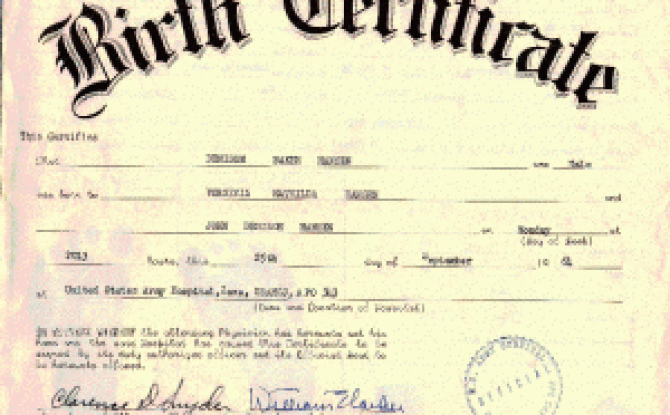
Adoption rights for gay couples advance as State agrees to issue birth certificates listing same-sex couples as parents

The Kansas Department of Health and Environment has agreed to issue birth certificates listing same-sex couples as parents in two cases, advancing adoption rights for gay couples even further. But KDHE spokeswoman Sara Belfry said that decision does not reflect a general policy change.

“We are still reviewing these applications on a case-by-case basis,” she said.

She said the decisions to issue birth certificates in two specific cases that were part of pending legal actions in state and federal court were based “upon consideration of applicable law and review of the impact of existing court orders.”

“My clients are pleased,” said David Brown, a Lawrence attorney who filed a lawsuit on behalf of one local couple. “It’s unfortunate that they had to go to this extent, but we are happy that the state of Kansas has decided to comply. I just hope they change policy so everyone doesn’t have to sue the state.”

Brown has handled several cases involving gay rights and same-sex marriage. Last week, he filed what is called a “parentage action” in Douglas County District Court on behalf of a Lawrence couple, Casey and Jessica Smith, seeking an order directing KDHE to issue a birth certificate listing both women as parents of their child.

The Smiths were legally married in California in 2013. Casey Smith conceived a child through artificial insemination around the first of this year, using sperm from an anonymous donor and gave birth to a son in September.

Douglas County District Judge Sally Pokorny granted the order directing KDHE to list both women as parents on the birth certificate. But KDHE objected at first, saying it had not been notified of the action and had not been notified of the petition and it wanted an opportunity to respond.

A hearing in that case had been scheduled for Nov. 6.

A few days after that case was filed, the American Civil Liberties Union of Kansas filed affidavits in U.S. District on behalf of the Smiths as well as another same-sex couple, Christa Gonser and her wife Carrie Hunt, who live in the Kansas City area. They were married in Canada in 2007.

Hunt also became pregnant through artificial insemination and gave birth to twins at Kansas University Hospital in Kansas City, Kan., on Sept. 22.

Click here to read the entire article.


by Peter Hancock, LJWorld.com, October 8, 2015

Commercial Surrogacy Legal Cases Strand Families

Commercial Surrogacy Legal Cases; Surrogacy ban strands families in Nepal

Australian parents have been left stranded overseas with their newborn babies, unable to bring them home, after a court issued a ban on commercial surrogacy in Nepal, having decided one of the many pending commercial surrogacy legal cases globally. Distressed parents said the health of their babies was at serious risk and that the children were “basically being held hostage” because local authorities refused to issue them exit visas.

“The longer this goes on, the bigger the risk becomes,” said one man whose twins, born six weeks prematurely, have fallen ill after their supply of formula ran out.

“It’s a matter of time until something drastic happens. I would hate for someone to die.”

Commercial surrogacy is banned in Australia and under NSW law prospective parents cannot pay a surrogate, even for arrangements in another country.

Australian babies and parents stranded in Nepal after commercial surrogacy ban

Nepal previously allowed the practice as long as the surrogate was not Nepalese, but its Supreme Court suspended commercial surrogacy services on August 25.

Parents said Nepali immigration officials have since refused to issue exit visas for babies born through surrogacy, even when the process was started long before the ban.

Lisa McDonald* was recently forced to return to Sydney, leaving her newborn son, Sam*, in Kathmandu with her husband, after she ran out of vital medicine.

She has a disease of the immune system and the couple’s biological child was carried by a surrogate.

“It was so hard to leave him and come back, it was torturous,” she said. “All I know is I want him home.”

Sam had to be rushed to hospital last week but transport is difficult because a dispute with neighbouring India has led to petrol rationing.

The Nepali government is also in upheaval after the adoption of a new constitution, a process that sparked deadly and ongoing protests.

“It’s really dangerous,” Ms McDonald said. “This is wrong, to be holding babies hostage like this. These are tiny babies. They just need to get them out.”

Nick Martin* and his partner have been in Kathmandu for six weeks with their twins. The Sydney father said resolving the babies’ status did not seem to be a government priority.

“We are distraught, absolutely distraught,” he said. “We’re effectively being kept captive in a country we don’t know, where we don’t speak the language. We just have no idea when we’re going to be going home.”
Click here to read the entire article.

by Kim Arlington, The Sydney Morning Herald – October 6, 2015

Adoption Gay Couples in China Look Abroad

Adoption Gay Couples in China Look Abroad

to Start a Family

Xu Zhe decided a few years ago that he wanted to get married and have a baby—typical life plans for a young man in China. But Mr. Xu is gay and his goals aren’t attainable in his country: Same-sex marriage and surrogacy aren’t legal.

That is why the Shanghai native set out for the U.S. in 2013. Mr. Xu and his long-term boyfriend married that year in California, in a symbolic gesture, since their marriage isn’t recognized in China. Shortly after exchanging vows, they began a search for an egg donor and a surrogate to carry their daughter. She was born earlier this year.

Their situation isn’t unique as the emergence of fertility services and surrogate programs geared toward gay Chinese suggest more couples are heading overseas to start their families.

Many go to the U.S. because of its robust gay-rights movement and liberal reproductive policies. Surrogate carriers are legal in some U.S. states and are believed to be more regulated than elsewhere in the world. The laws on parental rights are clear.

Yet this trend, while still nascent, is in some respects turning history on its head. For years, childless Americans have flocked to China in hopes to adopt a child there. Now, a segment of the Chinese population is looking to the U.S. to help them become parents.

“In the long run, I hope it’ll be possible for China to make it easier for all people to have their own families,” said Mr. Xu, who declined to disclose his partner’s and daughter’s names for this article.

Adoption Gay Couples in China: Gay & Lesbian couples in China resign themselves to not having children to avoid stigma!

There are no official estimates of how many Chinese same-sex couples are going to the U.S. to have children. The cost is prohibitive for most; the total bill, including egg donation, surrogacy and attorney and hospital fees, can reach up to $150,000. But the emergence of fertility consultancies and gay-rights activists acting as surrogates signals rising demand.

Carey Flamer-Powell launched an Oregon agency called All Families Surrogacy earlier this year, in part to help China’s gay and lesbian population, she said. She and John Hesla, an infertility specialist at Portland fertility clinic Oregon Reproductive Medicine, flew to Shanghai in June to speak to around 100 same-sex couples about their options for starting their own families.

“There’s research showing that in the future a man could harvest a stem cell, but don’t plan your family on that,” Dr. Hesla told the couples. He said that most would prefer their children to share their DNA and that the option is more easily available in the U.S. Around 40% of his patients are Chinese couples, some of whom are homosexual, Dr. Hesla said.

Around 20 same-sex Chinese couples have traveled to Los Angeles-based clinic HRC Fertility for services this year, up from around seven last year, said Peter Deng, chief executive of HRC’s China arm, which launched its marketing offices in China two years ago.

While most gay and lesbian couples in China resign themselves to not having children to avoid stigma, demand is high enough that Mr. Xu has also launched a health consultancy in Shanghai. It aims to connect the city’s gay community with overseas clinics, explain the medical procedures and outline options for bringing a child back to China as a foreign citizen or with a Chinese travel document.

Click here to read the entire article.


Wall Street Journal China – October 2, 2015

SHANGHAI—

Surrogate law change? Agency cheated donors!

Should surrogate law(s) change or be updated?Surrogates & egg donors cheated by agency!

The owner of a Glendora egg donation and surrogacy company was sentenced today to a year and a half in federal prison for cheating would-be parents, egg donors and surrogates out of nearly $270,000.

Allison Layton, 38, was also ordered to serve three years of supervised release after she is released from prison. A restitution hearing was set for Oct. 22.

Layton, who also used the name Allison Jarvie, pleaded guilty in February to a federal wire fraud charge. She owned Miracles Egg Donation, which claimed to handle the logistics of the donation and surrogacy process, and operated it out of her living room, according to the U.S. Attorney’s Office.

Between August 2008 and January 2012, would-be parents — who in the surrogacy and egg donation world are known as intended parents — paid thousands of dollars for egg donation and surrogacy services that Miracles promised to coordinate, federal prosecutors said.

Should Surrogate Law(s) Change? Glendora surrogacy agency owner gets prison for cheating would-be parents, egg donors and surrogates!

Layton took tens of thousands of dollars from intended parents. But instead of putting the funds into escrow accounts to be withdrawn only for certain costs related to surrogacy or egg donation, she used the money for her own personal expenses or to cover unpaid costs related to other clients, according to the U.S. Attorney’s Office.

As a result of Layton’s misappropriation of client funds, egg donors, surrogates, attorneys and others often weren’t paid for all the services they provided, and intended parents often did not receive all the services for which they had paid, according to court documents. At least one investor in Miracles also lost money.

Click here to read the entire article.


WhittierDaliyNews.com September 28, 2015

LOS ANGELES —

Gay Parents Adopting Face Issues

Gay Parents Adopting Face Issues With Birth Certificates In Some States

Gay parents adopting in a handful of states are seeing issues where the state is refusing to name both parents from a same-sex couple on a birth certificate, even though its among the benefits named in the Supreme Court decision legalizing gay marriage.

DAVID GREENE, HOST: In the state of Kentucky, Kim Davis, the Rowan County clerk, made big news when she refused to issue same-sex marriage licenses. But this is not the only controversy since the Supreme Court legalized same-sex marriage earlier this year, as NPR’s Jennifer Ludden reports, a handful of states are refusing to name both parents from a same-sex couple on birth certificates.

JENNIFER LUDDEN, BYLINE: Miami attorney Elizabeth Schwartz brought the case that legalized same-sex marriage in Florida in January. And she’s still getting high-fives from this summer’s Supreme Court decision.

ELIZABETH SCHWARTZ: Congratulations. We’re done. You know, crossed the finish line. And that it’s wah-wah (ph) not exactly.

LUDDEN: Last month, one of Schwartz’s plaintiffs called back. Cathy Pareto and her longtime partner were the first same-sex couple to legally marry in Florida, but Pareto says they got a rude awakening when her now-wife, Karla, delivered twins last month. A hospital staffer came to take information for the birth certificate.

CATHY PARETO: What’s the name of your child? Who’s the father? Oh, gee, there’s no father. Oh, but I want my wife listed. Oh, well, let me get back to you on that.

LUDDEN: Turns out the state’s vital statistics office said the hospital could not put Pareto’s name on the certificate. It pointed to the Florida statute that still said the state did not recognize same-sex marriage.

PARETO: At this point, I am nothing legally for my children. My twins and I are not the legally connected in any way.

LUDDEN: Pareto worries she’d lose custody if something happened to her wife. She also can’t sign for the twins at a doctor’s office, day care or to get a passport. So her attorney, Schwartz, has filed another suit on behalf of Pareto and two other couples.

SCHWARTZ: It’s a terrible waste of resources, of our resources and of the state’s resources. I mean, they ought to follow the law.

LUDDEN: Florida’s health department says it can’t comment on pending litigation. In court documents, it doesn’t actually make a case for not issuing same-sex birth certificates. The state simply says it has asked a judge to clarify whether it can. In recent months, courts in Utah, Texas and Ohio have ruled in those states can and must. The U.S. Supreme Court decision legalizing same-sex marriage specifically mentions birth certificates as a benefit to which gay and lesbian couples are now entitled. Lawsuits in another handful of states are pending. But even they won’t be the last word for same-sex couples with children.

Click here to read the entire interview.


NPR.org by Jennifer Ludden, September 21, 2014

Gay and Lesbian Adoption: Alabama Court Refuses

Alabama Supreme Court Refuses to Recognize Lesbian Mother’s Adoption from Another State

Today, there was a blow to gay and lesbian adoption rights when the Alabama Supreme Court refused to recognize an adoption by a lesbian mother of her three children granted by a Georgia court in 2007. Even though she had raised the children from birth and adopted them over eight years ago, the Court ruled that Alabama does not need to respect her adoption because it found that the Georgia court didn’t properly apply Georgia law when it granted her adoption.

Although the Alabama Supreme Court recognized that full faith and credit prohibits a state from inquiring into the laws applied by a court from another state, it ruled that Alabama did not have to respect the Georgia court’s adoption because the Court believed that Georgia law did not allow same-sex parents to adopt. One Justice dissented from this opinion, explaining that full faith and credit prohibits Alabama from considering whether the Georgia court correctly applied its own laws, and that this ruling puts all adopted children in Alabama at risk if it is later discovered that there was some small error in the adoption.

In E.L. v. V.L., two women in a long term relationship had three children through donor insemination. The non-biological mother, V.L., adopted the children in Georgia. The biological mother participated in that process and consented in writing to the adoptions. When the parents later broke up, the biological mother, E.L., kept V.L. from seeing the children. V.L. sought visitation in Alabama, where the family lives. E.L. opposed her request, arguing that the Georgia adoption was invalid in Alabama.

V.L is represented by the National Center for Lesbian Rights (NCLR), and Alabama attorneys Heather Fann of Boyd, Fernambucq, Dunn & Fann, P.C., and Traci Vella of Vella & King, Attorneys at Law.

“It is extremely difficult to see the distress in my children as they realize that the courts who are tasked with putting their best interests first won’t recognize our family,” said V.L. “I am just a Mom who wanted and prayed for these children and raised them from birth, and I hope every day that we can be together again.”

Alabama Supreme Court refuses to recognize gay and lesbian adoption(s)

from outside the state

“The Alabama Supreme Court’s refusal to recognize an adoption granted eight years ago harms not only these children, but all children with adoptive parents,” said NCLR Family Law Director Cathy Sakimura. “Children who are adopted must be able to count on their adoptions being final—allowing an adoption to be found invalid years later because there may have been a legal error in the adoption puts all adopted children at risk of losing their forever families.”

“The biological mother in this case chose my client as a second parent to these children, before their births, during their conceptions, and in formal adoption proceedings intended to ensure my client’s rights — wherein she stated that having my client as a parent was in the children’s best interests,” said Heather Fann. “Because, many years later, she chose to contradict her own decision-making regarding the establishment of a family for those children, a court ruled today that my client is not a parent. Not only is that not true, its harm extends far beyond my client, to children who have called her mother their entire lives, and now to adoptive families throughout Alabama. It’s beyond unfortunate that the Alabama Supreme Court has disregarded the recommendations of the children’s own lawyers and national adoption organizations in arriving at this result.”

“As a mother myself, my heart is breaking for my client, who loves her children as much as any other mother. Gay and lesbian adoption provides children with every bit as much love as those with a biological connection to a parent,” said Traci Vella. “Ask any adoptive parent how horrifying it would be to think his or her adoption could be overturned years after it was final. That is exactly what has happened in this case.”

The children’s Guardians Ad Litem are Breauna R. Peterson and Tobie J. Smith of the Legal Aid Society of Birmingham.

The American Academy of Adoption Attorneys and the Georgia Council of Adoption Lawyers filed an amicus brief in support of rehearing.


NCLR.Org – September 18, 2015

(Montgomery, AL, September 18, 2015)—