Gay marriage signed into law in Ireland

Gay Marriage Voted in by 62.1% in Ireland

Dublin (AFP) – Gay marriage was signed into law in Ireland, five months after a historic referendum saw the traditionally Catholic nation become the world’s first country to vote for gay unions.

“The Presidential Commission today signed the ‘Marriage Bill 2015’ into law,” the president’s office said in a statement, paving the way for the first weddings within a month.

Ireland voted 62.1 percent in favour of allowing marriage between two people “without distinction as to their sex” in May, the first time anywhere that gay marriage has been legalised in a referendum.

The president’s endorsement was the final hurdle for the bill after legal challenges briefly delayed the legislation from coming into effect.

The first ceremonies should be possible by mid-November, according to Justice Minister Frances Fitzgerald.

Senator Katherine Zappone, who had long campaigned for her Canadian marriage to her wife to be recognised in Ireland, called it “a defining moment”.

“It is a deeply emotional moment for those of us who have campaigned for so long,” Zappone said in a statement.

“This victory truly belongs to the nation, it is a moment for us all.”

In a memorable moment that unfolded live on national television after the referendum result was announced, Zappone proposed to her wife Ann Louise Gilligan to re-marry her under Irish law.

International gay rights campaigners congratulated efforts by Irish activists to win public support for a “Yes” vote in the referendum.

“Tribute must also be paid to national politicians in Ireland, as all the main political parties put aside their partisan differences to campaign for the greater goal of equality,” Evelyne Paradis of the International Lesbian, Gay, Bisexual, Trans and Intersex Association said in a statement.

Marriages between same sex couples that took place outside of Ireland will now be recognised under Irish law.

Click here to read the entire article.


YahooNews.com, October 30, 2015

Parenting Policies-China to End One Child Policy

As China ends its one child policy, some parents ponder the pros and cons of parenting a second child.

Parenting News from Beijing: China will allow all couples to have two children, a Communist Party leadership meeting decided on Thursday, bringing an end to decades of restrictive policies that limited most urban families to one child.

The announcement came after the party’s Central Committee concluded a four-day meeting in a heavily guarded hotel in western Beijing where it approved proposals for China’s next five-year development plan, which starts next year. The terse announcement from Xinhua, the state news agency, about the sharp shift in family planning policy gave no details.

The Chinese government has already eased some restrictions in what has often been described as the “one-child policy,” and a party conference in 2013 approved allowing couples to have two children when one of the spouses was an only child. But many eligible couples failed to take up the chance to have a second child, citing the expense and pressures of parenting children in a highly competitive society.

A summary of the decision by Chinese radio news said that officials had decided to “improve the demographic development strategy, and to comprehensively implement a policy that couples can have two children, actively taking steps to counter the aging of the population.”

The initial public reaction to the party leaders’ decision was restrained, and many citizens in Beijing who were asked whether they would grasp the chance to have two children expressed reluctance or outright indifference. Some, however, were pleased.

Still, the cost and difficulty of parenting 2 children are likely to deter many eligible couples from having more children despite the relaxed rules, Mu Guangzong, a professor of demography at Peking University, said in a telephone interview.

Click here to read the entire article.


by Chris Buckley - New York Times - October 29, 2015

Egg Donations, Should Women Be Paid?

Paying for Egg Donations

In an egg donations situation, should a woman who donates eggs to help people with fertility problems conceive a child be able to charge as much as she can get in a free-market transaction? Or are there ethical reasons to limit her reimbursement?

That is the issue raised in a federal lawsuit that accuses two professional societies and the fertility clinics associated with them of illegal price-fixing that limits donor compensation. A federal judge in northern California has ruled that the claim can move forward and certified it as a class action, which could go to trial next year.

Guidelines issued by the American Society for Reproductive Medicine and the Society for Assisted Reproductive Technology suggest that paying a woman more than $10,000 for her eggs is “beyond what is appropriate” and even paying $5,000 or more requires “justification.”

A vast majority of the nation’s fertility clinics follow these the guidelines. The stated rationale behind them is to avoid offering so much money that donors, especially those who are often young and poor, will rush to contribute their eggs without considering the risks.

This payment system is unfair. However well-intentioned, it favors the fertility clinics, which can keep more for themselves if they pay donors less, as well as the women who pay for fertility treatments. Meanwhile, it shortchanges the egg donors, whose wishes are ignored in the equation. And if there are indeed risks, they can be addressed and mitigated by the clinics and the doctors, who can strengthen their screening and counseling procedures and provide more information.

The money that donors get is meant to compensate them for physical and psychological tests; weeks of hormone injections to stimulate egg production; frequent tests and ultrasound examinations to track the developing eggs; repeated visits to the doctor, and minor surgery to remove the eggs when they are ready for retrieval.

Click here to read the entire article.


Editorial Board – New York Times, October 21, 2015

Historical Gay Adoption Debate: Adult Adoption

Historical Gay Adoption Debate: The Lost History of Gay Adult Adoption

Whether you’re aware of it or not the historical gay adoption debate has been raging for years as LGBT advocates and individuals attempted to secure legal rights to property, family, security and most importantly; one another. In 1977, 27-year-old Walter Naegle was planning to go to San Francisco. He was living in New York City, which he found awful, when, while waiting for a light to change in Times Square, he saw an unusually handsome reason to stay: Bayard Rustin.

Rustin, who once said, “I believe in social dislocation and creative trouble,” organized the antisegregation Journey of Reconciliation protest, a sort of early Freedom Ride, in 1947. He was in charge of logistics for the Rev. Martin Luther King Jr.’s March on Washington for Jobs and Freedom and he worked to integrate New York City schools. “I’m not much dazzled by celebrity,” Naegle said recently, “but I had known who he was since I was in high school.”

Naegle and Rustin were attracted to each other immediately — they kissed for the first time that day — and became a couple thereafter. During their 10 years together, marriage was not discussed; it simply wasn’t imaginable. (The term “gay marriage”’— where ‘gay’ doesn’t mean ‘lighthearted’— would not appear in this paper until 1989.) Had Rustin lived long enough, however — he died in 1987 — he would have definitely been game. “Oh, yes,” Naegle said, “he was much older than I was, and his generation of people were into that kind of thing.”

Gay Adoption Debate: Shrewd Legal Play – “The adoption proved a shrewd decision!”, Naegle, as next of kin, had visiting privileges when Rustin was hospitalized.

In 1982, when Rustin wanted to ensure that Naegle — who, at 37 years his junior, would surely outlive him — would inherit his estate, he availed himself of the least-bad option: adoption. There had been an article in The Advocate about a couple in the Midwest who unsuccessfully tried to adopt each other in order to forge a legal bond. “Maybe we should try that,” Rustin said he suggested.

Naegle recalled the adoption process: First, his biological mother had to legally disown him. Then a social worker was dispatched to the Rustin-Naegle home in Manhattan to determine if it was fit for a child. “She was apprised of the situation and knew exactly what was happening,” Naegle told me. “Her concern, of course, was that he wasn’t some dotty old man that I was trying to take advantage of, and that I wasn’t some naive young kid that was being preyed upon by an older man.”

The adoption proved a shrewd decision. Naegle, as next of kin, had visiting privileges when Rustin was hospitalized for a perforated appendix and peritonitis and was eventually executor of the will. Despite the oddness of the arrangement, it was, all things considered, legally seamless.

Now that marriage equality is an American right, the gay adoption debate seems a little silly to be including partner adoptions, which are hard to fathom, an artifact of an earlier societal paradigm that, in a remarkably short period of time, has come to seem inconceivable. “People today really have a hard time remembering, let alone feeling, what it was like to be an outlaw — to be truly strangers to the law — shoved out of every legal system, and then persecuted,” said Evan Wolfson, founder of Freedom to Marry, an organization that, for more than a decade, has played a large role in the passage of same-sex marriage legislation. It is easy to forget that an American state would not decriminalize sodomy until 1961; that as late as 1966, gays and lesbians could not legally buy a drink in a New York City bar; that even after the Stonewall riots, in 1969, the American Psychiatric Association considered homosexuality a mental illness. As recently as 2000, civil unions were still not widely available and domestic partnerships didn’t offer federal protections.

Click here to read the entire article.


by Elon Green, October 19, 2015

Egg Donors Challenge Pay Rates

Egg Donors Challenge Pay Rates, Saying They Shortchange Women


On their websites, next to glossy pictures of babies, some fertility clinics and egg-donor agencies refer to eggs as a “priceless gift” from caring young women who want to help people with fertility problems. There is a price tag for eggs, though, and it is now the subject of a legal battle. In a federal lawsuit, a group of women or egg donors, are challenging industry guidelines that say it is “inappropriate” to pay a woman more than $10,000 for her eggs. The women say the $10,000 limit amounts to illegal price-fixing, and point out that there is no price restriction on the sale of human sperm. A federal judge has certified the claim as a class action, which will most likely go to trial next year.

The guidelines do not have the force of law, though they have been widely followed. But demand for eggs has increased and put pressure on their price. So some high-end fertility clinics and egg-donor agencies are ignoring the guidelines and paying far more — on rare occasions in the six figures — while donors are shopping around to get the best price. The case could shake up the $80 million egg-donor market by spurring more negotiation. It is a potent reminder that egg donation is a big business, though one with many more inherent ethical issues than others.

“The lawsuit is raising awareness of the commodification of the whole thing, and that’s good,” said Sierra Poulson, 28, a lawyer in Nebraska not involved with the case, and a founder of the online forum We Are Egg Donors. “The guidelines are skewed toward the intended parents, toward the industry making more money and business,” Ms. Poulson said. “We’re in America — the market would take care of itself, without guidelines.”

Ms. Poulson, a three-time donor, is an example of how the market works. She was paid $3,000 for each of her first two donations, in Kansas, but $10,000 in Chicago for the last. “The third time I donated, the only reason was for the money,” she said.

As women wait longer to start their families, and find their fertility has waned, the demand for eggs from young donors — typically, donors are in their 20s — has risen rapidly. Women trying to get pregnant, along with surrogates hired by gay men to carry their children, used donor eggs in nearly 20,000 monthly cycles in 2012, compared with fewer than 12,000 a decade earlier, according to the Centers for Disease Control and Prevention, which collects statistics on assisted reproduction.

While many other countries limit egg donation, and the compensation that is allowed, egg donation is essentially unregulated in the United States. But in 2000, the American Society for Reproductive Medicine established the guidelines for how much women should be paid. They say that compensation over $5,000 requires “justification,” and that more than $10,000 is “beyond what is appropriate.” The amounts have never been adjusted.

Click here to read the entire article.


New York Times – October 16, 2015 by Tamar Lewin

Gay Fathers Offered Assistance by M.H.B.

Men Having Babies (MHB) offers assistance to gay fathers

Anthony Brown said, while growing up, he never saw a future where he’d be able to get married or have a child. However, today, because of how much society has changed in the past decade, he shares a 6-year-old son with his husband. Brown and his husband were fortunate in that they were able to afford to use a surrogate to start their family. For many would-be dads, the cost of surrogacy is prohibitive, reaching between $110,000-$140,000, Brown said. That is why, two years ago, the nonprofit Men Having Babies, which was founded in New York nearly a decade ago, began its Gay Parenting Assistance Program ( GPAP ) to help gay men afford surrogacy, start a family and become gay fathers.

Brown, a Men Having Babies board members, said GPAP is a program for gay men and trans women that offers assistance in the form of donated or discounted services and cash grants to eligible applicants who are accepted into the program.

“There are two stages,” Brown said. “In stage one, you get certificates for discounts from participating agencies and clinics.

“If you qualify, you are then invited to apply for stage two, and we actually give donated services and cash grants to people who pass through the grant committee selection process.”

Brown said the program has completed two full grant cycles and will soon enter into its third cycle.

“In those two years, we have given away at least $1.5 million worth of donated or discounted services or cash grants,” he said.

In addition to GPAP, Men Having Babies puts on annual conferences in five global cities: New York, Chicago, San Francisco, Brussels and Tel Aviv.

The conferences offer a wealth of information and personal experiences to prospective fathers, including how to choose a provider, costs associated with the process, resources available, the legal aspects of the process and much more.

A big decision prospective fathers need to make is whether they will use a domestic surrogate or look internationally for a surrogate.

Gay Fathers Offered Assistance by M.H.B., Men Having Babies

Men Having Babies focuses on domestic surrogacy, but at the organization’s Chicago conference, held in September, it brought in Canadian fertility lawyer Cindy R. Wasser, founder of Hope Springs Fertility Law, to talk about Canadian surrogacy options.

“There are some very good Canadian options, and law in Canada for surrogacy is very positive,” Brown said.

Wasser discussed some of the differences she has seen between surrogacy in the United States and surrogacy in Canada.

“One of the key differentiators for anyone coming to Canada is the cost,” Wasser said. “Our services are less expensive, and the dollar is good for Americans.”

She noted one of the issues parents need to consider when looking at international surrogacy is domestic citizenship/immigration for the baby.

Despite some differences, there are many issues that remain the same for couples, whether they are using international or domestic surrogates.

For potential gay fathers considering surrogacy, Wasser said one common consideration is which member of the couple will provide sperm or if both will, and, in that case, if they will be fertilizing together or at different times.

“If one partner is contributing and the other cannot, is there a family member of the non-contributor who could be the egg donor to establish a full family genetic connection?” was another question she posed.

While horror stories are few and far between, every so often one makes the headlines. Wasser said those situations arise from a “lack of good legal advice, respected agency assistance and proper medical care.” Brown also noted some of the horror stories he’s heard involve a lack of laws and regulations around surrogacy that make the surrogate legally vulnerable. “A lot of the controversy around surrogacy has been in third world countries,” he explained.

He said there have been cases where the surrogate doesn’t fully understand the contract she is signing or doesn’t receive the proper care and assistance she should be receiving, and she often doesn’t have proper legal representation looking out for her best interests.

He said Men Having Babies is committed to working with agencies with strong ethical commitments.

“Men Having Babies is developing ethical guidelines for intended parents,” he noted.


Click here to read the entire story.

Windy City Times – by Charlsie Dewey – October 14, 2015
Adoption rights for gay couples advance in Kansas

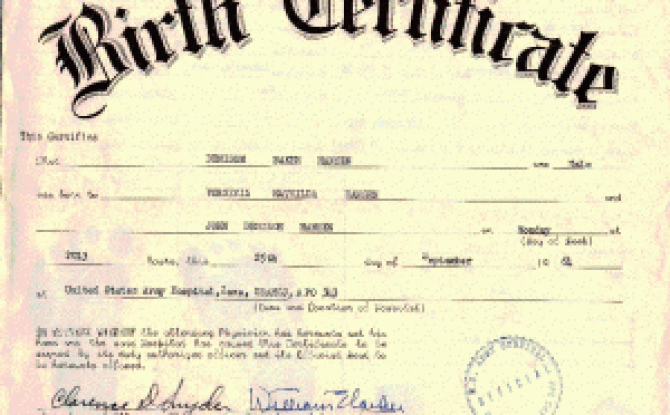
Adoption rights for gay couples advance as State agrees to issue birth certificates listing same-sex couples as parents

The Kansas Department of Health and Environment has agreed to issue birth certificates listing same-sex couples as parents in two cases, advancing adoption rights for gay couples even further. But KDHE spokeswoman Sara Belfry said that decision does not reflect a general policy change.

“We are still reviewing these applications on a case-by-case basis,” she said.

She said the decisions to issue birth certificates in two specific cases that were part of pending legal actions in state and federal court were based “upon consideration of applicable law and review of the impact of existing court orders.”

“My clients are pleased,” said David Brown, a Lawrence attorney who filed a lawsuit on behalf of one local couple. “It’s unfortunate that they had to go to this extent, but we are happy that the state of Kansas has decided to comply. I just hope they change policy so everyone doesn’t have to sue the state.”

Brown has handled several cases involving gay rights and same-sex marriage. Last week, he filed what is called a “parentage action” in Douglas County District Court on behalf of a Lawrence couple, Casey and Jessica Smith, seeking an order directing KDHE to issue a birth certificate listing both women as parents of their child.

The Smiths were legally married in California in 2013. Casey Smith conceived a child through artificial insemination around the first of this year, using sperm from an anonymous donor and gave birth to a son in September.

Douglas County District Judge Sally Pokorny granted the order directing KDHE to list both women as parents on the birth certificate. But KDHE objected at first, saying it had not been notified of the action and had not been notified of the petition and it wanted an opportunity to respond.

A hearing in that case had been scheduled for Nov. 6.

A few days after that case was filed, the American Civil Liberties Union of Kansas filed affidavits in U.S. District on behalf of the Smiths as well as another same-sex couple, Christa Gonser and her wife Carrie Hunt, who live in the Kansas City area. They were married in Canada in 2007.

Hunt also became pregnant through artificial insemination and gave birth to twins at Kansas University Hospital in Kansas City, Kan., on Sept. 22.

Click here to read the entire article.


by Peter Hancock, LJWorld.com, October 8, 2015

Surrogate law change? Agency cheated donors!

Should surrogate law(s) change or be updated?Surrogates & egg donors cheated by agency!

The owner of a Glendora egg donation and surrogacy company was sentenced today to a year and a half in federal prison for cheating would-be parents, egg donors and surrogates out of nearly $270,000.

Allison Layton, 38, was also ordered to serve three years of supervised release after she is released from prison. A restitution hearing was set for Oct. 22.

Layton, who also used the name Allison Jarvie, pleaded guilty in February to a federal wire fraud charge. She owned Miracles Egg Donation, which claimed to handle the logistics of the donation and surrogacy process, and operated it out of her living room, according to the U.S. Attorney’s Office.

Between August 2008 and January 2012, would-be parents — who in the surrogacy and egg donation world are known as intended parents — paid thousands of dollars for egg donation and surrogacy services that Miracles promised to coordinate, federal prosecutors said.

Should Surrogate Law(s) Change? Glendora surrogacy agency owner gets prison for cheating would-be parents, egg donors and surrogates!

Layton took tens of thousands of dollars from intended parents. But instead of putting the funds into escrow accounts to be withdrawn only for certain costs related to surrogacy or egg donation, she used the money for her own personal expenses or to cover unpaid costs related to other clients, according to the U.S. Attorney’s Office.

As a result of Layton’s misappropriation of client funds, egg donors, surrogates, attorneys and others often weren’t paid for all the services they provided, and intended parents often did not receive all the services for which they had paid, according to court documents. At least one investor in Miracles also lost money.

Click here to read the entire article.


WhittierDaliyNews.com September 28, 2015

LOS ANGELES —

Gay Parents Adopting Face Issues

Gay Parents Adopting Face Issues With Birth Certificates In Some States

Gay parents adopting in a handful of states are seeing issues where the state is refusing to name both parents from a same-sex couple on a birth certificate, even though its among the benefits named in the Supreme Court decision legalizing gay marriage.

DAVID GREENE, HOST: In the state of Kentucky, Kim Davis, the Rowan County clerk, made big news when she refused to issue same-sex marriage licenses. But this is not the only controversy since the Supreme Court legalized same-sex marriage earlier this year, as NPR’s Jennifer Ludden reports, a handful of states are refusing to name both parents from a same-sex couple on birth certificates.

JENNIFER LUDDEN, BYLINE: Miami attorney Elizabeth Schwartz brought the case that legalized same-sex marriage in Florida in January. And she’s still getting high-fives from this summer’s Supreme Court decision.

ELIZABETH SCHWARTZ: Congratulations. We’re done. You know, crossed the finish line. And that it’s wah-wah (ph) not exactly.

LUDDEN: Last month, one of Schwartz’s plaintiffs called back. Cathy Pareto and her longtime partner were the first same-sex couple to legally marry in Florida, but Pareto says they got a rude awakening when her now-wife, Karla, delivered twins last month. A hospital staffer came to take information for the birth certificate.

CATHY PARETO: What’s the name of your child? Who’s the father? Oh, gee, there’s no father. Oh, but I want my wife listed. Oh, well, let me get back to you on that.

LUDDEN: Turns out the state’s vital statistics office said the hospital could not put Pareto’s name on the certificate. It pointed to the Florida statute that still said the state did not recognize same-sex marriage.

PARETO: At this point, I am nothing legally for my children. My twins and I are not the legally connected in any way.

LUDDEN: Pareto worries she’d lose custody if something happened to her wife. She also can’t sign for the twins at a doctor’s office, day care or to get a passport. So her attorney, Schwartz, has filed another suit on behalf of Pareto and two other couples.

SCHWARTZ: It’s a terrible waste of resources, of our resources and of the state’s resources. I mean, they ought to follow the law.

LUDDEN: Florida’s health department says it can’t comment on pending litigation. In court documents, it doesn’t actually make a case for not issuing same-sex birth certificates. The state simply says it has asked a judge to clarify whether it can. In recent months, courts in Utah, Texas and Ohio have ruled in those states can and must. The U.S. Supreme Court decision legalizing same-sex marriage specifically mentions birth certificates as a benefit to which gay and lesbian couples are now entitled. Lawsuits in another handful of states are pending. But even they won’t be the last word for same-sex couples with children.

Click here to read the entire interview.


NPR.org by Jennifer Ludden, September 21, 2014

Gay and Lesbian Adoption: Alabama Court Refuses

Alabama Supreme Court Refuses to Recognize Lesbian Mother’s Adoption from Another State

Today, there was a blow to gay and lesbian adoption rights when the Alabama Supreme Court refused to recognize an adoption by a lesbian mother of her three children granted by a Georgia court in 2007. Even though she had raised the children from birth and adopted them over eight years ago, the Court ruled that Alabama does not need to respect her adoption because it found that the Georgia court didn’t properly apply Georgia law when it granted her adoption.

Although the Alabama Supreme Court recognized that full faith and credit prohibits a state from inquiring into the laws applied by a court from another state, it ruled that Alabama did not have to respect the Georgia court’s adoption because the Court believed that Georgia law did not allow same-sex parents to adopt. One Justice dissented from this opinion, explaining that full faith and credit prohibits Alabama from considering whether the Georgia court correctly applied its own laws, and that this ruling puts all adopted children in Alabama at risk if it is later discovered that there was some small error in the adoption.

In E.L. v. V.L., two women in a long term relationship had three children through donor insemination. The non-biological mother, V.L., adopted the children in Georgia. The biological mother participated in that process and consented in writing to the adoptions. When the parents later broke up, the biological mother, E.L., kept V.L. from seeing the children. V.L. sought visitation in Alabama, where the family lives. E.L. opposed her request, arguing that the Georgia adoption was invalid in Alabama.

V.L is represented by the National Center for Lesbian Rights (NCLR), and Alabama attorneys Heather Fann of Boyd, Fernambucq, Dunn & Fann, P.C., and Traci Vella of Vella & King, Attorneys at Law.

“It is extremely difficult to see the distress in my children as they realize that the courts who are tasked with putting their best interests first won’t recognize our family,” said V.L. “I am just a Mom who wanted and prayed for these children and raised them from birth, and I hope every day that we can be together again.”

Alabama Supreme Court refuses to recognize gay and lesbian adoption(s)

from outside the state

“The Alabama Supreme Court’s refusal to recognize an adoption granted eight years ago harms not only these children, but all children with adoptive parents,” said NCLR Family Law Director Cathy Sakimura. “Children who are adopted must be able to count on their adoptions being final—allowing an adoption to be found invalid years later because there may have been a legal error in the adoption puts all adopted children at risk of losing their forever families.”

“The biological mother in this case chose my client as a second parent to these children, before their births, during their conceptions, and in formal adoption proceedings intended to ensure my client’s rights — wherein she stated that having my client as a parent was in the children’s best interests,” said Heather Fann. “Because, many years later, she chose to contradict her own decision-making regarding the establishment of a family for those children, a court ruled today that my client is not a parent. Not only is that not true, its harm extends far beyond my client, to children who have called her mother their entire lives, and now to adoptive families throughout Alabama. It’s beyond unfortunate that the Alabama Supreme Court has disregarded the recommendations of the children’s own lawyers and national adoption organizations in arriving at this result.”

“As a mother myself, my heart is breaking for my client, who loves her children as much as any other mother. Gay and lesbian adoption provides children with every bit as much love as those with a biological connection to a parent,” said Traci Vella. “Ask any adoptive parent how horrifying it would be to think his or her adoption could be overturned years after it was final. That is exactly what has happened in this case.”

The children’s Guardians Ad Litem are Breauna R. Peterson and Tobie J. Smith of the Legal Aid Society of Birmingham.

The American Academy of Adoption Attorneys and the Georgia Council of Adoption Lawyers filed an amicus brief in support of rehearing.


NCLR.Org – September 18, 2015

(Montgomery, AL, September 18, 2015)—