Alaska issues first birth certificates to same-sex parents

KTVA.com, July 7, 2015 by Shannon Ballard

ANCHORAGE–   Like most people who haven’t lived in Alaska long, Amanda and Pam Bowers learned quickly to get outdoors.

On Tuesday they went for a walk around Kincaid Park. Amanda carried their 8-week-old daughter Ellie Lou Bowers strapped to her chest.

“She was born in Alaska so we have to get her out there to see as much as she can,” Amanda said.

The couple has been legally married since 2008. Amanda gave birth to Ellie but both of the new moms say motherhood feels so natural, which is the reason the Bowers want each of their names on Ellie’s birth certificate.

“Even though I didn’t carry her, she’s my baby, she’s my daughter,” Pam said.

However, Alaska statutes didn’t give that option. If a mother is married when she gives birth, the father’s name would appear on the birth certificate, according to Alaska’s laws. That didn’t apply to the Bowers’ case, as well as several other same-sex couples.

“What would happen is we’d have to go through second parent adoption procedures, which involve getting a lawyer and thousands of dollars,” Pam explained.

But now all that has changed. Acting State Register Andrew Jessen says the statute has been reworded: the word “father” has been replaced with “spouse.”

Click here to read the entire article.

Don’t blame gay men for the surrogacy industry’s troubles

By Avi Rose, July 2, 2015 – haaretz.com

Two-thirds of Israelis who use foreign surrogates are women, so why is the vitriol focused on gay fathers?

The U.S. gay community scored a major victory last week with the Supreme Court decision allowing same-sex marriage in all 50 states. Such a move is unlikely here in Israel, partly due to the fact that the community has placed a greater emphasis on parenting, and less on lobbying for marriage rights. This makes sense in a country that practically makes child-rearing a citizenship requirement.

Though gay men are putting much of their time, money and emotion into fulfilling this duty, they are hardly being praised for it. Following the earthquakes in Nepal, and the subsequent rescue of Israeli babies born to local surrogate mothers, critics from various sectors of Israeli society unleashed especially vitriolic criticism of gay men who engage in fertility commerce. Statements by media figures such as Irit Linor and Keren Noibach, leaders of the LGBT community such as former Jerusalem Open House director Elinor Sidi and politicians such as Moshe Feglin and Merav Michaeli, left the public with the impression that gay men are the primary consumers of reproductive services that exploit (mostly third-world) women.

For most Israelis unable to gestate a child on their own, surrogacy, often coupled with sperm and egg donation, are the best — if not only — way to become parents. As a gay parent of twins born though this process, I am open to critical discussion about surrogacy but unwilling to disproportionally shoulder the blame for a national fertility program that is deeply flawed and unbalanced, and an international trade that is ethically questionable, especially when I represent a minority of those who use these services.

Israel’s desire to increase its Jewish population at any cost has created a tangle of legal and medical practices that are contradictory and often counterproductive. We spend more on IVF than any other country, yet rates of success are relatively low. Our adoption policies are antiquated; racially and religiously biased in such a way as to be practically ineffective. Co-parenting arrangements – where unmarried individuals create a child – are based on contracts that are essentially unenforceable, leaving the father vulnerable to the loss of custody rights. Surrogacy has been legal here for almost two decades, but is so limited – to a few heterosexual married couples – that most potential parents are forced to seek services outside our borders. There, in the hands of the private sector, both the providers (mostly poor women) and the purchasers of surrogacy services are exploited, with little real support from government at home or abroad.

Though people from all segments of society are involved in these activities, for women and non-gay couples, the process is often cheaper and involves almost no public judgment. At home in Israel, women are given almost endless, low-cost conception assistance, including anonymous sperm and egg donation. If they need a surrogate, they can first seek domestic arrangements, and if they must go abroad, they face little public scrutiny afterward – society turns a blind eye, as if they gestated their children on their own.

Click here to read the entire article.

Surrogate children can now claim French citizenship, top court rules

RT.com/news July 3, 2015

France’s top court has ruled that two surrogate children born abroad will now have legal status in the country. They can obtain birth certificates and claim citizenship despite a ban on surrogacy in France.

“Surrogate motherhood alone cannot justify the refusal to transcribe into French birth registers the foreign birth certificate of a child who has one French parent,” saysa statement from the Court of Cassation, one of France’s courts of last resort which has jurisdiction over all matters.

The court said in its press release that it was asked to consider two cases. In each of them, a French citizen claimed to be father to a child born by a surrogate mother in Russia.

The court said that the plaintiff “asked for the transcription of the Russian birth certificate into the French birth registers.”

“…the rules pertaining to transcription into French civil status registers, construed in the light of Article 8 of the European Human Rights Convention, should apply to this case. Therefore the theory of a fraud cannot hinder the transcription of a birth certificate,” the court said in the statement.

Click here to read the entire article.

Supreme Court gay marriage decision could end debate over children’s well-being

Mashable.com June 21, 2015 by Rebecca Ruiz

Matthew Mansell and Johno Espejo are like most American parents. They juggle work and family, try to keep up with household chores, and spend weekends with their two children, Wyatt, 8, and Elyse, 7.

Saturday nights are a special occasion. Mansell’s mother, who lives with the family in their Placentia, California home, treats everyone to dinner at a local restaurant. They come home, pile on the couch, and watch a movie selected by one of the kids. Most recently, Elyse chose the animated children’s movie ParaNorman.

It would all be rather ordinary — except for the fact that Mansell and Espejo are plaintiffs in Tanco v. Haslam, which has been consolidated with four other lawsuits under Obergefell v. Hodges, a landmark case before the Supreme Court challenging same-sex marriage bans in Michigan, Tennessee, Ohio and Kentucky. (The couple lived in Tennessee when they filed the original suit.)

While the case disputes the constitutionality of gay marriage bans, it also raises emotional questions about whether children of such couples are somehow worse off than the offspring of straight couples. An estimated 122,000 same-sex couples in the U.S. are raising more than 200,000 children, according to the Williams Institute, a think tank at the University of California, Los Angeles.

Though decades of research show no emotional or psychological harm, opponents of same-sex marriage argue the possibility of such a thing is a compelling reason to prohibit gay unions. This line of reasoning is central to the defense of Michigan’s ban.

When the Supreme Court rules on the case in the coming weeks, its opinion could very well render that argument irrelevant. Mansell would welcome such a decision, but doesn’t need the Supreme Court to say what he already knows.

Click here to read the entire article.

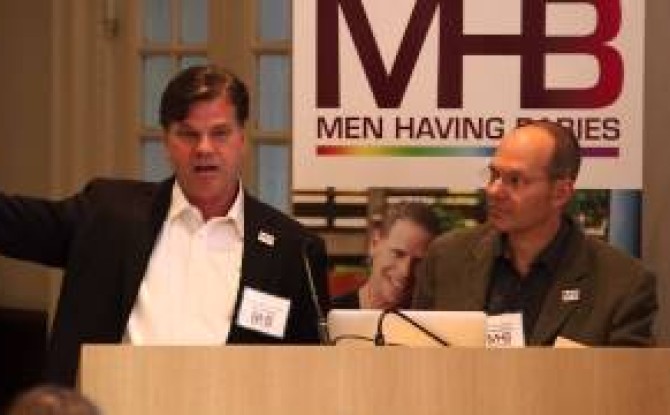
Overview of surrogacy and adoption options in the USA / 2015 Brussels MHB

Unused Embryos Pose Difficult Issue: What to Do With Them

By Tamar Lewin, New York Times, June 17, 2015

After years of infertility, Angel and Jeff Watts found a young egg donor to help them have a baby. They fertilized her eggs with Mr. Watts’s sperm and got 10 good embryos. Four of those embryos were transferred to Ms. Watts’s womb, resulting in two sets of twins — Alexander and Shelby, now 4 years old, and Angelina and Charles, not yet 2.

But that left six frozen embryos, and on medical advice, Ms. Watts, 45, had no plans for more children. So in December she took to Facebook to try to find a nearby Tennessee family that wanted them.

“We have 6 good quality frozen six-day-old embryos to donate to an amazing family who wants a large family,” she posted. “We prefer someone who has been married several years in a steady loving relationship and strong Christian background, and who does not already have kids, but wants a boat load.”

In storage facilities across the nation, hundreds of thousands of frozen embryos — perhaps a million — are preserved in silver tanks of liquid nitrogen. Some are in storage for cancer patients trying to preserve their chance to have a family after chemotherapy destroys their fertility. But most are leftovers from the booming assisted reproduction industry, belonging to couples like the Wattses, who could not conceive naturally.

And increasingly families, clinics and the courts are facing difficult choices on what to do with them — decisions that involve profound questions about the beginning of life, the definition of family and the technological advances that have opened new reproductive possibilities.

Since the first American “test tube” baby was born in 1981, in vitro fertilization, at a cost of $12,000 or more per cycle, has grown to account for more than 1.5 percent of all United States births.

The embryos with the greatest chance of developing into a healthy baby are used first, and the excess are frozen; a 2002 survey found about 400,000 frozen embryos, and another in 2011 estimated 612,000. Now, many reproductive endocrinologists say, the total may be about a million.

Couples are generally glad to have the leftover embryos, backups in case a pregnancy does not result from the first tries.

“But if I ask what they’ll do with them, they often have a Scarlett O’Hara response: I’ll think about that tomorrow,” said Dr. Mark V. Sauer, of Columbia University’s Center for Women’s Reproductive Care. “Couples don’t always agree about the moral and legal status of the embryo, where life begins, and how religion enters into it, and a lot of them end up kicking the can down the road.’’

There are no national statistics on what happens with these leftover embryos. As a practical matter, many sit in storage indefinitely, academic researchers say, either at fertility clinics or other facilities, costing $300 to $1,200 a year. A small percentage of people stop paying the storage fees and leave it to the clinic or facility to figure out what to do.

Click here to read the entire article.

Michigan Legislation Allows Adoption Agencies to Reject LGBT Parents

Reuters via New York Times – June 10, 2015

(Reuters) – Adoption agencies in Michigan would be able to refuse service on religious grounds to homosexual couples who want to adopt children under three bills that the state’s Republican-controlled Senate passed on Wednesday.

The bills, which must be signed by the governor to become law, say child-placing agencies shall not be required to provide adoption services under circumstances that conflict with their sincerely held religious beliefs contained in a written policy or other document. The agencies are private, but receive state funding.

While the bills do not specifically mention lesbian and gay couples, they are viewed as narrow versions of religious freedom acts passed in a number of states to shield businesses that want to refuse service to same-sex couples from discrimination lawsuits.

Supporters say the acts protect religious freedoms, while others say they are licenses to discriminate. With 37 states now allowing same-sex marriage, the Supreme Court has taken up the issue this year and conservative groups are turning toward backing religious-freedom laws from fighting recent battles on gay marriage.

Click here to read the entire article.

Gay adoption ban stricken from Florida laws after 4 decades

AP via The Tampa Tribune

TALLAHASSEE – The nearly four-decade-old law that prevents gays from adopting children will disappear from Florida’s statutes on July 1.

Republican Gov. Rick Scott signed a bill today that removes the language – though the ban hasn’t been enforced for the past five years.

The bill signed by Scott also promotes adoption, but the original language was changed to include a provision removing the gay adoption ban from state law.

While conservative Republicans objected to the idea, others said that it simply changes the law to reflect reality.

A judge ruled five years ago that the state’s ban was unconstitutional.

Click here to read the entire article.

Amendment: Gays could be denied as foster or adoptive parents in Texas

by Christy Hopp, May 25, 2015 – The Dallas Morning News

Gays and same-sex couples could be turned away from adopting children or serving as foster parents under an amendment filed by a social conservative House member and expected to be heard Tuesday.

The measure also would allow child welfare providers to deny teenagers in foster care access to contraception or an abortion under a wide umbrella of religious protections for the state contractor.

Rep. Scott Sanford, R-McKinney, has filed the measure that gives state contractors for child welfare services the right to sue the state if they are punished for making decisions based on their religious beliefs.

The state could not force contractors to follow policies providing for contraception or allowing same-sex couples to adopt, for instance. If the state tried to terminate a contract or suspend licensing for the state contractors’ failure to abide by such polices, the contractor could sue, win compensatory damages, relief from the policy and attorneys fees against the state, according to the proposal.

Sanford tried to pass as separate bill earlier in the session, but it failed. The proposal now has resurfaced as an amendment to the sunset bill that would reconstitute the Department of Family and Protective Services.

Civil rights and gay equality groups fought a similar measure earlier in the session, saying, “If enacted into law, Rep. Sanford’s amendment would allow child welfare providers to discriminate against not just gay and transgender families seeking to provide loving homes for children who need them, but also against people of other faiths, interfaith couples and anyone else to whom a provider objects for religious reasons. This would seriously weaken the state’s child welfare system by further shrinking the pool of qualified parents who can provide a safe, loving home for children.”

Click here to read the entire article.

The 2015 MHB Brussels conference on Parenting Options for European Gay Men – highlights