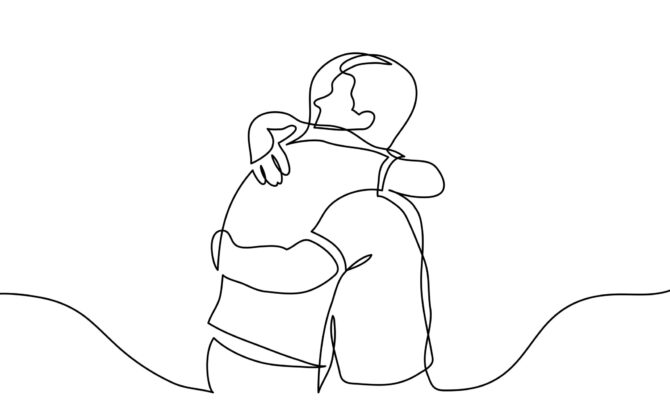
The door was open and a “frail little voice” called out for the brothers to come inside.
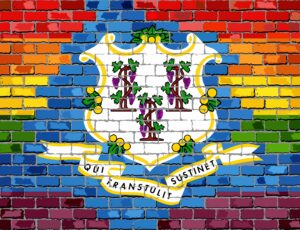
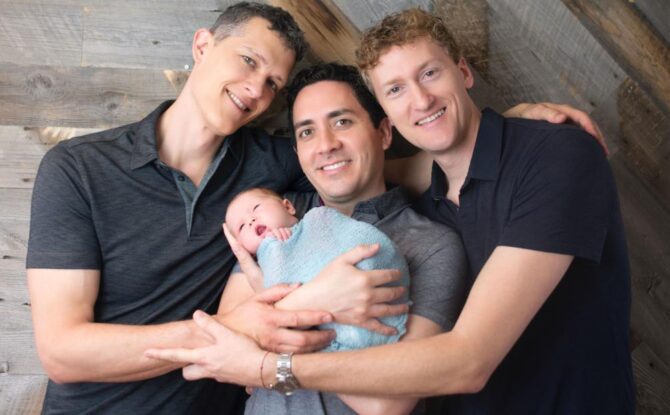
Proponents told the state judiciary committee that the Connecticut Parentage Act would fill the gaps in the existing state law and ensure equal protection for these LGBTQ parents to have custody, parenting time, and legal and medical decision making. It also ensures that children are connected to their parents’ healthcare.
Advocates argue that the current law is outdated and unconstitutional.
“Even though I was not legally the child of one of my fathers, even though many treated us with disgust and disdain, I am certain that my life and the moment I was born has brought my fathers deep and abiding joy,” said Malina Simard-Halm, a New Haven resident and member of LGBTQ+ family advocacy organization COLAGE. “And because of my dads, I have grown up in a family that has shown me the meaning of love, that supported me so much that now I am lucky enough to be here advocating so that people don’t have to go through what they did.”
On Monday, state lawmakers on the judiciary committee heard testimony from Simard-Halm and other advocates for the bill, including members of non-traditional families, doctors, lawmakers, lawyers and nonprofit organizations.
Simard-Halm said her fathers used a surrogate mother to have her and fought through what she described as a “hostile legal system” to raise her.
“Exclusive parentage law sends a message that children like me do not belong,” she said. “When I was growing up, laws like Connecticut’s gave authority to the schoolyard bullying and kindled my own insecurities. At times, it led me to feel ashamed of the people who loved me and fought for me the most,” she said.
Douglas NeJaime, a professor of family and constitutional law at Yale Law School, helped draft the bill and has pushed for its passage since it was introduced in 2019.
“The Connecticut Parentage Act solves the problems in our parentage law,” NeJaime said. “It satisfies constitutional requirements. It reflects the diversity of families in our state. It protects children who are vulnerable under current law. It brings order to an area where there is uncertainty. It updates law that is outdated and it reflects best practices.”
A 2019 version of the bill was reintroduced this year with input and revisions from state courts and agencies.
wshu.org, March 9, 2021 by Alek Lewis
Click here to read the entire article.
Opinion – The Covid-19 pandemic has thrown the country into an economic recession and an unprecedented restructuring of our work and social lives. Early on, some likened the public health crisis to a blizzard, imagining that people would stay home, cozy up with their romantic partners and make babies.
These playful visions have given way to a more sobering reality: The pandemic’s serious disruption of people’s lives is likely to cause “missing births” — potentially a lot of them. Add these missing births to the country’s decade-long downward trend in annual births and we can expect consequential changes to our economy and society in the years to come. Unfortunately, there are no easy fixes.
Research we did last year showed that the Covid pandemic would lead to a decline in U.S. births of about 8 percent, as compared with the number of expected births without a pandemic, resulting in 300,000 fewer births this year than would otherwise be expected. This prediction was based largely on the fact that economic factors affect people’s decisions about whether and when to have a baby.
There is a well-documented cycle to the nation’s birthrate: When the labor market is weak, aggregate birthrates decline; when the labor market improves, birthrates improve. At the individual level, there is also a well-documented link between changes in income and births: When income increases, people often expand their families; when people experience job or income loss, they have fewer children.
This effect was evident after the Great Recession. States that experienced higher increases in unemployment experienced larger declines in birthrates; a one percentage point increase in the unemployment rate was associated with a subsequent drop in births of 1 percent. Estimates suggest that U.S. unemployment will have risen by around 5.5 percentage points in the year following the start of the pandemic. From the unemployment effect alone, we might therefore expect a 5.5 percent reduction in births on account of the Covid pandemic.
NYTimes.com, March 7, 2021 by Melissa S. Kearney and
Click here to read the entire article.
A lesbian couple who wanted to have another child opted ended up with more than they expected. Instead, Heather Langley and Priscilla Rodriguez welcomed home gorgeous quintuplets.
Hadley, Reagan, Zariah, Zylah, and Jocelyn are only the second set of all-girl quintuplets ever recorded in America. They join their older sister, Sawyer, in a very happy home.
Due to the pandemic, Rodriquez was unable to accompany Langely to her doctor appointments and wasn’t in the room when she found out they were having five babies instead of one. Langely texted her partner to break the news.
“She was incredibly shocked,” Langely told Metro. “She responded to my text saying ‘please tell me this is a joke’. She didn’t believe I was being serious at first because you rarely hear of people being pregnant with five babies.”
“I immediately felt scared when we found out there was going to be five because I feared my pregnancy would be worrying and complicated,” she confessed. “I was also panicking about how we would take care of five babies and how on earth we would pick and agree one five names, let alone one. However, after the initial shock and the news had sunk in, I realized how special and unique our babies were going to be.”
“At around 19 weeks we had a scan to find out the gender of the babies,” she added. “The midwife just kept saying ‘another girl.’ I could not believe we were going to have five more girls. I just kept thinking, ‘Wow that is a lot of girls, what are we going to do with them all?’ We would have six in total.”
“And then when we found out that they were going to be the second-ever set of all-girl quintuplets in the US, we felt so blessed with how rare and extraordinary they were.”
Quintuplets occur naturally in 1 in 55,000,000 births.
LGBTQNation.com by Bil Browning, January 27, 2021
Click here to read the entire article.
What’s at Stake For LGBTQ Families This Election? It was the worst of times; it was the worst of times. I’m an optimist at heart, but there were days this year when looking on the bright side seemed like the act of a lunatic. Every day I felt the heaviness in my heart.
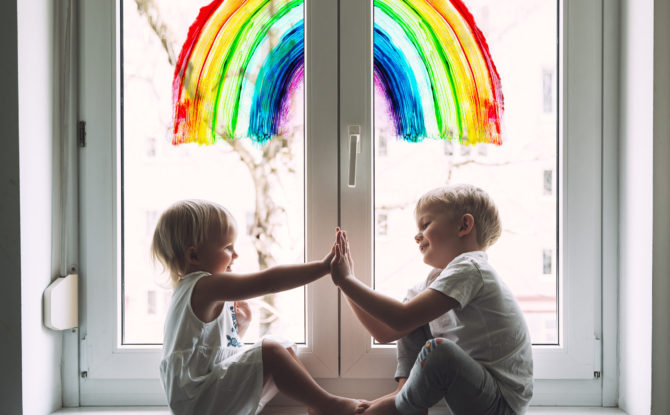
Then, one morning in August, I walked down our dirt road with the dog. Mist was rising off Long Pond. When we got home, I found a small stone among the snapdragons and joe-pye weed in our garden. Someone had painted it with a rainbow. On one side were the words “You matter.”
This turned out to be one of a series of painted rocks that an anonymous person, or persons, have been leaving around my neighborhood. Some of the messages on them are generic, like “Maine: The way life should be.” But others seemed specific to their recipients. In front of the house of a neighbor with lots of children was a red rock inscribed with “Kids are great.” In the garden of a new arrival to our tiny Maine neighborhood: “Welcome to the lake.” By the house of a couple with a goofy black Lab: “Your dog is cute.”
It seemed as if a guardian angel had appeared among us, charged with the task of giving us hope at a time when many of us have never felt so lousy.
For me, a reminder that my big gay family matters right now was more than a pleasantry. It was like a message from heaven. For the last four years the message from Donald Trump has been the opposite: To him, we don’t matter at all. In so many ways, he’s made it clear he feels we’d be better off erased.
The messaging began the first week of his administration, when mention of L.G.B.T.Q. rights disappeared from the White House website.
This was just for starters. Later, he rejected plans to add questions about gender identity and sexual orientation to the 2020 census. He banned trans people from the military. On the anniversary of the Pulse nightclub shooting, he announced that his administration would roll back Obama-era health care protections for trans people. He prohibited embassies from flying the rainbow flag on flagpoles. For three out of four Junes he has failed to mention Pride Month — although one time he did take time out of his busy schedule to talk up National Homeownership Month.
His Department of Justice filed a brief with the Supreme Court endorsing the idea that employers had the right to fire L.G.B.T.Q. people just for being themselves. In the end, even the conservative-majority Supreme Court ruled against him. But the idea that the president of the United States went out of his way to put me, and people like me, at risk, is harrowing.
This August, at its convention, the Trump Republican Party re-endorsed its 2016 platform. You know, the one that sanctifies “traditional marriage” and condemns the Supreme Court ruling in favor of marriage equality. The one that describes the ruling defending a marriage like mine as “full of ‘silly extravagances.’”
Last week the administration filed a brief with the Indiana Supreme Court making the case that a Catholic school can fire a gay teacher who marries. It’s a First Amendment case, the administration says. Because persecuting L.G.B.T.Q. people is a form of free expression, I guess. Like cake frosting.
Also in the last week, the president released a shortlist of potential Supreme Court nominees for his second term, a list rife with anti-L.G.B.T.Q. and anti-civil rights individuals. The legal director of Lambda Legal, an organization that fights for the legal rights of L.G.B.T.Q. people, described the nominees as “terrifying.” One of them, Allison Jones Rushing, has ties to a group called the Alliance Defending Freedom, which has espoused the idea that homosexuality should be criminalized. The Southern Poverty Law Center calls it a hate group.
NYTimes.com, September 16, 2020 by Jennifer Finney Boylan
Click here to read the entire article.
The pandemic has affected queer youth in many ways. When Brittany Brockenbrough’s transgender son lost his in-school counseling and the ability to have meet-ups with other L.G.B.T.Q. youth during the pandemic, his mental health suffered.
“He began to feel depressed and was withdrawn,” said Ms. Brockenbrough, a mother of two in Virginia. She was later able to get her son teletherapy and in-home support from a local mental health agency and to find ways for him to stay in touch with others in his community through such activities as weekly Zoom meetings and online game nights.
“He is doing much better now that he is back in treatment and staying connected to the community,” she said. “Social distancing and taking precautions is necessary, but for the L.G.B.T.Q.+ community, even those who have supportive parents, losing the ability to have that in-person social support with other L.G.B.T.Q.+ youth can have a significant impact.”
As young people continue to adjust to the pandemic, some are dealing with increased anxiety and stress. For those who are lesbian, gay, bisexual, transgender, queer or questioning, there may be additional challenges and risks resulting from limited access to community support, lack of in-school counseling and, in some cases, the difficult circumstances of quarantining with unsupportive family members.
“My parents do not accept that I am gay,” an 18-year-old from Yonkers, N.Y. who did not want his name published, said. “My support system was mostly at school, and now I am quarantining with family members who don’t accept who I really am.”
The young man, whose virtual high school graduation was last week, said his parents reacted with “anger” and “disgust” when they found out he was gay, and that being home with them during the Covid-19 shutdown has been very uncomfortable. “It is humiliating to have to rely on people who do not respect you,” he said.
L.G.B.T.Q. youth are already a vulnerable population and at higher risk for anxiety, depression, homelessness and self harm than their non-L.G.B.T.Q. peers. A 2018 study in JAMA Pediatrics by researchers at Harvard University and the Fenway Institute found that transgender youth were at a greater risk for attempted suicide, depression and anxiety, and that gender-affirming mental health services are greatly needed to address these concerns.
Sarah Gundle, a clinical psychologist in New York City, said that while online supports are available during this crisis and can provide help, for many they cannot replace in-person treatment and interaction with a community that accepts and validates your identity.
“L.G.B.T.Q.+ youth who have to be at home for extended periods of time and live with unsupportive family members — or their family environment makes it unsafe for them to be out at home — can experience a profound sense of isolation,” Dr. Gundle said. “A pandemic brings significant uncertainty — there is no definitive end — and it can feel as if there is no escape. Many L.G.B.T.Q.+ youth also have to worry about their safety and the repercussions if their family members find out.”
When college campuses closed in March because of the pandemic, having to return home to an unsupportive space was not a safe option for some students.
Danushi Fernando, the director of L.G.B.T.Q. and Gender Resources at Vassar College in Poughkeepsie, N.Y., said that approximately 225 students — following state guidelines — remained on campus through the spring semester for various reasons, some because they did not feel safe sheltering with their families. Vassar also provided support for students through virtual gatherings, support groups and counseling.
NYTimes.com, June 29, 2020 – by Misha Valencia
To read the entire article, click here.
Co-parenting families are drawing on the resiliency that comes from living on the margins in the Coronavirus pandemic. Four months ago, Lisa Lo, from Calgary, separated from the father of her two young children, ages two and five, in part because she wanted to open her marriage to relationships with both men and women.
Lo, whose name has been changed to protect her family’s privacy, is polyamorous, and she’s had three relationships since her separation, one of which has ended, and two of which have been complicated by pandemic living arrangements.
Some of these relationships have brought big feelings, but through it all, Lo is mindful of keeping an emotional balance for her kids, who spend most of their time with her. “They pick up on my emotions,” she said. “If I’m happy, they’re happy. If I’m stressed and upset, then they’re stressed and upset.”
But that was all pre-pandemic: “Now, dating has been put on hold,” she told HuffPost Canada. Lo’s priorities are different these days. She is very much focused on the challenges COVID-19 poses to all multi-household families: creating consistent self-isolation protocols, navigating the handing-off of children, communicating in a time of stress, finding legal counsel.
To create a situation that worked for everyone, Lo had to have hard conversations with her ex-husband about whether to integrate any of her existing polyamorous relationships into their isolation cohort.
They settled on Lo living with one somewhat-ex-partner (it’s complicated). They are also still employing a nanny in both households, in part, because this is supportive of Lo’s mental health. The negotiations about child schedules and hand-offs between households have been complex.
Lo has also been challenged by some of her loved ones about having non-immediate family members in her household “pod” during the pandemic. But, she was able to take that in stride.
She said being queer has given her a lot of practice with tough discussions: “I’m used to being outspoken about things that are unconventional. I’m done being in the closet about anything.”
Rachel Farr is an assistant professor of Psychology, and she runs the FAD (Families, Adoption, and Diversity) research lab at the University of Kentucky. She said that for LGBTQ2 families, this pandemic both feeds into existing patterns of resilience and creates new ones.
“Some of the emotional dynamics I think are true for any family trying to negotiate [this pandemic],” she told HuffPost, “but there are added layers of sensitivity and vulnerability for queer families, who also face stigma and various forms of silencing through institutional discrimination or lack of legal protections.”
Huffingtonpost.ca by Brianna Sharpe, April 23, 2020
Click here to read the entire article.
Men’s bodies change when they become fathers. As an anthropologist who studies human fatherhood at the University of Oxford, I’ve run up against a widespread and deeply ingrained belief among fathers: that because their bodies haven’t undergone the myriad biological changes associated with pregnancy, birth and breastfeeding, they’re not as biologically and psychologically “primed” for caretaking as women are.

As a result, they feel less confident and question their abilities to parent: Will they be “good” parents? Will they bond with their babies? How will they know what to do?
As my own personal and professional experiences dictate, the idea that fathers are biologically “less prepared” for parenthood is unlikely to be true. Much of the role of parenting is not instinctual for anyone. (I remember the steep learning curve of those first days of motherhood — learning what each of my baby’s cries meant, mastering the quick diaper change and juggling the enormous amount of equipment necessary just to make it out the door.)
And while the biological changes fathers undergo are not as well understood (nor as outwardly dramatic) as those of mothers, scientists are just beginning to find that both men and women undergo hormonal and brain changes that herald this key transition in a parent’s life.
In essence, being a dad is as biological a phenomenon as being a mom.
Take testosterone, the stereotypically “male” hormone that plays important roles in male fetal development and puberty. Testosterone is largely responsible for motivating men to find partners and, studies suggest, men with higher levels of testosterone tend to be more attractive to potential mates. But being a successful human father means focusing inward on the family and resisting the drive to seek out another partner. So, experts believe, men have evolved for some of that testosterone to go.
In a pioneering five-year study published in 2011, for instance, Dr. Lee Gettler, Ph.D., an American anthropologist, followed a group of 624 single, childless men in the Philippines from age 21 to 26. Dr. Gettler found that while all men in the study experienced normal, age-related dips in testosterone, the 465 men who became dads during that five-year period experienced a more significant drop — an average 34 percent (when measured at night) — than those who remained single or married.
Globally, study after study — including my own unpublished findings in the United Kingdom — have found similar results, noting that this reduction in testosterone can happen just before and just after the birth of a man’s first child. And while it isn’t clear exactly what prompts this drop, Dr. Gettler said that his own preliminary results suggest that the more dramatic the drop, the bigger effect it seems to have on a man’s caregiving behavior. “We found that if brand new fathers had lower testosterone the day after their babies were born,” said Dr. Gettler, “they did more caregiving and baby-related household tasks months later.”
While news of this drop in testosterone is often greeted with groans of resignation from men — choose fatherhood and choose the road to emasculation, they think — some studies have suggested that the lower a man’s testosterone, the more likely he is to release key reward and bonding hormones, namely oxytocin and dopamine, when interacting with his child. Caring for your child, therefore, produces not only a strong bond but a neurochemical reward, inducing feelings of happiness, contentment and warmth — a welcome trade-off.
The brain also appears to undergo structural changes to ensure that fathers exhibit the key skills of parenting. In 2014, Dr. Pilyoung Kim, Ph.D., a developmental neuroscientist at The University of Denver, put 16 new dads into an M.R.I. machine: once between the first two to four weeks of their baby’s life, and again between 12 and 16 weeks. Dr. Kim found brain changes that mirrored those previously seen in new moms: Certain areas within parts of the brain linked to attachment, nurturing, empathy and the ability to interpret and react appropriately to a baby’s behavior had more gray and white matter between 12 and 16 weeks than they did between two and four weeks.
NYTimes.com, By Anna Machin, June 13, 2019
Click here to read the entire article.