The Family I Never Thought I’d Have

By Anthony M. Brown – November 21, 2015

What is it about families?   Wars have been fought over them. History has been made because of them. Comedians and therapists have made millions talking about them. But when it all boils down, family makes us who we are, whether standing with them or running from them.
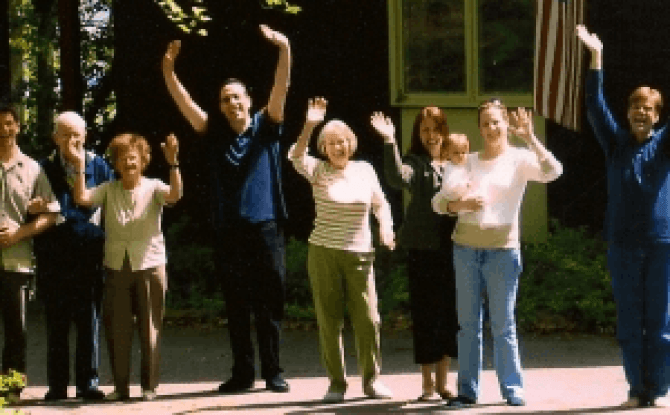
familyMy husband Gary’s blind Aunt Elda died about 5 years ago. We got her cancer diagnosis a year or so  before her death, and it took a while for it to hit home that there was no successful treatment for her ovarian/GI cancer. She had lived outside Gary’s family for many years, in large part due to her husband Chuck. Chuck was perhaps the most prejudiced, bigoted, intolerant man I had ever met. His willingness to make racist or homophobic statements in my husband’s and my presence was almost as strong as his love for Elda. But he physically removed Elda from the family by moving out of state and at one point actually said to her, “you better hope you die first because your family will never be there for you.” Chuck died first.  And we were there for her.

In the perfect ironic twist, Chuck’s mentor and most respected business manager, a man named Ralph Thomas, was also my father’s best friend. He cringed when I would talk about Ralph and his wife in very personal terms as I saw them often before my father died. On Uncle Chuck’s deathbed, everything changed.

Chuck had suffered a series of strokes, the last one leaving him unable to communicate. Gary and I were visiting him in the hospital when I noticed that he was agitated. I knew from my father’s deathbed experience how to shift a person up in the bed by lifting the small blanket placed under the patient and on top of the bed linens. I asked Chuck if he wanted to move up. He blinked his eyes rapidly. Gary and I lifted the blanket, and Chuck, successfully up in the bed. As our eyes met, I could swear I saw him crying and with that, a world of misunderstanding and homophobia flew right out the hospital window.

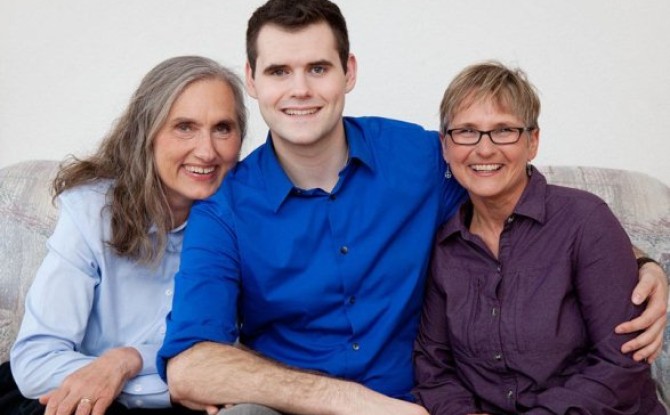
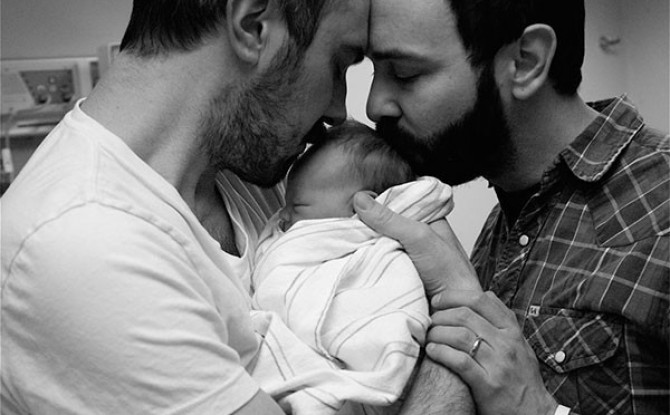
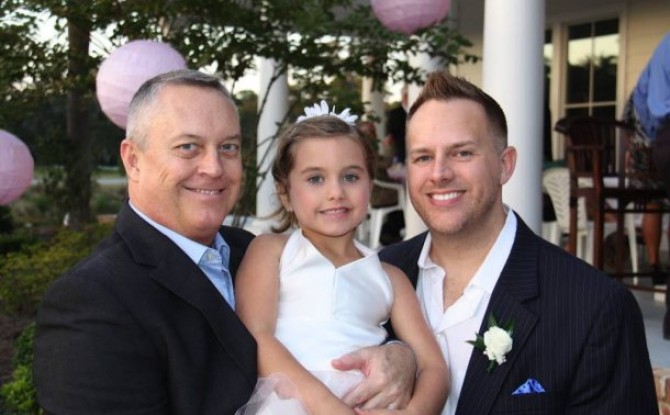
I don’t know what chuck would have made of the fact that I am a donor dad and have two beautiful little girls with two wonderful women who are their parents or that my husband and I have a son  who has a surrogate mom, but both my family and Gary’s family get it.  And it couldn’t have happened at a better time.

Gary’s father throughout this time had been enduring a prolonged battle with Parkinson’s disease, which, toward the end of his life, left him mentally aware, yet unable to communicate. If he could have, he would have probably yelled. Italians yell, that’s just the way it is. It took me, a southern WASP, years of therapy to realize that Gary’s screaming had more to do with his heritage than anything I may have done. He learned that from his parents. And while they didn’t really communicate, they yelled, A LOT.

Even with the Parkinson’s, Gary’s parents yelled at each other. It used to bother me, but now I get it. While home over one weekend fairly close to may father-in-law’s death, we watched the ultimate tearjerker movie, The Notebook, based on the novel by Nicholas Sparks. It tells the tale of a man who reads a handwritten story to a woman in a nursing home everyday until she realizes, through her dementia, that it is their love story. For a few minutes, she remembers, then he is a stranger again.

At the conclusion of the movie, Gary’s mom was sitting in Gary’s lap, both crying, and I was holding my father-in-law’s hand, also crying. Tears everywhere. Gary’s parents hugged each other and, in a moment that I will remember for the rest of my life, Gary’s dad, who had not been able to communicate clearly for months,  looked at his wife of over 60 years and said, “I didn’t know that this was what you’ve been dealing with.   I am sorry.” In that amazing, crystalline moment – we all lost it. Gary’s mom replied that she loved him and that she wanted to take care of him. Gary and I hugged while this exchange occurred knowing that a gift had just been given to everyone in that room.

Enter Michael, Gary’s older brother, who had been watching this whole emotional experience transpire with his then girlfriend, now wife, Xiao from the other room. Xiao is Chinese and had never met a gay person, much less a gay couple, before dating Michael. They had only been dating for a few months when this happened. Michael told me that Xiao had also seen the hug–fest and asked, “How long have Tony and Gary been together?” Michael replied, “almost 20 years.” Xiao said, “Do you think we will be like that in 20 years?” Michael said, “I hope so.”

Regardless what people think about their in-laws, there are lessons to be learned from them, joys and sorrows to be experienced because of them. These are the things that only a family can provide and while many on the less tolerant side of the aisle would either discount or misunderstand my family, no one can change the fact that I am married to a man and that I married into a family that loves and respects both me and my husband. I have children that will learn their values from this amazing family and my children will continue to teach me theirs.  It doesn’t get much better than that.


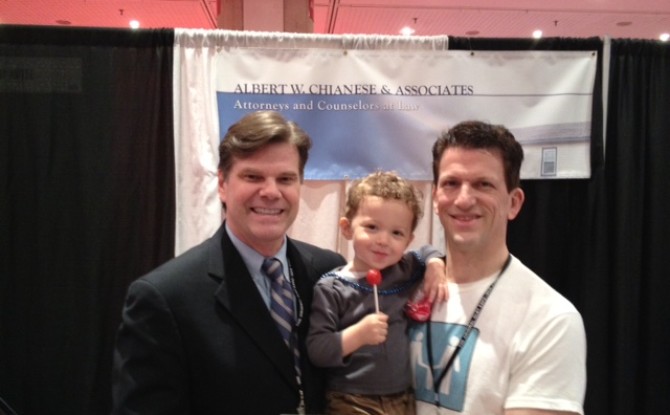
Anthony M. Brown currently heads the Nontraditional Family and Estates Law division of the law firm of Albert W. Chianese & Associates, PC, specializing in estate planning and second and step-parent adoptions. Anthony is the Board Chariman of Men Having Babies, and is the Executive Director of The Wedding Party.  He can be reached at: Anthony@timeforfamilies.com.


About MHB

Men Having Babies, Inc. is a nonprofit organization that was spun off in July 2012 from a program that ran at the NYC LGBT Center since 2005. It started as a peer support network for biological gay fathers and fathers-to-be, offering monthly workshops and an annual seminar. Over time, elaborate online resources were developed, the group’s mailing list expanded to about 2000 couples and singles from around the world, and it teamed up with LGBT family associations to develop similar programs in Chicago, San Francisco, LA, Barcelona, Tel Aviv and Brussels.


Our mission includes:

  • The provision of educational and practical information to assist gay prospective parents achieve biological parenting.
  • Promoting the affordability of surrogacy related services for gay men through financial assistance and the encouragement of transparency and customer feedback.
  • Promoting surrogacy practices that minimize the risks and maximize the potential short and long-term benefits to all involved.
  • Raising awareness about the potential benefits and meaningful relationships surrogacy arrangements can bring about.


Beyond the seminars and workshops, Men Having Babies runs several programs to promote its educational, advocacy and affordability mission, including:

Assistance in academic studies about gay parenting and surrogacy.
Step Parent Adoption; Married still need one?

Step Parent Adoption; Marriage means I don’t need one?

Step Parent adoption is still a must to secure your family, even after marriage equality.  Marriage equality was a long fought battle and a much celebrated victory for gay and lesbian couples across the country. Now that it is the law of the land, many people mistakenly believe that their marriage alone will secure their family. Unfortunately family law has not caught up to the realities of how we create our modern families.

For both gay and lesbian couples, securing the legal rights of a non-biological parent is crucial to create the kind of emotional, and legal, security that most other families take for granted. The legality of both parents relationship to their child is often assumed. Parents are parents, regardless of the biological connection to your child. In New York State, the law doesn’t agree.

Married lesbian couples in many states, New York included, can list a non-biological mother name as a parent on a child’s birth certificate if they are married at the time of the birth of the child and they use an anonymous sperm donor. While a name on a birth certificate is an important goal, it in itself does not create a legal relationship, only through step parent adoption can they be acheived.

Step Parent adoption is still a must to secure your family, even after marriage equality.

In New York County, Surrogate Judge Kristin Booth Glen, in a case entitled In the Matter of Sebastian, discusses the issue of establishing parental rights for a non-biological parent specifically.  The case involves married lesbian couple who used an anonymous sperm donor to have a child. Glen concludes, when discussing the non-biological mother’s relationship with the child that, “the only remedy available here that would accord the parties full and unassailable protection is a second-parent adoption pursuant to New York Domestic Relations Law (“DRL”) § 111 et seq.”  Glen further states, “that a judicial order of adoption in one state must be afforded full faith and credit in every state, and that there can be no “public Policy” exception to that mandatory recognition…”.

While it is true that many states have what is called a “martial presumption of parentage,” the truth about this is that it is applied differently in different states.  For instance, in New York State, where I practice, there is specific case law that holds that the marital presumption of parentage does not apply to same-sex couples.  That case is called “Matter of Paczkowski v. Paczkowski.”  In that case, the appellate division of the Second Department of New York, the state’s intermediate appellate court, held that the “presumption of legitimacy… is one of a biological relationship, not a legal status.”

In essence, the court says that a marriage does not create a legal right between a non-biological parent and a child.  While it may be an indication of intent to be a parent, as would a non-biological parent’s name on a birth certificate, the only way to actually create the legal relationship that guarantees the security that all same-sex families need, is through an adoption order, and in some states, a parentage order.  Unfortunately, New York currently does not have the capacity to issue a parentage order but there is legislation in committee in Albany that may change that. 

Surrogate Options & Known Donors Complicate the Legalities of Chosen Families

One further compounding variable is that many lesbian couples are now choosing known sperm donors. While the desire for a child to know their biological heritage and have a father figure makes sense to many couples, adding another potential parent into the mix can create problems if an adoption does not take place to terminate the donor’s rights to the child and create the intended, non-biological parent’s rights to their child.

For male couples who want to have biologically related children, surrogacy is the only real option. Surrogacy is an emotionally, and financially, exhausting process.  It is a true leap of faith.  Couples considering surrogacy must juggle a myriad of concerns, the least of which being the cost.  With gestational surrogacy tabs running as high as $180,000.00, budgeting is a must.  Lawyer’s fees are often lumped together in surrogacy accounting statements, and some agencies do not include the cost of a second or step parent adoption in order to keep the numbers low.  Often, the cost of a pre-birth order is less than a second parent adoption.

step parents adoption, step parent adoption, adoption step parent, adoption for step parents

In some cases, depending on where your surrogate mother gives birth, her name may be removed from the child’s original birth certificate by a proceeding called a pre-birth order.  Some states do not provide for pre-birth orders.  Those that do may or may not replace the surrogate’s name with that of the non-biological intended parent.  California, for instance, does offer the ability to include the non-biological parent’s name on the child’s original birth certificate, and that very significant step is often mistakenly viewed as a replacement for a second parent adoption, which is the only definitive way to establish parental rights between a non-biological parent and a child born through surrogacy.

In order to understand why a second parent adoption is vital if you have a pre or post-birth (or parentage) order, you must understand what that order is, and what protections it provides.  Pre and post-birth orders are court orders that are obtained by filing a petition in the appropriate court in the state in which the child will be born.  Often, these petitions are not filed in the county where the carrier lives, but in a county which has a judge who understands the importance of these orders and grants them upon the motion of an attorney representing the intended parents.  This in itself may create a problem.

Some states may not recognize the relationship created by the pre-birth order because of the lack of a full judicial process attendant to a parentage order.  For an issue to be precluded from challenge, for instance the issue of a non-biological parent’s relationship to a child born through surrogacy, the court looks at the process by which that issue has been established.  The reason why adoption orders from one state are valid in every state, regardless of the gender of the parents, is because the judicial process of the adoption.  The state, for all intents and purposes, becomes and “adversary” to the adoptive parents in the adoption process.  The state performs background checks, it orders that fingerprints be taken, mandates that a home study is performed by a licensed social worker to ensure that the child’s prospective residence is safe and clean and essentially verifies all adoption requirements submitted by the petitioning parent, or parents.  The adoption order is the product of a fully litigated judicial process.  Because this rigorous process is not part of a parentage order proceeding, states which do not offer such orders may not recognize a relationship created in one.

Furthermore, some courts, through a parentage order, will add the name of the non-biological parent to the original birth certificate if that person is married to the biological parent.  For same-sex couples, this can present an issue, particularly if the non-biological parent’s relationship to the child is being challenged in a state that resists same-sex marriage.  These situations usually arise upon the dissolution of a relationship and during the custody/visitation/support aspect of that process.

Protecting our families may seem like navigating a ship through a sea of legal, financial and emotional waters.  But what is more important than the security of knowing that every child has a legal relationship with their parents that cannot be challenged for whatever reason. Every parent deserves that security as well.

by Anthony M. Brown – September 16, 2015

Anthony M. Brown, Esq. currently is an associate with the law firm of Albert W. Chianese & Associates heading their Nontraditional Family and Estates Law division serving unmarried individuals, couples and families in Manhattan and on Long Island.  Anthony is the Executive Director of The Wedding Party and has been a Board member since its inception in 1999.   The Wedding Party is a non-profit educational organization that educates the public about marriage and its importance to all citizens through outreach programs and strategic media placement. Anthony is the founder of TimeForFamilies.com, a web environment dedicated to assisting gay and lesbian couples create their own families. Anthony is the Board Chairman of Men Having Babies, a non-profit organization created to assist gay men looking create families through surrogate options and is a legal consultant for Family By Design, a co-parenting information and matching website.


A Quick Guide To The Research On Same-Sex Parenting (As Presented To The Federal Courts)

By Zack Ford, ThinkProgress.org, October 28, 2013

Two marriage equality cases are advancing to the Ninth Circuit of Appeals from the states of Nevada (Sevcik v. Sandoval) and Hawaii (Jackson v. Abercrombie). In both cases, marriage equality lost at the district court level, distinguishing them from the case challenging California’s Proposition 8 and essentially freeing them of the jurisdictional issues that complicated the Prop 8 case. This means that the two cases provide an opportunity for the court to directly consider the constitutionality of states banning same-sex marriage.

Zach-Wahls-DNC-2012-200x300Numerous professional organizations submitted amicus briefs last week advising the court about why it should support marriage equality and in particular, addressing the question of same-sex parenting. Opponents assert that same-sex marriage should be banned because children fare better with different-sex parents than with same-sex parents. Not only does this ignore the fact that joint adoption is already legal for same-sex couples in both Nevada and Hawaii, but as the scholarly community points out, it disregards the consensus of scientific research endorsing same-sex parenting.

In a brief filed by the American Psychological Association, National Association of Social Workers, American Association for Marriage and Family Therapy, American Psychoanalytic Association, and Hawaii Psychological Association, the scholars outline three factors that research has determined leads to good parenting:

  • The quality of the relationships between parent and child.
  • The quality of the relationships among adults in the child’s life (such as between the parents).
  • Available economic resources to support the child’s development (e.g., safer neighborhoods, more nutritious food, etc.).

The groups point out that these factors are not impacted by sexual orientation, and thus there is no reason to conclude same-sex parents would be inferior in any way.

In a complementary brief, the American Sociological Association (ASA) expanded upon what research says specifically about the outcomes for children of same-sex parents:

Click here to read the entire article.

To adopt, or not to adopt… Really?

March 20, 2012 (See 2015 addendum @ the bottom of the article.)

Legal Surrogacy – To adopt, or not to adopt…???

adoptSurprisingly, that has been one of the most asked questions by parents of children born with the assistance of a surrogate mother.  In many cases, the carrier’s name may be removed from the child’s original birth certificate by a proceeding called a pre-birth order.  Some states do not provide for pre-birth orders.  Those that do, may or may not replace the carrier’s name with that of the non-biological intended parent.  California, for instance, does offer the ability to include the non-biological parent’s name on the child’s original birth certificate, and that very significant step is often mistakenly viewed as a replacement for a second parent adoption, which is the only definitive way to establish parental rights between a non-biological parent and a child born through legal surrogacy.

Legal Surrogacy is an emotionally, and financially, exhausting process.  It is a true leap of faith.  Couples considering surrogacy must juggle a myriad of concerns, the least of which being the cost.  With gestational surrogacy tabs running as high as $150,000.00, budgeting is a must.  Lawyer’s fees are often lumped together in surrogacy accounting statements, and some agencies do not include the cost of a second parent adoption in order to keep the numbers low.  Often, the cost of a pre-birth order is less than a second parent adoption.

In order to understand why a second parent adoption is vital, you must understand what a pre-birth order is, and what protections it provides.  Pre-birth orders are court orders that are obtained by filing a petition in the appropriate court in the state in which the child will be born.  Often, these petitions are not filed in the county where the carrier lives, but in a county which has a judge who understands the importance of pre-birth orders and grants them upon the motion of an attorney representing the intended parents.  This in itself may create a problem.

Some states may not recognize the relationship created by the pre-birth order because of the lack of a full judicial process attendant to a pre-birth order.  For an issue to be precluded from challenge, for instance the issue of a non-biological parent’s relationship to a child born through surrogacy, the court looks at the process by which that issue has been established.  The reason why adoption orders from one state are valid in every state, regardless of the gender of the parents, is because the judicial process of the adoption.  The state, for all intents and purposes, becomes and “adversary” to the adoptive parents in the adoption process.  The state performs background checks, it orders that fingerprints be taken, mandates that a homestudy is performed by a licensed social worker to ensure that the child’s prospective residence is safe and clean and essentially verifies that all adoption requirements by the petitioning parent, or parents.  The adoption order is the product of a fully litigated judicial process.  Because this rigorous process is not part of a pre-birth order proceeding, states which do not offer pre-birth orders may not recognize a relationship created in such an order.

Furthermore, some courts, through a pre-birth order, will add the name of the non-biological parent to the original birth certificate if that person is married to the biological parent.  For same-sex couples, this can present a fatal issue, particularly if the non-biological parent’s relationship to the child is being challenged in a state that does not recognize same-sex marriage.  These situations usually arise upon the dissolution of a relationship and during the custody/visitation/support aspect of that process.

In New York County, Legal Surrogacy Judge Kristin Booth Glen, in a case entitled In the Matter of Sebastian[i] discusses the issue of establishing parental rights for a non-biological parent specifically.  The case involves married lesbian couple who used an anonymous sperm donor to have a child. Glen concludes, “that although [the] petitioner [non-biological parent] already has a legally protected parental relationship with Sebastian [through a marriage recognized in New York] and, even in the absence of that legal relationship, could utilize several less intrusive, expensive and time consuming methods of establishing one, the only remedy available here that would accord the parties full and unassailable protection is a second-parent adoption pursuant to New York Domestic Relations Law (“DRL”) § 111 et seq.”  Glen further states, “that a judicial order of adoption in one state must be afforded full faith and credit in every state, and that there can be no “public Policy” exception to that mandatory recognition…”.

The Matter of Sebastian case is an amazing confluence of family law, Constitutional law and reproductive law, with the ultimate conclusion that same-sex parents need to adopt to secure the non-biological parent’s rights to their children.  It is a broad and definitive statement that applies to all same-sex families, regardless of how their children were conceived.

While parents going through legal surrogacy must navigate financial and emotional waters, as well as an unsure legal landscape, the last step in the process, the second parent adoption, may seem like an afterthought.  It is, however, the only way to complete the process and ensure that each parent has a permanent and portable legal relationship with the child.


ADDENDUM (July 17, 2015) – It seems like ages ago when I wrote this piece, and the gay rights movement has literally transformed the world in those short 3 years.  While marriage equality is the law of the land in the United States, many people misinterpret this truly revolutionary civil rights gain as having the same transformative and direct effect on family law, specifically as it applies to the rights of a non-biological child to their bio parent’s spouse, even if achieved through legal surrogacy. 

While it is true that many states have what is called a “martial presumption of parentage,” the truth about this is that it is applied differently in different states.  For instance, in New York state, where I practice, there is specific case law that holds that the marital presumption of parentage does not apply to same-sex couples.  That case is called “Matter of Paczkowski v. Paczkowski.”  In that case, the appellate division of the Second Department of New York, the state’s intermediate appellate court, held that the “presumption of legitimacy… is one of a biological relationship, not a legal status.”

In essence, the court says that a marriage does not create a legal right between a non-biological parent and a child.  While it may be an indication of intent to be a parent, as would a non-biological parent’s name on a birth certificate (as echoed in “Matter of Sebastian” as mention in the body of this article) the only way to actually create the legal relationship that guarantees the security that all same-sex families need, is through an adoption order, and in some states, a parentage order.  Unfortunately, New York currently does not have the capacity to issue a parentage order but there is legislation in committee in Albany that may change that. 

In our ever evolving world where gay couples and, more particularly, gay families are becoming more common place and understood, there are still areas of the law that directly affect our lives that continue to fall short of protecting our families in the ways that they must be protected.  Creating family security is of the utmost importance and it is the responsibility of every gay parent to make sure that happens.


[i]  http://www.nylj.com/nylawyer/adgifs/decisions/041009glen.pdf 25 Misc.3d 567, 879 N.Y.S.2d 677 (N.Y. Co. Sur. Ct. 2009)

LGBT seniors more likely to be poor, isolated

By Ruth Schneider, 365gay.com
03.25.2010 11:00am EDT

A new report from Movement Advancement Project sheds light on stereotypes of senior members of the LGBT community.

The report finds “LGBT elders are more likely to live in poverty, face social and community isolation, and lack appropriate health care and long-term care” according to a news release on the group’s Web site.

The report, called the first major collaboration between LGBT groups and advocates of the elderly, provides a road map for advocates to help seniors age. The report includes input from Services & Advocacy for Gay, Lesbian, Bisexual & Transgender Elders, American Society on Aging, National Senior Citizens Law Center, Center for American Progress and AARP.

“Most Americans already face challenges as they age, but LGBT older adults have the added burden of a lifetime of stigma; familial relationships that generally lack legal recognition under the law; and unequal treatment under laws, programs and services designed to support and protect older Americans,” the release said.

Thinking about adopting?

With more than 125,000 children adopted per year in the United States alone, and increasing acceptance of same-sex couples as parents, adoption has become a wonderful way to have a family.  Ask any adopted adult and they will tell you of the profound experience that is adoption.

Private Adoption – There are so many private adoption stories to be told and I hope that if you have one, you will share them here on TimeForFamilies.com.  Checking out a non-gay adoption forum may also help you with unanswered questions and give you ideas on how best to proceed.  The first step for many couples seeking to adopt is finding an adoption agency or attorney.  Of the many choices available, I have personally heard favorable comments made about Susan Romer of Adams & Romer and Friends in Adoption.  Resident Bloggers Ricky and Anthony are using Friends in Adoption so if you have a specific question, email Ricky and Anthony for more information.

Public Adoption – Becoming a parent through the foster care system, especially in New York, is a process that has united literally thousands of children with loving families, both same-sex and different sex families.  While the children in the system may be older or harder to place, the state will work with you to find the right match.  Remember to be direct and flexible.  There is always a solution.

International Adoption – Adopting a child from a foreign country will require finding an agency that is not only open to working with gay parents, but has a successful history of placing foreign children in gay households.  The parents will be required to share this information with the foreign country. Religious influence is an absolute consideration, both on a national and agency level.  The culture of the foreign country will often dictate whether or not a gay couple may adopt there.  The solution ultimately may be to adopt as a single parent in the foreign country, then have a second parent adoption in the US.

Second Parent Adoption – The court procedure known as second parent adoption is the only means by which a non-biological parent in a same-sex relationship may create a legal and portably binding relationship with their partner’s biological child. If the couple uses a unknown sperm or ova donor, the child born of such an arrangement will only have one legal parent if that couple is unmarried. Some courts are now recognizing same-sex marriages validly performed in other jurisdictions for the purpose of adding a nonbiological parent’s name to a child’s Birth Certificate, however, other states are not bound to respect that relationship unless there is a Second Parent Adoption.  For more information, visit my Second Parent Adoption page.

Thinking about having a known Donor?

Lesbian moms have more options than ever when planning a family.  The number of couples choosing a known donor over anonymous sperm donation is steadily increasing and the benefits of known donor families are as wonderful as they are complicated.

What should you consider with a known donor?  First, you must know what role you and your partner want to play in your child’s life.  If there isn’t room for anyone else, that is the answer to your question.
However, having more love and support for your child is always a plus and with careful legal and emotional planning, known sperm donation can be the answer to your family planning prayers.  I should know, I am a donor dad and I couldn’t be happier.
Among the many considerations in known donor situations are: decision making authority, legal surrender of parental rights, amount of time each person will have with the child (from infancy to adulthood), financial constributions, emotional makeup of the donor, relatinship status of the donor…  To read my op-ed on being a known donor, click here.
One of my unique legal services is known donor counseling.  If you would like to discuss specific questions to consider before approaching a known donor, please email me today.

Are you ready for your family?

Why do you want a family? Could it be that having and raising children just comes naturally? Could it be that all humans, regardless of who they love, are born with the innate desire to provide love to others? Many paths lead to family and, as lesbian and gay couples are discovering in growing numbers, our options are as varied as they are unique. Continue reading to learn more about your options or contact me today to see how I may help you and your family.