
Estate Planning Basics for Gay Couples

What are the estate planning basics that all gay couples need to know? This article will give you the information you need to take those first steps toward protecting your family.

Some of the most common errors that gay couples make regarding estate planning basics can be corrected fairly easily. Before we discuss these, it is important to know that over half the American public, regardless of orientation, do not have a Will. The number one reason I hear is, “I don’t have anything so why do I need a Will?” The truth is that most people, when they know what the state requires when someone dies without a Will, realize that they have more than they think and that they want to decide what happens when they die.

tips for estate planning
Maximizing non-probate assets – The rule of estate planning basics is to know what assets a Will passes to your desired beneficiary. Wills cover probate assets, or assets held solely in your name. Examples include real property, bank accounts and personal belongings. Personal belongings are key because many people do not like the idea of a distant relative rooting through their most cherished items after death. Wills do not pass non-probate assets, or assets held jointly with someone else, assets held in trust for someone else or any asset that has a designated beneficiary, like an insurance policy, a 401(k) or an IRA retirement plan.

Property ownership – The most valuable asset for many people is a home, condominium or cooperative apartment. If you own that property jointly as a married couple (Tenants by the Entirety) or with someone you are not married to (joint tenants with right of survivorship), then that property will pass directly to the surviving co-owner. If, however, you are not married and own the property with another person and the title to the property simply states both names, without the words, “joint tenants with right of survivorship,” then your half interest in the property must pass through your Will. This form of ownership is called “tenants in common.” One of the most estate planning basics is to verify on your title document exactly how you own that property with another person.

Documents everyone should have – While marriage provides some very important protections for gay couples, it is always advisable to have a comprehensive estate plan to make sure that you have control over you body and your assets. The top 6 document list of estate planning basics include the following:
• Last Will and Testament – A Last Will and Testament allows the drafter of the document to control the distribution of their assets upon death.
• Durable Power of Attorney – This document allows the drafter to authorize another person to make financial decisions for them. It authorizes, among other things, payment of debts, collection of payments, redistribution of assets, withdrawal of assets from a bank account and the sale of property.
• Designation of Guardian for Property Management and/or Personal Needs – If a person were to be judicially declared incompetent or incapable of managing their property or themselves, the court would appoint a guardian for that purpose. The guardian is usually a family member. This document allows the Principal to designate who that guardian would be.
• Living Will – A Living Will states exactly what measures a person wants or does not want if certain critical and specifically outlined medical conditions arise.
• Medical Power of Attorney / Health Care Proxy – This document allows a designated person to have access to medical records and make specified medical decisions for the Principal.
• Priority Visitation Directive – A Priority Visitation Directive specifies who the Principal prefers to have priority visitation privileges, usually over family members. This is particularly important if you are no married.
• Affidavit of Burial or Cremation – This document ensures that a funeral director or funeral home administrator follows the instructions given them by the person designated in the affidavit.

Without estate planning basics – If you are married, now that marriage equality is the law of the land, certain protections are guaranteed. Your assets will pass to a surviving spouse, and you children, in defined percentages according to the state in which you live. Your spouse will be allowed to make medical decisions for you, however, financial decision making requires an executed Durable Power of Attorney. If, however, you want to make sure that specific items go to anyone other than your spouse and/or children, you must have a validly executed Last will and testament.
When you are considering the estate planning basics that all gay couples, and individuals, should have, please consider me a resource. For more information the basics for estate planning for gay couples, contact Anthony M. Brown at Time for Families and speak to a specialist family lawyer to secure your and your family’s future.

Contact Time For Families

Contact Form
* indicates required field

Gay rights – Why religious freedom bills could be just the beginning of the gay marriage debate

Gay rights vs. religious protections feels like the social battle of the moment right now, and it might not go away anytime soon.

In the wake of the June Supreme Court ruling legalizing same-sex marriage, dozens of states have considered or are considering legislation to give Christians and other people protections from doing something that violates their religious belief. It’s got LGBT advocates playing whack-a-mole across the nation as they argue that these laws amount to sanctioned discrimination of gay rights.

Three battles in the South over gay rights in particular have made headlines. Mississippi recently passed a sweeping bill allowing  businesses, religious institutions and state government employees to refuse service to LGBT people. Georgia’s Gov. Nathan Deal (R) vetoed a bill aimed at protecting religious institutions from having to perform same-sex marriages. And then there’s North Carolina and its bill limiting public bathrooms and locker room access for transgender people, which is a whole other issue for another day.

We spoke to Rochelle Finzel,  director of the children and families program with the nonpartisan National Conference of State Legislatures to get a better feel for why this seems to be taking up so much oxygen now — and what could come next. It’s important to note that Finzel and her staff don’t take any positions on policy; rather they track the legislative trends related to family law. Our conversation has been edited for length and clarity.marriage equality

THE FIX: There’s a perception that laws protecting religious institutions and officials from having to perform same-sex marriages is a new phenomenon this year. But really, the 13 states that legalized same-sex marriage through state legislation included religious freedom protections too, right?

Finzel: That’s right. In some states that was the compromise; the only way they were going to get their legislation passed to legalize same-sex marriage was to make sure those religious officials were protected.

What’s happening now, after the Supreme Court ruling where now all states have to recognize same-sex marriage, I think it raised those same concerns of: How do we make sure the law is protecting those whose religious beliefs do not necessarily support same-sex marriage? So these conversations have been a little bit broader than just the solemnization question.

THE FIX: So you’re saying these new bills are controversial in part because they’re expanding beyond protecting religious institutions to how to protect the average person on the street who doesn’t agree with same-sex marriage for religious reasons? Is that a new debate?

Finzel: From my vantage point, that’s new.

The bills that have generated the most controversy and the legislation that ultimately most states, besides Mississippi, have  vetoed, that’s been where that controversy has arisen. And certainly where you see the business community weigh in.

It raises the question of: Are we then allowing discrimination if a person is able to deny services or benefits to someone based on their religious beliefs? We’re protecting one set of beliefs, but then is it discrimination on the other end? And that’s been the real question. But we are very early on in this conversation on gay rights.

THE FIX: How do you see this conversation evolving?

Finzel: This is new territory for states. They’re trying to think about the implications of same-sex marriage across a whole host of issues, from the religious protections as well as some of the family law. I think certainly the emphasis and focus right now is just on same-sex marriage and recognizing same-sex marriage.

The next piece will be, now that we have same-sex marriage and also have same-sex parents, what are the implications in terms of custody, parentage, paternity and all those related issues — child support, child custody, adoption.

THE FIX: When the Supreme Court legalized same-sex marriage in June, was your reaction like, ‘Oh man, get ready for this huge legislative battle in the states,’ or have all these developments surprised you?

Finzel: It may have happened more quickly than we had anticipated. But it certainly has been on our radar. We were thinking, ‘What will this do for family law?’ And I’m not so sure that anyone really has all of the answers to that question yet.

THE FIX: Why are bathroom bills happening in conjunction with all this?

Finzel: That’s a good question. Maybe it’s a question to pose to some of the advocates on these issues. Has that been part of their platform as well?

THE FIX: Is it fair to say the religious protection vs. gay rights discussion has been centered in the South, which tends to have a higher concentration of social and religious conservatives who don’t necessarily agree with same-sex marriage?

Finzel: I think it’s a discussion around the country. All states are — and especially where the Supreme Court ruling was the first time they had to recognize same-sex marriage — sort of deer in the headlights, like, ‘Okay, what do we do?’ And I would say that’s across the board.

There are some that are looking at family law, some looking at how we change the language of our statutes so they reflect a more gender-neutral portrayal of family structures. We see more activity in the Republican states, but it’s not that it hasn’t been introduced or discussed in Democratic states. Family issues are not partisan.

by Amber Phillips, Washington Post – April 13, 2106

Click here to read the entire article.

Adoption For Gay Couples is Still the Best Answer – The Message of Matter of Kelly S. v. Farah M.

Does this case render adoption for gay couples as unnecessary or is it simply an affirmation of another state’s more progressive parentage laws?

There has never been a stronger case for adoption for gay couples than Matter of Kelly S. v. Farah M.  I reported this week about a case out of the Second Department Appellate Division in New York affirming a Suffolk County Family Court decision granting visitation to a non-biological lesbian mother. At first glance, this appears to create new law in New York, doing away with previous NY law holding that a non-biological mother does not have standing to seek custody or visitation.  But on further inspection, its true message is that the only way to avoid costly and bitter court battles is through adoption for gay couples.

adoption for gay couples

Facts of the case – Kelly Steagall and Farah Martin met and entered into a relationship in 2000 and became registered domestic partners in California in 2004. They were legally married there in 2008.  Ms. Martin conceived two children through artificial insemination who were born in March of 2007 and April of 2009.  The couple used the same known donor for each child and, instead of using a doctor or fertility clinic to assist with the insemination, they privately inseminated at home.  After moving to New York in 2012, the couple separated in 2013 and Kelly moved to Arizona.  Kelly filed a visitation petition in Suffolk County New York in 2014.

Ms. Martin objected to Ms. Steagall’s status as a legal parent stating that New York law did not support her position and, in what the court saw a self-serving move, sued the known donor to establish that he was the other “true” parent.

What the court said – Appellate division Judge Roman, in her affirmation of the lower Family Court’s ruling, stated that because the couple was in a registered domestic partnership and subsequent marriage in California when the children were born, California law, which is far more progressive that New York family law, should govern and therefore, Ms. Steagall’s parentage could be recognized under California law.

New York Law – In New York County, Surrogate Judge Kristin Booth Glen, in a case entitled In the Matter of Sebastian, discusses the issue of establishing parental rights for a non-biological parent specifically.  The case involves married lesbian couple who used an anonymous sperm donor to have a child. Glen concludes, when discussing the non-biological mother’s relationship with the child that, “the only remedy available here that would accord the parties full and unassailable protection is a second-parent adoption pursuant to New York Domestic Relations Law (“DRL”) § 111 et seq.”  Glen further states, “that a judicial order of adoption in one state must be afforded full faith and credit in every state, and that there can be no “public Policy” exception to that mandatory recognition…”.

This case essentially relies on a marital presumption of parentage. In California, a registered domestic partnership at the time was viewed for all intents and purposes as a marriage.  While it is true that many states have what is called a “martial presumption of parentage,” it is applied differently in different states.  In New York State, there is specific case law that holds that the marital presumption of parentage does not apply to same-sex couples.  That case is called “Matter of Paczkowski v. Paczkowski.”  In that case, the appellate division of the Second Department of New York, the same court that decided the Matter of Kelly S. v. Farah M., held that the “presumption of legitimacy… is one of a biological relationship, not a legal status.”

In essence, the court says that a marriage does not create a legal right between a non-biological parent and a child.  While it may be an indication of intent to be a parent, as would a non-biological parent’s name on a birth certificate, the only way to actually create the legal relationship that guarantees the security that all same-sex families need, is through adoption for gay couples, and in some states, a parentage order.  Unfortunately, New York currently does not have the capacity to issue a parentage order but there is legislation in committee in Albany that may change that.

How does this case affect Gay couples? – The take away from this case may not be what many of us in the LGBT legal community want, particularly in New York. While the language in the decision is expansive and is certainly heading in the right direction, it does not change the law in New York.  Had Kelly Steagall and Farah Martin lived in New York, conceived and gave birth to their children in New York, the outcome of this case could have been vastly different and Kelly Steagall would still, under current New York law, have had to fight in the courts for visitation to the children she had helped to raise since their birth.  No one factors into their family equation to emotional and financial costs of fighting to see the children to whom they area  parent, nor should they.  But the reality of the situation is much more nuanced.  If you are a New York resident, second or step parent adoption for gay couples is the best and only way to ensure that the emotional and financial costs of litigation can be avoided.

Anthony M. Brown, head of Nontraditional Family and Estates division of Albert W. Chianese & Associations, has extensive experience in helping same-sex couples through the adoption process, having gone through the process himself. If you have yet to create a legal relationship with your child or children, call 212-953-6447 or email Anthony at Anthony@timeforfamilies.com.

NY Appeals court: Divorcing lesbian mother has parental rights

A state appeals court has upheld a Suffolk Family Court decision finding that two women who are divorcing are the legal parents of their children, including the one who did not give birth to them.

The unanimous decision for the Appeals court, Appellate Division’s Second Department, written by Justice Sheri Roman, finds that Kelly Steagall, 47, now of Arizona, has the right to seek visitation of the children born during her marriage to Farah Martin, 40, who grew up in Nesconset.

As in last year’s ruling by Suffolk Family Court Judge Deborah Poulos, Roman noted that the issue is affected by many factors, including the validity of California law in New York, whether a sperm donor who was a friend to the couple has any parental responsibilities and how the two women raised the children when they were together.

Steagall and Martin had three kids together. Steagall gave birth to the first one, and Martin carried the other two.

The couple later moved to Long Island and then separated. Martin went to Family Court seeking to deny Steagall’s parental rights to the younger two children, arguing that because Steagall never adopted them, an informal artificial insemination process left the children’s legal parentage in doubt.

Roman’s decision said that makes no difference.marriage equality

“The parties made an informed, mutual decision to conceive the subject children via artificial insemination and to raise them together, first while in a registered domestic partnership in California and, later, while legally married in that state,” Roman wrote. “Additionally, the children were given [Steagall’s] surname, [Steagall] was named as a parent on each birth certificate and the parties raised the children from the time of their births … until the parties separated.”

Steagall said she is grateful for the decision, but worries the protracted legal battle and her inability to see her children regularly has damaged her relationship with them.

“There was borderline parental alienation going on, and I feel that’s still going on,” she said. “My kids will barely speak to me on the phone.”

Steagall’s appellate attorney, Christopher Chimeri of Hauppauge, said the ruling now enables Steagall to have a fair fight for visitation. He said courts are going to see more such cases.

“The law is, in effect, catching up to how families are formed and maintained,” he said.

by Andrew Smith, April 8, 2016 – newyorknewsday.com

Click here to read the entire article.

New York Surrogacy – The State of the State

Many LGBT individuals and couples are turning to surrogacy to have their families. New York surrogacy is complicated and evolving, but there is hope on the horizon.

Surrogacy is defined and the act of a woman, altruistic in nature, of gestating and giving birth to a child with the intention of giving that child to the intended parent or parents. There are two types of surrogacy: traditional and gestational. Traditional surrogacy is when the surrogate mother is also the egg donor and the child is biologically related to her. With a gestational surrogacy, a fertilized egg is implanted into the womb of the surrogate and she is not biologically related to the child. Most surrogates today are gestational surrogates.

Currently in New York State, The Domestic Relations Law, Article 8, Section 123 essentially criminalizes compensated New York surrogacy. The law states that no person may request, accept or facilitate the receipt of compensation for a surrogacy arrangement. The law does, however, allow for “altruistic” surrogacy, or non-compensated surrogacy, and authorizes limited reimbursement payments for medical and legal costs related to the surrogacy. But the law does not stop there. Lawyers who facilitate compensated surrogacy agreements can lose their licenses and be convicted of a felony. Monetary sanctions from $500.00 to $10,000.00 are also possible. This does not mean that gay individuals and couples in New York cannot enter into a compensated surrogacy contract. It means that the surrogate cannot live, or more importantly give birth, in New York State, forcing them to incur extra costs of traveling to other states in order to support their surrogate mother.

gay surrogacy

The good news is that a group of advocates and attorneys have created a solution to this problem. It is called the Child Parent Security Act (CPSA), a law that would not only legalize and regulate compensated New York surrogacy, but would also allow for the issuance of parentage orders to secure the parental rights of the non-genetically related parent. Currently, non-genetically related parents must have a second or step parent adoption to protect their families. As of this post, the CPSA is stuck in committee in the New York legislature, held back due to certain legislators’ misunderstanding of surrogacy. Many of these legislators are staunch supporters of the rights of the LGBT community; however, surrogacy for them is a “hot button” issue, as it currently is in Europe.

If you are thinking about surrogacy to have your family, there are a few legal issues you should know about prior to signing any contracts. The most important is that compensated surrogacy is governed by the laws of the state where your surrogate lives, or where she gives birth. It is critical to be aware of these ever changing laws and make sure that the current law is incorporated into your gestational carrier (GC) contract. These contracts will contain such other provisions as: a mandate for medical and psychological testing, details of conception and abstinence for the GC and her partner or spouse, termination of GC’s parental rights, provisions for death or divorce of intended parents (IPs), payment of expenses, compensation, review of GC’s health insurance, breach and remedy procedures, selective reduction provisions to name just a few. These contracts are purposefully dense as their purpose is to cover any and all possible situations that may arise in the relationship IPs will have with their surrogate. It is critical that you have an attorney who is versed in Assisted Reproductive Technology (ART) law to assist you in the drafting and review of your surrogacy contract.

Finally, for those considering New York surrogacy, make sure to read through the Men Having Babies Framework of Ethical Guidelines for Intended Parents, an invaluable document created to assist IPs in navigating the process with dignity and awareness of your surrogate mother’s needs through the process. If you are looking for an attorney in New York who specializes in helping same sex couples have families, call Anthony M. Brown, head of Nontraditional Family and Estates division of Albert W. Chianese & Associations, at 212-953-6447 or email questions to Anthony@timeforfamilies.com.

HIV Positive Dads Follow Their Family Dream

These HIV positive dads fathered children. Science has come a along way to help HIV+ dads have families of their own.

Aslan always believed he would be a father—if not with a partner, then by teaming up with one of his straight, single female friends. But “at the age of 36, I became infected with the [HIV] virus,” he said. “I thought my whole world collapsed. Everything crashed with that. I believed that there would be no child.” He was gay and single, living in a cosmopolitan city in his southern European country, when a female friend asked him to pair up to make a baby. He had heard that it could be done safely, but when he told her his HIV status, her reaction, he said somewhat morosely, was “very naturally, not very brave.” Unwilling to face that rejection again, he spent years trying to bury his profound desire become one of many HIV positive dads.

Things were different for Brian Rosenberg and Ferd van Gameren, who were already in their forties by the time they began thinking about having kids. Their early years together focused on keeping Brian, who is HIV+, healthy and Ferd negative. But once protease inhibitors emerged and Brian’s health was stable, the couple decided to focus on enjoying life. They moved from Boston into a one-bedroom Chelsea co-op in New York City, started summering in Fire Island, and hopped around their friends’ parties having “a gay old time,” as Brian put it.Donor

After several years, though, all that began to pale. “We started thinking that life had to be more meaningful for us than the next party, the next fabulous vacation.” They wanted a family, and all the responsibility, love, and exhaustion that went with it. They tried adoption first, but when one birthmother backed away, their hearts were broken–so they discussed surrogacy. Given his HIV status, Brian assumed that Ferd would be the biological dad–but Ferd wanted to raise Brian’s bio children. And so in 2009 Ferd went online and found the Special Program for Assisted Reproduction, or SPAR, dedicated to helping HIV-positive men father children safely. The program is run by the Bedford Research Foundation and its director Dr. Ann Kiessling.

Back in southern Europe, by 2011, Aslan was learning about the same option. He was seven months into a new relationship that seemed as if it would stick—and despite himself, he began to imagine having a family with this man. Coincidentally, an American friend forwarded him an article about Circle Surrogacy, which worked with HIV-positive gay men in the States. “And it gave me, like, a wow, big hope, a new window to plan my life again!” Aslan quickly contacted Circle Surrogacy, which connected him with Dr. Ann Kiessling. “She was very kind and explained all the procedures, that it’s completely safe. And this was the start.”

But how can HIV positive dads father children?

“How” has both a practical and a technical answer. This article will tell you the practical steps to take, one by one, with some technical information mixed in along the way. Experts agree that it can be done safely. According to Dr. Brian Berger of Boston IVF, over the past 15 years fertility centers have helped conceive thousands of babies fathered by HIV-positive men—and not a single woman or child has been infected as a result.

So how can an HIV-positive gay man become a biological father? Let’s look at the process, step by step.That’s because, apparently, HIV cannot attach to or infect spermatozoa—the single-cell swimmers that deliver chromosomes to an egg. Sometimes the surrounding fluid—the semen, the ejaculate that carries the sperm along, and which is made separately—does include HIV. But sperm is made only in the testes, which are walled off from the rest of the body, heavily fortified against the illnesses or infections that might affect the rest of the body, for obvious evolutionary reasons. Because sperm doesn’t get mixed with semen until the very last moment, at ejaculation, it remains safe. And after decades of research, the medical profession has figured out how to use only the uninfected sperm to fertilize an egg.

Step 1: Make sure dad is healthy. 

The first, and most important, step is to ensure that the prospective dad is healthy—that his HIV levels are undetectable or nearly so, his T-cell count is high, he’s free of other complications or infections, and he is working closely with a doctor to stay in good health. Says Dr. Bisher Akil, a New York City physician who specializes in caring for HIV-positive patients, “Can HIV positve dads become parents? The answer in 2014 is absolutely yes.” In 2014, no one should use his HIV infection to stop from having a full and normal life, he emphasizes. “The only point I make to potential fathers is that they need to take care of themselves and make sure they have their infection under control. The occasional medical problem that might appear, whether or not related to HIV, needs to be treated very aggressively. They need to be compliant with medications and treatment. That’s not any different from any father with a chronic illness. Now that they have responsibility of having a child, we want to take them through their lives.”

Click here to read the entire article.

April 5, 2016 via gayswithkids.com

LGBT Parental Rights: A new family form but an old question

LGBT parental rights in a changing world.  Will the law catch up to our families?

Lesbian couples raising children conceived through assisted reproduction made front-page news last month when the Supreme Court rebuked Alabama’s refusal to recognize the Georgia adoption decree that made two women legal parents of the couple’s three children. On Tuesday, the Maryland Court of Appeals will take up a related issue.  LGBT parental rights are in the news.

In 2009, after nine years together, Michelle Conover, a transgender man now known as Michael Conover, and Brittany Eckel decided to have a child. They used Shady Grove Fertility Center, selecting semen from an anonymous donor chosen for characteristics similar to Conover. Eckel was inseminated, and, in April 2010, Jaxon was born and given Conover’s last name. Conover was present at Jaxon’s birth and was his stay-at-home parent. When Jaxon was 5 months old, the couple married. About a year later, they separated, although they continued to raise Jaxon together until Eckel allegedly cut off Conover’s access. In their subsequent divorce action, Conover sought visitation rights, but the trial court and the Court of Special Appeals ruled that he was not Jaxon’s legal parent and, as a third party, not entitled to continue his relationship with him.

lesbian family law

The family form is new, but the legal question in the case is not: Who is a child’s legal parent? Extramarital affairs and nonmarital births have always provided challenges for courts grappling with that question, but assisted reproduction has added another dimension.

When married heterosexual couples with an infertile husband began using donor semen in the mid-20th century, some courts called the practice adultery, and legal authorities opined that the child was “illegitimate.” The result was statutory reform in many states, including Maryland, delineating that a child conceived through a married woman’s insemination with the consent of her husband is the “legitimate” child of both of them.

Several state courts have read those statutes to apply to the child of a married lesbian couple. But what about Jaxon, whose parents were not married when he was born? Unmarried couples — gay and straight — now regularly use assisted reproduction. The District has recognized since 2009 that a child born to a married or unmarried couple that uses donor insemination is the legal child of both members of the couple. Had Jaxon been born in a D.C. hospital, Eckel and Conover would both be listed as his parents on his birth certificate.

Washington Post – April 3, 2016, by Nancy Polikoff

Click here to read the entire article.

Mississippi Same-Sex Adoption Ban Unconstitutional

Mississippi Same-Sex Adoption Ban Unconstitutional: The Supreme Court “foreclosed litigation over laws interfering with the right to marry and ‘rights and responsibilities intertwined with marriage,’” a federal judge ruled Thursday.

WASHINGTON — A federal judge in Mississippi on Thursday afternoon halted enforcement of the state’s ban on same-sex couples adopting children.

Citing the U.S. Supreme Court’s 2015 decision ending bans on same-sex couples’ marriages, U.S. District Court Judge Daniel P. Jordan III granted a preliminary injunction against the state’s Department of Human Services in a case filed this past August.gay rights, lgbt adoption rights, adoption rights, gay adoption rights, gay adoption new york

Of the Supreme Court’s decision, Jordan wrote, “[T]he majority opinion foreclosed litigation over laws interfering with the right to marry and ‘rights and responsibilities intertwined with marriage.’”

Jordan concluded on Thursday: “The majority of the United States Supreme Court dictates the law of the land, and lower courts are bound to follow it. In this case, that means that [the adoption ban] violates the Equal Protection Clause of the United States Constitution.”

The case was brought by same-sex couples seeking to adopt through the foster care system or private adoptions, as well as by the Campaign for Southern Equality and the Family Equality Council. They snagged Roberta Kaplan as their lead attorney in the challenge — the lawyer who represented Edie Windsor in her successful challenge to the Defense of Marriage Act and then Mississippi same-sex couples who successfully challenged the state’s same-sex marriage ban.

While Jordan did grant their requested preliminary injunction, he also granted the requests made by many of the defendants to be removed from the lawsuit. Jordan granted requests to dismiss the complaint against Mississippi Gov. Phil Bryant, Attorney General Jim Hood, and several judges — finding that they were not the appropriate parties to be sued by the couples and groups.

Buzzfeed.com, by Chris Gender – March 31, 2016

Parental Rights battle in Michigan: When law doesn’t call you mom

Lesbian couple who used artificial insemination to have kids fight over parental rights now that they’ve split up.

For the last eight years, Jennifer Zunk’s life has been filled with motherly duties.

Changing diapers. Pediatrician visits. Making lunches. Doing laundry.

The kids call her mom. But the law doesn’t.

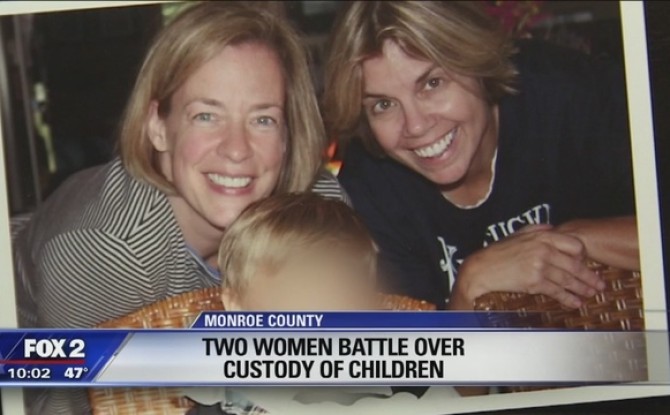
In a thorny custody case involving a lesbian couple who used artificial insemination to have a family, Zunk is in the fight of her life to protect her parental rights with two children she has raised since birth. She and her partner of 15 years broke up last year, and her ex-partner is now trying to terminate Zunk’s guardianship of their 8-year-old daughter and 6-year-old son.gay family law

But Zunk is fighting back as she faces what could best be described as a medical and legal conundrum — a difficult situation in which the law and technology are out of step. Technology allowed the two women — one a doctor; the other a teacher — to have and raise children together. But the law doesn’t recognize them both as parents.

That’s because of another legal snafu: The women broke up before same-sex marriage was legalized in the U.S., so Zunk couldn’t adopt the children because Michigan didn’t allow it. As it stands, the law only recognizes one parent: Her ex-partner — 47-year-old urologist Carin Hopps of Monroe, who delivered both children after being impregnated using in vitro fertilization. She is the biological parent of the daughter, who was conceived using a sperm donor. But she’s not biologically related to the son, who was conceived using a donor egg and a donor sperm.

Both women have been in the children’s lives since birth. Both entered into agreements to use egg donors. Both have paid for their upbringing. And the kids, who have hyphenated last names for each parent, call them both mom.

Welcome to America’s latest custody battle — a new and even more complicated fight over parental rights involving same-sex couples who used artificial reproductive technology to have babies and raise them together, but then break up with one parent then claiming “they’re mine.” Family law experts say the law isn’t exactly clear on how to handle this scenario, which has left parents like Zunk wondering: Will I lose my children?

“It’s the wild, wild West out here,” said Zunk’s attorney, Dana Nessel, who believes Michigan has outdated custody laws that are costing same-sex spouses their parental rights. “It’s not a disaster waiting to happen — there are disasters which occur on a regular basis, needlessly. Other states are literally light-years ahead of Michigan in this regard.”

Detroit Free Press, by Tressa Baldas, March 20, 2016

Click here to read the entire article.

Gay Premarital Agreements

Gay Premarital Agreements, or Prenups for gay couples, are now a viable and important option for long and short term couples who plan to marry.

Prior to the Obergefell Supreme Court marriage decision from June of 2015, gay couples could enter into “Domestic Partnership Agreements” which would approximate the benefits of gay Premarital Agreements, but lacked the certainty of enforcement in many courts around the country.


Before we discuss what a Premarital Agreement can do for a gay couple, there are limitations to these agreements which must be understood to grasp their scope and importance. First, a Premarital Agreement cannot do the following:

  1. Premarital Agreements cannot be “unconscionable” at the time of drafting or at the time they are enforced.
  2. Provisions in a premarital Agreement concerning child custody, visitation or support are not binding on a court.
  3. Your Premarital Agreement cannot create an incentive to divorce.
  4. Your Premarital Agreement cannot create an incentive toward conduct that it illegal or unfair.

While it may seem obvious, Premarital Agreements cannot anticipate, nor should they, the needs of a child in a married relationship. The best interests of a child are always the primary concern of a court and those needs may change from the time an agreement is executed to when it is subject to enforcement.  Child custody, visitation and support issues must be addressed at the time of the dissolution of the marriage.

lesbian family law

What can a Gay Premarital Agreement do? They can memorialize each spouse’s respective contributions toward the acquisition of major assets (both prior to and after the marriage), such as real property, investments and so forth, and provide a mechanism for division of assets and liabilities in the event of dissolution of the marriage.  This is of particular importance as many gay couples have been together longer than they have been allowed to marry.  Therefore, property may have been acquired by the couple in disproportionate percentages without adequate documentation of contribution.

Premarital Agreements define financial obligations to one another, both during the marriage and after dissolution. While many states, New York included, have a statutory formula which must be incorporated into a Premarital Agreement to protect both parties, the parties may deviate from that formula as long as they are not taking advantage of one another or the law.

Premarital Agreements for gay couples can define what separate property and joint property is for the purposes of distribution upon divorce or separation. For instance, in many states, marital property is defined as anything acquired by either spouse after the marriage.  The agreement will allow the parties to characterize property as they choose, not as the court chooses, and protect that property from unfair distribution.

Premarital Agreements for gay couples, as for non-gay couples, have a few prerequisites. In New York, for instance, a Premarital Agreement must be fair at the time of drafting and at the time of dissolution.  Each party must have independent legal counsel and each party must fully disclose all financial information to the other prior to the execution of the agreement in order for a court to enforce that agreement.

Understanding the limitations and benefits of a Premarital Agreement can be reassuring to a couple looking to marry, but it can also be overwhelming when trying to decide what is best for you. For a reputable and trustworthy attorney in New York who specializes in helping same sex couples have families, call Anthony M. Brown, head of Nontraditional Family and Estates division of Albert W. Chianese & Associations, at 212-953-6447 or email questions to Anthony@timeforfamilies.com.

Contact Time For Families

Contact Form
* indicates required field