
Parent Adoption – Is it Right for Your family?

The “parent adoption” process is also referred to as Second Parent or Step Parent Adoption. Here is what you need and what you need to know!

When one partner or spouse in a relationship adopts the biological child of their parent or spouse that is referred to as a “Parent Adoption.” If the parties are unmarried, it is called a Second Parent Adoption.  When the parties are married, it is called a Step Parent Adoption.  While gay couples across the country enjoy equal marriage rights, the laws for New York State adoption are still muddled, and it’s advisable for most same-sex couples to petition for a second or step parent adoption to build that legal relationship between non biological parent and child. If there is another biological parent involved, or if a couple uses a known sperm donor, their consent will be required for the adoption to move forward.  If, however, the child is the product of an anonymous sperm donation, then no consent is required.2nd parent adoption, second parent adoption, second parent adoptions, second parent adoption new york

New York State Adoption Step by Step

In a nutshell, you need to compile a lot of paperwork and have a good family lawyer, preferably one that specializes in adoptions for same-sex couples. Here is a rundown of what you will need:

  • The completed intake from your attorney. This is a general questionnaire that includes information for both parents and the child.
  • The original birth certificate for the child. A copy will not suffice. You will, however, get a new original birth certificate after the adoption which will add the name of the adoptive parent if it is not already on the original birth certificate.
  • A letter from the employer of the petitioning parent, and in some counties the biological parent, stating their position and salary. If you are not currently employed, they will need your last year’s tax returns.
  • A letter from the doctor of both parents stating that they are in general good health.
  • A letter from the child’s pediatrician stating that he or she is in general good health.
  • A completed form 1-D (a more elaborate medical assessment) by the child’s pediatrician
  • In cases of a surrogacy, you will need copies of your carrier and donor agreement.
  • In cases of artificial insemination, in vitro fertilization and surrogacy, a letter verifying insemination.
  • If married, a copy of your marriage license.
  • Previous divorce decrees if either parent has been previously married.
  • If either parent has ever been arrested or convicted of a crime, the details and disposition records for any offense must be submitted.
  • A list of every residence the petitioning parent has lived at for the past 28 years, including months and years associated with every address.
  • Financial information, including the value of your home, any owned real estate, stocks and bonds, life insurance information and any sources of income other than employment.
  • The petitioning parent must be fingerprinted for a criminal background check
  • A home study, which is generally arranged for once your lawyer has been retained.

Keep in mind that this process may vary slightly from state to state and county to county, so it’s important to find an attorney familiar with the legal details in your specific location. While the New York State parent adoption process may seem harrowing, keep in mind that your adoption attorney is there to help you, advise you and even help keep you organized every step of the way.  Read more about the process here.

Anthony M. Brown, head of Nontraditional Family and Estates division of Albert W. Chianese & Associations, has extensive experience in helping same-sex couples through the adoption process, having gone through the process himself. If you have yet to create a legal relationship with your child or children, call 212-953-6447 or email Anthony at Anthony@timeforfamilies.com.


New Jersey Court Awards Three Parent Custody to Family

In a first-impression ruling breaking new ground for New Jersey, Superior Court Judge Stephanie M. Wauters created three parent custody in her ruling in D.G. & S.H. v. K.S., 2016 WL 482622, 2015 N.J. Super. LEXIS 218 (N.J. Super. Ct., Ocean County, Aug. 24, 2015, approved for publication, Feb. 5, 2016), stating that a child’s birth parents, a gay man and a straight woman who conceived the child through assisted reproductive technology, should share joint legal custody together with the father’s same-sex spouse, who was found by the court to be a psychological parent of the child.

In the same ruling, Judge Wauters held that the mother could not relocate with the child to the west coast in order to live with her boyfriend, as the child would be adversely affected by the impact of such a move on her relationship with her fathers. However, Wauters ruled, while treating the biological father’s husband as a joint residential custodian parent, she could not declare him a legal parent of the child, since New Jersey’s law on parentage adheres to the traditional paths to that status of genetic contribution, gestation or adoption, and none of those methods of attaining parental status were presented in this case.

lgbt family law

The child, identified in the opinion as O.S.H., was born in 2009. D.G. is her biological father, and K.S. is the biological mother. S.H. is D.G.’s husband. The much-simplified story of the case is that D.G., S.H. and K.S. began in the fall of 2006 to discuss the possibility of conceiving a child together and raising the child with a tri-partite parenting arrangement. They decided to use D.G.’s sperm because he and K.S. had been long-time friends. They decided not to use a doctor’s assistance, instead following directions in a book on the “Baster Method,” by which they accomplished insemination at home, although K.S.’s first pregnancy ended in a miscarriage. After O.S.H. was born, D.G, S.H. and K.S. shared parenting responsibilities. The child mainly lived with her mother with frequent visitation with the fathers. D.G. operated a business (with flexible hours) at the Jersey Shore, and S.H. was employed as a New York City high school teacher. K.S. worked in a New Jersey restaurant owned by her parents. The men shared an apartment in Manhattan as their primary residence. The parents spent most of the summer after O.S.H. was born in a small house in Point Pleasant Beach owned by K.S., and at the end of the summer the men decided to rent their own home in Point Pleasant Beach for ease in shared parenting of the child. Parenting time fluctuated depending on the work commitments of the various parents. K.S. owned a home in Costa Rica where she would spend part of the winters with the child, and where the men occasionally visited. After Superstorm Sandy in October 2012 damaged the New Jersey coastal homes, the child spent more time with her fathers in New York City.

By Art Leonard, March 7, 2016 – Le-Gal.org

Click here to read the entire article.

Supreme Court Restores Visitation Rights to Lesbian Adoptive Mother

WASHINGTON — In a pair of unsigned opinions, the Supreme Court on Monday restored the rights of a lesbian adoptive mother who had split with her partner and reversed a murder conviction tainted by prosecutorial misconduct.


The adoption ruling reversed one by the Alabama Supreme Court, which had refused to recognize the woman’s adoptions of three children, which had been granted by a Georgia court in 2007.

The woman, identified in court papers as V.L., said she was overjoyed.

“I have been my children’s mother in every way for their whole lives,” she said in a statement. “I thought that adopting them meant that we would be able to be together always. When the Alabama court said my adoption was invalid and I wasn’t their mother, I didn’t think I could go on.”

The United States Supreme Court’s opinion, which was unsigned and had no noted dissents, said the Alabama court had violated the Constitution’s “full faith and credit” clause. “A state may not disregard the judgment of a sister state because it disagrees with the reasoning underlying the judgment or deems it to be wrong on the merits,” the opinion said.

Supreme Court

The two women in the case, V.L. v. E.L., No. 15-648, were in a committed relationship that started in 1995 and lasted about 17 years. They shared a last name.

One of them, identified in court papers as E.L., gave birth to a child in 2002 and to twins in 2004, both times by insemination from an anonymous donor. They raised the children together in Alabama until they broke up in 2011, and the adoptive mother, V.L., continued to see the children for a time afterward.

When a dispute about the visits arose, V.L. turned to an Alabama court, which granted her visitation rights based on the Georgia adoption judgment. The Alabama Supreme Court reversed that, saying in an unsigned opinion that the Georgia judgment was not entitled to the “full faith and credit” ordinarily required by the Constitution “to the public acts, records and judicial proceedings of every other state.”

The Alabama Supreme Court reasoned that the Georgia court had misunderstood Georgia law in allowing the adoption, saying that “Georgia law makes no provision for a nonspouse to adopt a child without first terminating the parental rights of the current parents.”

by Adam Liptak – New York Times, March 7, 2016

Click here to read the entire article.


Lesbian confirmed as next Puerto Rico chief justice

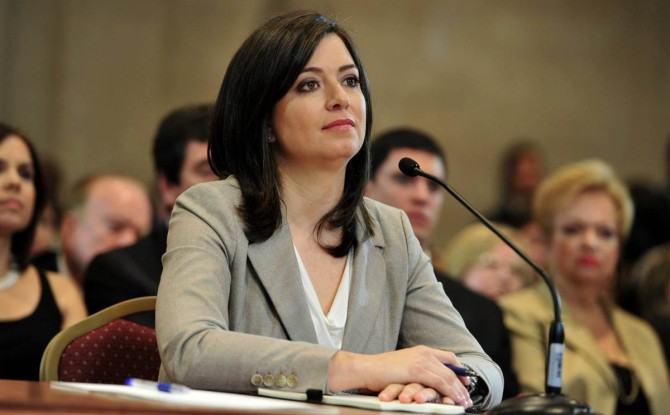
The Puerto Rico Senate on Monday confirmed a lesbian woman to become the next chief justice of the U.S. commonwealth’s highest court. Senators approved lesbian Maite Oronoz Rodríguez’s nomination by a 14-12 vote margin.

Rodríguez has been a member of the Puerto Rico Supreme Court since 2014. She will become the first openly lesbian chief justice in the U.S. “The confirmation of Maite Oronoz Rodríguez as the first openly LGBT chief justice in Puerto Rico and the United States makes history, breaks barriers, and marks a momentous step towards achieving a judiciary that reflects full and rich diversity of our country,” Omar Gonzalez-Pagan of Lambda Legal told the Washington Blade in a statement. “A diverse judiciary serves not only to improve the quality of justice, it boosts public confidence in the courts.” Gay Law

Washingtonblade.com, February 24, 2016

Click here to read the entire article.

Congo to Let 150 Adopted Children Leave Country After Two-Year Wait

KINSHASA — Democratic Republic of Congo will allow some 150 children adopted by foreign parents, mostly Americans, to leave the country after spending more than two years in legal limbo, the interior ministry said on Monday.

In 2013, Congo imposed a moratorium on exit visas to children adopted by foreign parents, citing fears that the children could be abused or trafficked. The government has also voiced concerns about adoptions by gay couples.

Congo became a favored international adoption destination in recent years because it has more than 4 million orphaned children, according to the U.N. children’s agency UNICEF, as well as lax regulation.

The central African nation is mineral-rich but deeply impoverished. It has suffered through two civil wars and armed groups continue to plague its eastern region.

Between 2010 and 2013, U.S. adoptions from Congo rose 645 percent, the U.S. Department of State said.   international

Interior ministry spokesman Claude Pero Luwara said an inter-ministerial commission had approved the exit visas. In November, the commission signed off on exit visas for about 70 children adopted by European, Canadian and American families.

Congo’s government has come under intense pressure from those countries’ governments to lift the suspension.

“The dossiers that were released … it was mostly American children,” Luwara said, adding that the commission will consider about 900 more foreign adoption cases and plans to complete its work next month.

Parliament is expected to take up a bill this year to lift the moratorium and regulate foreign adoptions.

New York Times, February 22, 2016 by Reuters

Click here to read the entire article.

2016 Impact Award Honors Anthony M. Brown

Gay City News announced this week that they would be honoring a select group New Yorkers to receive their first ever Impact Award for 2016.  Among those honored is Anthony M. Brown, founder of Time For Families.


Anthony, recipient of the 2016 Impact Award, currently is an associate with the law firm of Albert W. Chianese & Associates heading their Family and Estates Law division serving unmarried individuals, couples and families in Manhattan and on Long Island.  Anthony is the Executive Director of The Wedding Party and has been a Board member since its inception in 1999.   The Wedding Party is a non-profit educational organization that educates the public about marriage and its importance to all citizens through outreach programs and strategic media placement.  Anthony is the Board Chairman of Men Having Babies, a non-profit organization created to assist gay men looking to create families through surrogacy with educational and financial assistance. Anthony is also a legal consultant for Family By Design, a co-parenting information and matching website.

anthony brown

Anthony & Family

Anthony worked as a legal intern for Lambda Legal in the summer of 2002. While there he helped to prepare briefing for the landmark case of Lawrence v. Texas and his research was quoted specifically in Justice Sandra Day O’Connor’s concurring opinion. Anthony also worked as a law guardian at The Children’s Law Center, representing the legal needs of children in Brooklyn Family Court.   Anthony graduated from Brooklyn Law School, where he served as research assistant to Nan Hunter, the founder of The Gay and Lesbian Project at the ACLU. Anthony is a member of The Family Law Institute of the National Gay and Lesbian Bar Association, the New York State Bar Association, the New York County Lawyers Association and the committee for assisted reproduction of the American Bar Association.  Anthony and his husband were the subjects of CNN’s, “In America, Gary and Tony Have a Baby,” a 2010 documentary about their journey of having a child through surrogacy.

“I am grateful to be honored with this award, especially considering the other honorees.  Thanks to Gay City news and The Point Foundation for the hard work they do for our community everyday,” said Anthony.


Mitch McConnell’s Stance in Scalia Confirmation Fight Could Help and Hurt G.O.P.

WASHINGTON — Senator Mitch McConnell’s strategy to maintain the Republican majority has been clear: trying to prove that his party can govern. But by saying he will block a Supreme Court nominee for Scalia who has not even been named, Mr. McConnell is headed toward partisan warfare instead.

The death of Justice Antonin Scalia has energized a right flank that has been long suspicious of Mr. McConnell and forced him into a fight that is likely to derail his smooth-functioning Senate. The tactic could alienate moderate voters and imperil incumbent Republicans in swing states, but in the supercharged partisanship of a Supreme Court fight, he probably had no choice. By framing his decision as deferring to voters in the next election, people close to him say he has minimized the political risk.

“It was necessary,” said Josh Holmes, Mr. McConnell’s former chief of staff, who now works as a Republican consultant. “The suggestion that the American people should have a say here isn’t exactly risky ground to be treading.

scalia

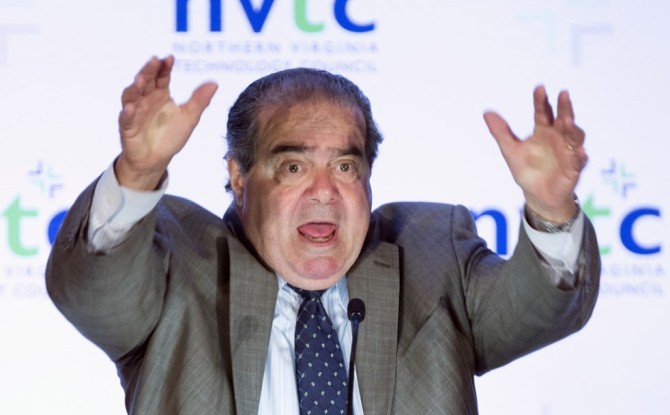
U.S. Supreme Court Justice Antonin Scalia speaks at an event sponsored by the Federalist Society at the New York Athletic Club in New York October 13, 2014. REUTERS/Darren Ornitz . SAP is the sponsor of this content. It was independently created by Reuters’ editorial staff and funded in part by SAP, which otherwise has no role in this coverage.

“As for the politics,” he continued, “if anyone thinks the center of the electorate is clamoring for Obama to name another left-wing jurist they’re nuts. The liberal left will be as loud as they ever have been, but the reality is that the consternation will be confined to the activist left.”

Mr. McConnell’s other calculation is that if Democrats maintain the White House and take back the Senate, he will at least have denied President Obama a closing victory on the court. If Republicans take over, any heat he will take in the next year for the highly unusual move of blocking a nominee will have been worth it.

He has spent his leadership of the slender Republican majority balancing the demands of conservatives, who view Mr. Obama’s presidency as an eight-year constitutional crisis, and his obligations to vulnerable Republicans up for re-election this year. He has chosen the conservatives.

But events in the coming months could confound that decision. Mr. Obama’s nominee will put a face on what Democrats will call a clear case of obstruction, giving them someone to rally around. And a divided court must render decisions on abortion-clinic access, affirmative action at universities and Mr. Obama’s executive actions on immigration. Every deadlocked 4-to-4 decision will spotlight the Senate’s inaction, amplifying Democrats’ cries of irresponsibility but also highlighting the stakes for conservatives set against enabling a left-leaning court majority.

New York times, By Jennifer Steinhauer – February 14, 2016

Click here to read the entire article.

Egg Donor Prices Cap Lawsuit Settled By Fertility Industry

The nation’s leading professional association of fertility specialists has reached a settlement with a group of women who claimed the medical group’s guidelines on human egg donor prices violated federal antitrust laws.

Two women who provided eggs to couples struggling with infertility sued the American Society for Reproductive Medicine in federal court in San Francisco in 2011, claiming that the group artificially suppressed the amount they can get for their eggs. Two other women later joined the case.

The medical group agreed to delete provisions in its guidelines concerning egg donor compensation, according to the proposed settlement filed in court last week. It also agreed to pay plaintiffs’ lawyers $1.5 million in fees and costs. The four named plaintiffs would also receive $5,000 each. The settlement needs court approval.

As WSJ’s Ashby Jones earlier reported, the lawsuit challenged egg fee guidelinesestablished by the organization more than a decade ago. The group, which represents fertility specialists, suggested that payments for donated human eggs should not go above $5,000 without justification, and said that payments greater than $10,000 went “beyond what is appropriate.”

The price guidelines aren’t mandates. But more than 90% of the nation’s clinics belong to the society, so they’re widely followed.

anonymous egg donor

Industry groups behind the price guidance say caps are needed to prevent coercion and exploitation in the egg-donation process. But the plaintiffs claimed the guidance amount to an illegal conspiracy to set prices.

Under the terms of the settlement, which still needs final court approval, ASRM agreed to delete some language from the guidelines. According to the proposed settlement:

ASRM will amend the challenged report concerning donor compensation by removing numbered paragraph 3 (which reads “[t]otal payments to donors in excess of $5,000 require justification and sums above $10,000 are not appropriate.”) and by removing the following language from page 4: “Although there is no consensus on the precise payment that oocyte donors should receive, at this time sums of $5,000 or more require justification and sums above $10,000 are not appropriate” and “A recent survey indicates that these sums are in line with the practice of most SART member clinics.”

by Jacob Gershman, Wall Street Journal, February 3, 2016

Click here to read the entire article.

Indian Supreme Court to Reconsider Criminalization of Homosexuality

In 2013, the Indian Supreme Court shocked the nation and the world by re-criminalizing homosexuality.

Decades of progress, which had culminated in a 2009 ruling by a lower court to legalize same-sex activities, were swept away by the odd decision to reinstate a ban first imposed by British Colonial authorities in 1860. Tomorrow holds hope for change, however, as India’s supreme judicial body is set to decide whether or not to revisit the issue. Activists are hoping that the Indian Supreme Court, which is known for its progressive approach to civil rights and the rights of minority groups, will rectify what many have interpreted as a gross affront to human dignity in the world’s largest democracy.

International

Sadly, the legal challenge faced by LGBT people is not unique to India. While Britain has progressed immensely on LGBT issues in recent years—marriage equality is now legal in England, Scotland, Wales, and the Republic of Ireland—its legacy around the globe is far less positive. Of the 76 countries that still criminalize homosexuality, more than half of them do so because of laws imposed by the British Empire in the 19th century. Activists have repeatedly called upon Britain to pressure Commonwealth nations (former colonies) to overturn the archaic laws. At the opening ceremony for the 2014 Commonwealth Games, held in Glasgow just months after Scotland voted to legalize same-sex marriage, organizers included a same-sex kiss—something that was broadcast live to more than 1 billion people across the Commonwealth.

Click here to read the entire article.
Out.com by James McDonald, February 2, 2016

Ban On Same Sex Marriages Still In Effect

Ban On Same Sex Marriages Still In Effect Alabama Chief Justice Says

Alabama Chief Justice Roy Moore’s latest move stating ban on same sex marriages is still effective is “sad & pathetic,” Montgomery County Probate Judge Steven Reed tweeted on Wednesday.

Alabama Chief Justice Roy Moore, in an administrative order issued on Wednesday morning, announced that a ban on granting same-sex couples’ marriages remains in effect in Alabama until a specific court order is issued to end the ban.

Specifically, Moore wrote that a prior order of the Alabama Supreme Court that barred probate judges from issuing marriage licenses to same-sex couples remains in effect.

Moore’s order, however, makes no mention of a contradictory federal court injunction issued this past year.

The U.S. Supreme Court decision from this past June in Obergefell v. Hodges, Moore wrote, only specifically struck down the marriage bans in Kentucky, Michigan, Ohio, and Tennessee. While it is precedent that would be applicable to other states’ bans, he wrote, it is not a specific order that would end Alabama’s ban.

“[A]n order issued by a court with jurisdiction over the subject matter and person must be obeyed by the parties until it is reversed by orderly and proper proceedings,” he explained.

Moore concluded: “Until further decision by the Alabama Supreme Court, the existing orders of the Alabama Supreme Court that Alabama probate judges have a ministerial duty not to issue any marriage license contrary to the Alabama Sanctity of Marriage Amendment or the Alabama Marriage Protection Act remain in full force and effect.”

Moore stated that he issued the order as the head of the Unified Judicial System of Alabama and under his authority “to correct or alleviate any condition or situation adversely affecting the administration of justice within the state” or take other action “necessary for the orderly administration of justice within the state.”

by Chris Geidner – Buzzfeed.com, January 6, 2016