Second parent adoption key to creating security

Growing evidence around secure, same-sex families shows that their children are happy and healthy.  Securing those families through second parent adoption or step parent adoption is key to creating this security.

Second parent adoption is needed and recommended as one tenet of the debate surrounding same-sex marriage has focused on whether same-sex parents provide poorer conditions for raising children compared with different-sex parents. Political and public dialogue ensures that this notion remains pervasive and persuasive, even though the Supreme Court decision this summer ensured marriage equality in the U.S.

And it isn’t just talk: Laws exist that implicitly reflect the rhetoric that somehow same-sex parents are different.

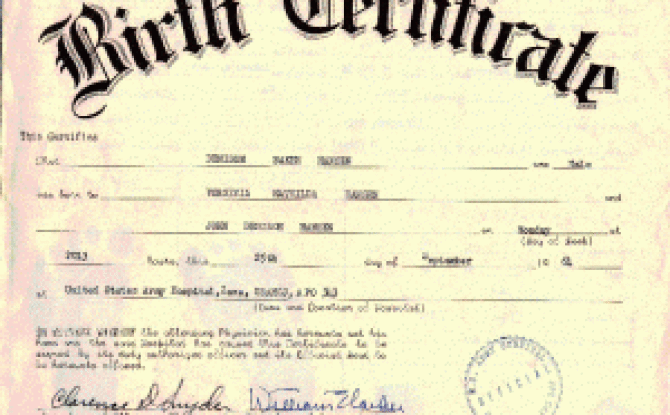
For example, even though same-sex couples make decisions together to have a child, and even if both parents appear on the birth certificate, the nonbiological parent may have limited legal rights over the child.

In Texas, two parents of the same sex are even prohibited from being listed on supplemental birth certificates, only allowing for parents where “one of whom must be a female, named as the mother, and the other of whom must be a male, named as the father.”

Laws and Policies That Undermine Same-Sex Parenting Are Not Based on Science

Although all states offer second parent adoption to same-sex parents in legally recognized unions, only 15 states and the District of Columbia offer second-parent adoption to same-sex parents in cohabiting relationships. This means that in cases where the parents are not married, the nonbiological partner may be denied access to the children.

An underlying assumption about parents in same-sex couples seems to be that same-sex parents are less invested or are unable to follow through on the types of parenting that matter for children.

This type of argument is often rooted in the idea that biological parents who are partnered with each other have an advantage over a parent partnered with someone other than their child’s biological parent, with nonbiological parents less likely to invest or commit to children who are not their “own.”

This is wrong and must stop.

Laws and policies that undermine the rights of same-sex parents are more based on politics than on actual science of how they parent. Same-sex parents who conceive children via assisted reproductive technology, for example, should have the same parental rights as heterosexual parents who conceive via assisted reproductive technology and do not have to jump through the same legal hoop.

Very little research has directly tested whether there are different types of parenting investments by same-sex couples. However, in one study that we conducted, we found no difference in the amount of time parents spend with children between same-sex parents and different-sex mothers. But there is a catch.

Mothers in same-sex relationships, fathers in same-sex relationships, and mothers in heterosexual relationships spent about the same amount of time in child-focused activities, about 100 minutes a day.

Men in heterosexual relationships, however, spent significantly less child-focused time than all three other groups of parents — about 50 minutes per day. That means the only difference that we found tended to favor same-sex couples (and heterosexual mothers).

Importantly, these differences persisted when we controlled for factors that have well-known influences on time spent with children, including parent’s education, the number of children, the age of the children, and parent’s time spent working or commuting.

Here’s the catch to this “no difference” conclusion. When combining estimates across mothers and fathers to look at time investments at the family level, not just by individual parents, children raised in same-sex families would receive an average of 3.5 hours of child-focused time a day, compared with 2.5 hours for children in heterosexual families.

Click here to read the entire article.


News.UTexas.edu, by Kate Prickett & Alexa Martin-Storey, November 19, 2015

Gay Parents, Is This Country Still Not Ready?

This Country Is Apparently Still Not Ready for Gay Parents

In a couple of weeks, our nation will turn to celebrate the 20th anniversary of National Adoption Month. It’s a time of year marked with an annual proclamation by our president, special events, family gatherings, and mass adoption finalizations. Television and radio programs will burst with stories both heartwarming and horrifying in an effort to draw attention to the glaring need to find homes for the 400,000 children that linger, on average, for nearly two years in the foster care system.

As someone who’s lectured at the university level about this system, of which I am a product, I have to admit I’ve never understood why so many of my foster care brothers and sisters continue to languish in the foster care system. In truth, they should have found homes a long time ago. At this very minute, there are an estimated 2 million potential gay parents, many of whom would love to do so through adoption. Research also shows that children growing up with gay parents fare as well as children raised by heterosexual parents. That means that in the LGBT population alone there may be more than enough ready and capable parents to provide families for our nation’s foster children.

And yet 11 states continue to bar same-sex couples and LGBT individuals from adopting. That means we have enough children needing homes to fill a city the size of Cleveland or Minneapolis. We have a surplus of parents who would like to adopt them. But we’re still seeking ways to prevent them from finding each other. That makes no sense.

It makes even less sense when you consider that foster care programs cost American taxpayers $22 billion each year. That’s about $68 out of the pocket of every one of the estimated 320 million people in the United States every year.

This is but one of the many ways that nation’s love affair with homophobia is devastating our nation’s foster children. And it gets worse when we consider the effects of homophobia on LGBT children in foster care. Consider this:

• LGBT children are over represented in the foster care system. In Washington alone, an estimated 19 percent of foster children identify as LGBT — a figure that is nearly double that of the general LGBT population.
• Once in foster care, LGBT children often receive worse treatment than their non-LGBT peers. A recent study in Los Angeles County found that LGBT children experience more foster care placements and are three times more likely than non-LGBT foster children to have been hospitalized for emotional reasons.
• Many foster care caseworkers and LGBT children report that foster care is not a safe place to question your orientation, and many foster homes and families are not thoroughly assessed to see if they can support LGBT children.
•In some areas, an estimated 56 percent of LGBT children end up running away from foster care when they encounter violence and rejection. Some have even been forced to endure so-called conversion “therapy” and exorcisms.

Click here to read the entire article.


by Dashanne Stokes, TheAdvocate.com, October 20, 2015

Gay Parents Adopting Face Issues

Gay Parents Adopting Face Issues With Birth Certificates In Some States

Gay parents adopting in a handful of states are seeing issues where the state is refusing to name both parents from a same-sex couple on a birth certificate, even though its among the benefits named in the Supreme Court decision legalizing gay marriage.

DAVID GREENE, HOST: In the state of Kentucky, Kim Davis, the Rowan County clerk, made big news when she refused to issue same-sex marriage licenses. But this is not the only controversy since the Supreme Court legalized same-sex marriage earlier this year, as NPR’s Jennifer Ludden reports, a handful of states are refusing to name both parents from a same-sex couple on birth certificates.

JENNIFER LUDDEN, BYLINE: Miami attorney Elizabeth Schwartz brought the case that legalized same-sex marriage in Florida in January. And she’s still getting high-fives from this summer’s Supreme Court decision.

ELIZABETH SCHWARTZ: Congratulations. We’re done. You know, crossed the finish line. And that it’s wah-wah (ph) not exactly.

LUDDEN: Last month, one of Schwartz’s plaintiffs called back. Cathy Pareto and her longtime partner were the first same-sex couple to legally marry in Florida, but Pareto says they got a rude awakening when her now-wife, Karla, delivered twins last month. A hospital staffer came to take information for the birth certificate.

CATHY PARETO: What’s the name of your child? Who’s the father? Oh, gee, there’s no father. Oh, but I want my wife listed. Oh, well, let me get back to you on that.

LUDDEN: Turns out the state’s vital statistics office said the hospital could not put Pareto’s name on the certificate. It pointed to the Florida statute that still said the state did not recognize same-sex marriage.

PARETO: At this point, I am nothing legally for my children. My twins and I are not the legally connected in any way.

LUDDEN: Pareto worries she’d lose custody if something happened to her wife. She also can’t sign for the twins at a doctor’s office, day care or to get a passport. So her attorney, Schwartz, has filed another suit on behalf of Pareto and two other couples.

SCHWARTZ: It’s a terrible waste of resources, of our resources and of the state’s resources. I mean, they ought to follow the law.

LUDDEN: Florida’s health department says it can’t comment on pending litigation. In court documents, it doesn’t actually make a case for not issuing same-sex birth certificates. The state simply says it has asked a judge to clarify whether it can. In recent months, courts in Utah, Texas and Ohio have ruled in those states can and must. The U.S. Supreme Court decision legalizing same-sex marriage specifically mentions birth certificates as a benefit to which gay and lesbian couples are now entitled. Lawsuits in another handful of states are pending. But even they won’t be the last word for same-sex couples with children.

Click here to read the entire interview.


NPR.org by Jennifer Ludden, September 21, 2014

Step Parent Adoption; Married still need one?

Step Parent Adoption; Marriage means I don’t need one?

Step Parent adoption is still a must to secure your family, even after marriage equality.  Marriage equality was a long fought battle and a much celebrated victory for gay and lesbian couples across the country. Now that it is the law of the land, many people mistakenly believe that their marriage alone will secure their family. Unfortunately family law has not caught up to the realities of how we create our modern families.

For both gay and lesbian couples, securing the legal rights of a non-biological parent is crucial to create the kind of emotional, and legal, security that most other families take for granted. The legality of both parents relationship to their child is often assumed. Parents are parents, regardless of the biological connection to your child. In New York State, the law doesn’t agree.

Married lesbian couples in many states, New York included, can list a non-biological mother name as a parent on a child’s birth certificate if they are married at the time of the birth of the child and they use an anonymous sperm donor. While a name on a birth certificate is an important goal, it in itself does not create a legal relationship, only through step parent adoption can they be acheived.

Step Parent adoption is still a must to secure your family, even after marriage equality.

In New York County, Surrogate Judge Kristin Booth Glen, in a case entitled In the Matter of Sebastian, discusses the issue of establishing parental rights for a non-biological parent specifically.  The case involves married lesbian couple who used an anonymous sperm donor to have a child. Glen concludes, when discussing the non-biological mother’s relationship with the child that, “the only remedy available here that would accord the parties full and unassailable protection is a second-parent adoption pursuant to New York Domestic Relations Law (“DRL”) § 111 et seq.”  Glen further states, “that a judicial order of adoption in one state must be afforded full faith and credit in every state, and that there can be no “public Policy” exception to that mandatory recognition…”.

While it is true that many states have what is called a “martial presumption of parentage,” the truth about this is that it is applied differently in different states.  For instance, in New York State, where I practice, there is specific case law that holds that the marital presumption of parentage does not apply to same-sex couples.  That case is called “Matter of Paczkowski v. Paczkowski.”  In that case, the appellate division of the Second Department of New York, the state’s intermediate appellate court, held that the “presumption of legitimacy… is one of a biological relationship, not a legal status.”

In essence, the court says that a marriage does not create a legal right between a non-biological parent and a child.  While it may be an indication of intent to be a parent, as would a non-biological parent’s name on a birth certificate, the only way to actually create the legal relationship that guarantees the security that all same-sex families need, is through an adoption order, and in some states, a parentage order.  Unfortunately, New York currently does not have the capacity to issue a parentage order but there is legislation in committee in Albany that may change that. 

Surrogate Options & Known Donors Complicate the Legalities of Chosen Families

One further compounding variable is that many lesbian couples are now choosing known sperm donors. While the desire for a child to know their biological heritage and have a father figure makes sense to many couples, adding another potential parent into the mix can create problems if an adoption does not take place to terminate the donor’s rights to the child and create the intended, non-biological parent’s rights to their child.

For male couples who want to have biologically related children, surrogacy is the only real option. Surrogacy is an emotionally, and financially, exhausting process.  It is a true leap of faith.  Couples considering surrogacy must juggle a myriad of concerns, the least of which being the cost.  With gestational surrogacy tabs running as high as $180,000.00, budgeting is a must.  Lawyer’s fees are often lumped together in surrogacy accounting statements, and some agencies do not include the cost of a second or step parent adoption in order to keep the numbers low.  Often, the cost of a pre-birth order is less than a second parent adoption.

step parents adoption, step parent adoption, adoption step parent, adoption for step parents

In some cases, depending on where your surrogate mother gives birth, her name may be removed from the child’s original birth certificate by a proceeding called a pre-birth order.  Some states do not provide for pre-birth orders.  Those that do may or may not replace the surrogate’s name with that of the non-biological intended parent.  California, for instance, does offer the ability to include the non-biological parent’s name on the child’s original birth certificate, and that very significant step is often mistakenly viewed as a replacement for a second parent adoption, which is the only definitive way to establish parental rights between a non-biological parent and a child born through surrogacy.

In order to understand why a second parent adoption is vital if you have a pre or post-birth (or parentage) order, you must understand what that order is, and what protections it provides.  Pre and post-birth orders are court orders that are obtained by filing a petition in the appropriate court in the state in which the child will be born.  Often, these petitions are not filed in the county where the carrier lives, but in a county which has a judge who understands the importance of these orders and grants them upon the motion of an attorney representing the intended parents.  This in itself may create a problem.

Some states may not recognize the relationship created by the pre-birth order because of the lack of a full judicial process attendant to a parentage order.  For an issue to be precluded from challenge, for instance the issue of a non-biological parent’s relationship to a child born through surrogacy, the court looks at the process by which that issue has been established.  The reason why adoption orders from one state are valid in every state, regardless of the gender of the parents, is because the judicial process of the adoption.  The state, for all intents and purposes, becomes and “adversary” to the adoptive parents in the adoption process.  The state performs background checks, it orders that fingerprints be taken, mandates that a home study is performed by a licensed social worker to ensure that the child’s prospective residence is safe and clean and essentially verifies all adoption requirements submitted by the petitioning parent, or parents.  The adoption order is the product of a fully litigated judicial process.  Because this rigorous process is not part of a parentage order proceeding, states which do not offer such orders may not recognize a relationship created in one.

Furthermore, some courts, through a parentage order, will add the name of the non-biological parent to the original birth certificate if that person is married to the biological parent.  For same-sex couples, this can present an issue, particularly if the non-biological parent’s relationship to the child is being challenged in a state that resists same-sex marriage.  These situations usually arise upon the dissolution of a relationship and during the custody/visitation/support aspect of that process.

Protecting our families may seem like navigating a ship through a sea of legal, financial and emotional waters.  But what is more important than the security of knowing that every child has a legal relationship with their parents that cannot be challenged for whatever reason. Every parent deserves that security as well.

by Anthony M. Brown – September 16, 2015

Anthony M. Brown, Esq. currently is an associate with the law firm of Albert W. Chianese & Associates heading their Nontraditional Family and Estates Law division serving unmarried individuals, couples and families in Manhattan and on Long Island.  Anthony is the Executive Director of The Wedding Party and has been a Board member since its inception in 1999.   The Wedding Party is a non-profit educational organization that educates the public about marriage and its importance to all citizens through outreach programs and strategic media placement. Anthony is the founder of TimeForFamilies.com, a web environment dedicated to assisting gay and lesbian couples create their own families. Anthony is the Board Chairman of Men Having Babies, a non-profit organization created to assist gay men looking create families through surrogate options and is a legal consultant for Family By Design, a co-parenting information and matching website.



LGBT Families: Parenting & Second-Parent Adoption

LGBT Families: Parenting and Flaming Hoops of Second-Parent Adoption

LGBT Families and their personal stories are both moving and informative when planning your own family as a gay couple. At 30 weeks pregnant, my favorite time of each day is the moment when I lie down in bed and watch my stomach curiously shift as my daughter turns and rolls beneath the surface. “Look! Look!” I tell my wife when I can feel a movement is imminent, and she will place her hand on my belly, eager to make some early connection with the little creature that will be the center of our lives in ten short weeks. Each day we talk about how excited we are to meet our daughter — to see her, to feel her, to learn about her personality and if you’re my wife you will talk elatedly about teaching her how to throw a football.

In the midst of this excitement about our new family, we are beginning another new process — a second-parent adoption, so that my wife can also be recognized as our daughter’s legal parent. Although my wife’s name will be listed on our daughter’s birth certificate, and although we are legally married in New York State, and although we carefully chose our sperm donor together and although she will change a thousand poopie diapers and fall asleep reading Dr. Seuss books to our daughter one day — she will not have legal status as a parent to our child until we complete an extensive and expensive adoption process. Straight couples sometimes also choose to do second-parent adoptions, but this typically only occurs among unmarried straight couples when one is not the biological parent of the child. However, for the thousands of married same-sex couples like ourselves who have chosen to start a family and have children together, marriage or parental names on the birth certificate are not enough to secure our families.

LGBT Families of all kinds have second parent adoptions

We began researching second-parent adoptions for same-sex couples once we found out I was pregnant. We weren’t entirely convinced it was necessary; we live in and mostly travel to states with marriage equality laws in place and it seemed far-fetched that we would find ourselves in an unfriendly hospital where my wife would be barred from visiting me or making decisions on behalf of our daughter. And yet, all of our LGBT parent friends have gone through the adoption process, and even our LGBT friends without kids — including lawyers, nurses, activists and policymakers have encouraged us to do it. Only my moms, two lesbians who raised me and my siblings in New England years before any state recognized gay marriage, questioned the necessity of a second-parent adoption. “Listen honey, if you are ever in an emergency — you will find a way. Nothing will keep you guys from your child,” was my mother’s trusting advice. Yet LGBT families have faced these types of challenges for years and will continue to face them as long as there aren’t federal protections in place.

Despite last year’s momentous Supreme Court decision finding the Defense of Marriage Act’s (DOMA) ban on same-sex marriage unconstitutional, LGBT families still face what is often referred to as a “patchwork” of laws and regulations across the United States, including those that can prohibit a “non-recognized” same-sex parents from covering their child on their health insurance plan, visiting a sick child in a hospital, or from consenting to necessary medical care. In the worst of cases, a child could be removed from the family home if the legal parent dies and there’s no second-parent adoption in place.

In states that do allow LGBT parents to petition for second-parent adoptions (and at the time of this writing only 14 states and D.C. allow this), the adoption process can vary regionally, and even from judge to judge. This type of arbitrary consideration for a child’s “best interest” is likely to happen more with the passage of any federal legislation such as the recently introduced bill which would allow adoption and foster care service providers to “refuse to work with families with whom they have personal, religious, or moral objections.” As the attorney who is working on our adoption told us, “Less than half the states currently recognize same-sex marriages. If you were to leave NY for any purpose, there could be issues. Although you and your wife are in concert on this, if you were in another state and became disabled or died, she might have to deal with interfering relatives or an unfriendly Child Protective Services, medical or court system. A birth certificate is not proof of parentage and not entitled to full faith and credit in all states. A court order is your best protection.”

Click here to read the entire article.


by Allison Auldridge, huffingtonpost.com, August 15, 2015

Federal judge orders Utah to put same-sex couple on their child’s birth certificate

July 15, 2015 – Fox13Now.com

SALT LAKE CITY — A federal judge has ordered the Utah Department of Health to put a same-sex couple on their child’s birth certificate, ruling that the state is discriminating against them.

U.S. District Court Judge Dee Benson said that in light of the U.S. Supreme Court’s ruling on same-sex marriage, Utah would need to change its laws to reflect that new reality.

“I’m just still trying to see if there’s any way you can, now that same sex marriage is legal, tell me Utah has a rational basis in discriminating against this woman,” he told lawyers for the Utah Attorney General’s Office.

Kami and Angie Roe sued the state after health officials refused to list Angie as a parent of their child. The couple married after Utah’s ban on same-sex marriage was overturned. Kami is the birth mother of their child, Lucy. Angie Roe said she took the exact same steps that a man would if his wife used assisted reproductive services (such as a sperm donor), including signing the same paperwork. But the Utah Department of Health refused to issue a birth certificate with Kami and Angie Roe’s names on it.

Click here to read the entire article.

Virgin Islands Supreme Court Rules in Favor of Second-Parent Adoptions

May 23rd, 2015 by Art Leonard

On May 20 the Supreme Court of the Virgin Islands ruled that the Superior Court erred when it dismissed a second-parent adoption petition on the ground that the Virgin Islands did not recognize the Canadian same-sex marriage of the petitioners and granting the co-parent’s petition would require terminating the parental rights of the birth mother.  In re L.O.F. & N.M., 2015 V.I. Supreme LEXIS 13.  Eschewing a literal reading of the archaic adoption statutes, the court held that the policy of deciding adoption petitions in the best interest of children provides a basis to “waive” the termination of parental rights when a same-sex co-parent (or stepparent, for that matter) petitions to adopt a child.

The biological mother of L.O.F. and N.M. and her same-sex partner were married in Canada in 2007, and have raised their children together in St. Croix, V.I.  The children were conceived through anonymous sperm donations, the donors having necessarily waived any parental rights.  The women filed an adoption and name-change petition in the Superior Court in December 2012, asking the court to grant an adoption in the partner’s favor without affecting the parental rights of the birth mother so that “all parental rights and obligations [are] shared equally.”  The petition described this arrangement as a “second-parent adoption,” a procedure approved in many court decisions in the United States.  However, Superior Court Judge Denise A. Hinds Roach denied the petition, holding that because the petitioners “filed together as spouses” under “a limited ‘spousal’ or ‘stepparent’ provision in the V.I. adoption statutes and the V.I Code limits marriage to different-sex couples, the court could not grant the adoption.  After the superior court denied a motion for reconsideration, the petitioners appealed to the Supreme Court.

Writing for the unanimous court, Justice Maria M. Cabret found that Judge Hinds Roach had misconstrued the V.I. adoption provisions.  Indeed, the court found that a literal interpretation of those provisions would disallow ordinary stepparent adoptions.  This is because the statute authorizes adoptions only by single people or married couples, and apparently requires terminating the parental rights of natural parents upon the adoption of their children.  Reviewing the history of the V.I. statute, first enacted in 1921 and later incorporated without change in the V.I. Code in 1957, Justice Cabret pointed out that divorce and remarriage were not common phenomena in the Virgin Islands in those days so provision for stepparent adoptions was not made.  However, the court went on to say that a literal reading of the statutory language should be rejected if it would produce absurd results or undermine the statutory objective, which is to “consider the best interests of the child when making decisions that concern the child.”

Click here to read the entire article.

French Court OKs Adoption by Lesbian Partners

Associated Press – April 16, 2015

PARIS — A French court has authorized four lesbian women to adopt children born to their wives abroad through artificial insemination.

While France has legalized gay marriage and adoption, only heterosexual couples are allowed to have medically assisted fertilization. Supporters of gay rights praised Thursday’s ruling, which allows these children to have two legal parents.

The Versailles appeals court overturned a ruling delivered by a lower court a year ago, according to the lawyer for one of the four couples.

In April 2014, a lower court in Versailles had said the birth mother in that case had committed fraud by having artificial insemination in Belgium. It was then the first court ruling against adoption by a lesbian couple since the gay marriage law had been enacted in May 2013. Several other ones had followed since then.

France’s highest court later ruled that seeking fertilization abroad is “not an obstacle” to allowing lesbian women to adopt the children of their partners, even if this way of having babies is forbidden to lesbian couples in France.

Click here to read the entire article.

Alabama Judge Refuses To Approve Adoption Of Lesbian Couple Who Fought Gay Marriage Ban

ontopmag.com, February 26, 2015

Less than two weeks after a lesbian couple won the right to have their marriage recognized in Alabama, Mobile County’s probate judge has refused to process the couple’s adoption petition.

Cari Searcy and Kimberly McKeand, together over 15 years, exchanged vows in California in 2008.

In 2005, McKeand gave birth to the couple’s son, K.S.

In 2012, Mobile County Probate Judge Don Davis denied Searcy’s request to adopt K.S., citing the state’s law that only married couples may adopt their partner’s children. Davis determined that Searcy was not a “spouse” of McKeand because Alabama does not recognize their out-of-state marriage.

The women challenged the state’s marriage ban and won. U.S. District Judge Callie “Ginny” Granade declared unconstitutional an Alabama law and constitutional amendment limiting marriage to heterosexual couples. Her ruling took effect on Monday, February 9 after the Supreme Court refused to block its implementation.

Davis refused to comply with the ruling until Granade ordered him to begin issuing marriage licenses to gay couples.

According to AL.com, Davis has indicated that he will not process the women’s adoption petition until the Supreme Court rules in a case challenging marriage bans in four states.

A lawyer for the couple called Davis’ decision “disappointing.”

Click here to read the entire article.

Lesbian couple wins right to have names on children’s birth certificates

By LAURA KEBEDE Richmond Times-Dispatch Richmond.com – January 25, 2015

When Maria Hayman delivered her twins, Merida and Finn, on June 13, 2013, at St. Francis Medical Center, there was no doubt in her mind as to who the other parent was.

Her wife, Joani Hayman, had contributed eggs that were placed in Maria after being fertilized with sperm from a donor who had revoked his parental rights.

But Joani’s name was not allowed on the children’s birth certificates because egg donors do not have parental rights, according to the Code of Virginia.

But after an 18-month game of wait-and-see as the issue of gay marriage was being settled in Virginia, Richmond Judge Designate T.J. Markow last month ordered the Office of Vital Records in the Virginia Department of Health to amend the birth certificates to show Maria and Joani as the “only parents of the children.”

The Haymans initially contemplated pursuing a custody order, or what their attorney, Colleen Quinn, says was called “LGBT two-parent protocol” in Virginia by lawyers familiar with same-sex couple cases.

Click here to read the entire article.