Parent Adoption – Is it Right for Your family?

The “parent adoption” process is also referred to as Second Parent or Step Parent Adoption. Here is what you need and what you need to know!

When one partner or spouse in a relationship adopts the biological child of their parent or spouse that is referred to as a “Parent Adoption.” If the parties are unmarried, it is called a Second Parent Adoption.  When the parties are married, it is called a Step Parent Adoption.  While gay couples across the country enjoy equal marriage rights, the laws for New York State adoption are still muddled, and it’s advisable for most same-sex couples to petition for a second or step parent adoption to build that legal relationship between non biological parent and child. If there is another biological parent involved, or if a couple uses a known sperm donor, their consent will be required for the adoption to move forward.  If, however, the child is the product of an anonymous sperm donation, then no consent is required.2nd parent adoption, second parent adoption, second parent adoptions, second parent adoption new york

New York State Adoption Step by Step

In a nutshell, you need to compile a lot of paperwork and have a good family lawyer, preferably one that specializes in adoptions for same-sex couples. Here is a rundown of what you will need:

  • The completed intake from your attorney. This is a general questionnaire that includes information for both parents and the child.
  • The original birth certificate for the child. A copy will not suffice. You will, however, get a new original birth certificate after the adoption which will add the name of the adoptive parent if it is not already on the original birth certificate.
  • A letter from the employer of the petitioning parent, and in some counties the biological parent, stating their position and salary. If you are not currently employed, they will need your last year’s tax returns.
  • A letter from the doctor of both parents stating that they are in general good health.
  • A letter from the child’s pediatrician stating that he or she is in general good health.
  • A completed form 1-D (a more elaborate medical assessment) by the child’s pediatrician
  • In cases of a surrogacy, you will need copies of your carrier and donor agreement.
  • In cases of artificial insemination, in vitro fertilization and surrogacy, a letter verifying insemination.
  • If married, a copy of your marriage license.
  • Previous divorce decrees if either parent has been previously married.
  • If either parent has ever been arrested or convicted of a crime, the details and disposition records for any offense must be submitted.
  • A list of every residence the petitioning parent has lived at for the past 28 years, including months and years associated with every address.
  • Financial information, including the value of your home, any owned real estate, stocks and bonds, life insurance information and any sources of income other than employment.
  • The petitioning parent must be fingerprinted for a criminal background check
  • A home study, which is generally arranged for once your lawyer has been retained.

Keep in mind that this process may vary slightly from state to state and county to county, so it’s important to find an attorney familiar with the legal details in your specific location. While the New York State parent adoption process may seem harrowing, keep in mind that your adoption attorney is there to help you, advise you and even help keep you organized every step of the way.  Read more about the process here.

Anthony M. Brown, head of Nontraditional Family and Estates division of Albert W. Chianese & Associations, has extensive experience in helping same-sex couples through the adoption process, having gone through the process himself. If you have yet to create a legal relationship with your child or children, call 212-953-6447 or email Anthony at Anthony@timeforfamilies.com.

Surrogacy Ethics – Is It Selfish for a Gay Couple to Have Kids via Surrogacy?

Surrogacy ethics are in the news more and more around the world.  Are gay men’s options for family limited to adoption?


Question – My husband and I are gay and are exploring the possibility of having children using an egg donor and a surrogate mother. Sometimes when we mention this in conversation, people ask us, in a chiding tone, Why don’t you adopt? They often then argue that with so many children in need of good homes, it would be ethically superior for us to adopt, instead of spending a small fortune so we can have children to whom we are genetically tied. In addition, there are ethical issues related to paying women for their eggs or paying women to carry our children as surrogates. Are we acting unethically — or at the least selfishly or self-indulgently — in pursuing biological children instead of adopting orphans who could benefit from what (we like to think) would be a good home? David Lat, New York

adopt

Answer – Anybody who is contemplating having a baby, by whatever means, could be adopting a child instead. If those who chide you include people who have biological children themselves, you might want to point this out. Come to think of it, your friends who don’t have children are also free, if they meet the legal requirements, to adopt. Every child awaiting adoption is someone who could benefit from parental volunteers. There is no good reason to pick on you.

The path you have chosen, it’s true, mixes commerce and reproduction through egg donation and surrogacy. But while acquiring an egg and then working with a surrogate mother are transactions with ethical risks, they can each be conducted in morally permissible ways. The main concerns I would have as to surrogacy ethics are avoiding exploitation — so you need to make sure that the donor and the surrogate are acting freely and are fairly compensated — and taking care that your understanding with the surrogate mother is clearly laid out in advance. But any responsible agency that assists you in this should cover these bases.

Wanting a biological connection with your child is pretty normal: We evolved to pass on our genes, after all, even if we’re free to give Mother Nature the side-eye.

New York Times, By

Click here to read the entire article.

Second Parent Adoption Process: New York State

The second parent adoption process for New York State: What you need and what you need to know!

The second parent adoption process is the process of a same-sex parent adopting their partner’s biological child, regardless of whether or not they are married or their relationship is legally recognized. While everyone has equal marriage rights now, the laws for New York State adoption are still striving to meet the modern day needs of our families, and it’s advisable for most same-sex couples to petition for a second parent adoption to build that legal relationship between non biological parent and child. Marriage is not necessary for second parent adoption. If the couple is married, they would then petition for a stepparent adoption, although the process is very similar.

adoption new york,new york adoption,new york state adoption, stepparent adoption process,adopting step children,co parent adoption,2nd parent adoption,second parent adoptions,gay adoption new york,gay couple adoption, gay couples adopting


New York State Adoption Process: What you need

In a nutshell, you need a lot of paperwork and a good family lawyer, preferably one that specializes in adoptions for same-sex couples. Here is a rundown of what you will need:

  • The completed intake from your attorney. This is a general questionnaire that includes information for both parents and the child.
  • The original birth certificate for the child. A copy will not suffice. You will, however, get a new original birth certificate after the adoption.
  • A letter from the employer of the petitioning parent, and in some counties the biological parent, stating their position and salary. If you are not currently employed, they will need your last year’s tax returns.
  • A letter from the doctor of both parents stating that they are in general good health.
  • A letter from the child’s pediatrician stating that he or she is in general good health.
  • A completed form 1-D (a more elaborate medical assessment) by the child’s pediatrician
  • In cases of a surrogacy, you will need copies of your carrier and donor agreement.
  • In cases of artificial insemination, in vitro fertilization and surrogacy, a letter verifying insemination.
  • If married, a copy of your marriage license.
  • Previous divorce decrees if either parent has been previously married.
  • If either parent has ever been arrested or convicted of a crime, the details and disposition records for any offense must be submitted.
  • A list of every residence the petitioning parent has lived at for the past 28 years, including months and years associated with every address.
  • Financial information, including the value of your home, any owned real estate, stocks and bonds, life insurance information and any sources of income other than employment.
  • The petitioning parent must be fingerprinted for a criminal background check
  • A home study, which is generally arranged for once your lawyer has been retained.

Keep in mind that this process may vary slightly from state to state and county to county, so it’s important to find an attorney familiar with the legal details in your specific location. While the New York State adoption process may seem harrowing, keep in mind that your adoption attorney is there to help you, advise you and even help keep you organized every step of the way.

Anthony M. Brown, head of Nontraditional Family and Estates division of Albert W. Chianese & Associations, has extensive experience in helping same-sex couples through the adoption process, having gone through the process himself. If you have yet to create a legal relationship with your child or children, call 212-953-6447 or email Anthony at Brown@awclawyer.com.


Contact Time For Families

Contact Form
* indicates required field

2nd parent adoption of a stepchild?

2nd parent adoption of a stepchild in same sex couples: is it the right choice?

2nd parent adoption is the process of adopting the biological or adopted child of one’s spouse. While laws vary to some degree state to state, now that same-sex couples can legally marry they go through a very similar process as heterosexual couples do when adopting a spouse’s child.

Why go through 2nd parent adoption?

There are many reasons people choose to go through the process of adopting a stepchild; those reason could vary from wanting to create a strong cohesion in the family unit, to wanting the child to be able to receive an inheritance or even wanting legal rights as a parent to help make decisions on the child’s education, health and welfare.


When is 2nd parent adoption is not the best option?

Adopting a stepchild is a lifelong commitment and should not, under any circumstance, be taken lightly. While adopting a stepchild can strengthen a family’s cohesiveness, it’s not going to strengthen a marriage on the fritz and should not be used as a tool to try and “save” a relationship. It’s important to make sure you’re completing the adoption for the right reasons. If the parental relationship is going through bumpy times, the adoption process can add further stress and it’s probably best to wait until the parental relationship is on solid ground before beginning the adoption process. This goes for any stressful situation; if the family at large is going through a particularly stressful time, it might be best to wait.


My stepchild’s other biological parent is still out there. Can I adopt?

If your stepchild’s biological parent still retains their legal rights as their parent (regardless of the extent to which they participate in the child’s life), you must get them to sign an “adoption surrender” or “consent to adoption” form in order for you to begin the 2nd parent adoption process. This will relinquish their parental rights to that child. If they refuse to sign an adoption surrender, you will likely have a much harder time adopting your stepchild. In that situation, a termination of parental rights action would need to be brought against the other biological parent. Furthermore, if the child is older than 12 years of age, they will also need to consent to the adoption.


What else can I do?

A great way to prepare for the adoption process is with counseling. 2nd parent adoption can, and often does, yield a shift in the family harmony. Often this change is positive, but not always. It’s incredibly helpful to discuss everybody’s feelings, the ramifications of adoption, biological parents, etc. as you’re going through the legal process.

Regardless of the situation, 2nd parent adoption can be overwhelming to navigate on your own. As the head of Nontraditional Family and Estates division of Albert W. Chianese & Associations, Anthony M. Brown provides experience and expertise in 2nd parent adoption and legal proceedings with same-sex couples and families. If you’re interested in adopting your stepchild and have any questions, call 212-953-6447 or feel free email any questions or concerns.  

Arkansas’ Cautionary Birth Certificate Tale

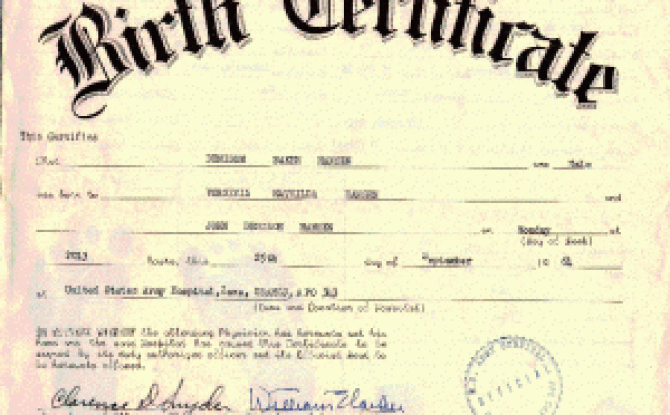
Birth Certificate

Arkansas’ Cautionary Birth Certificate Tale

It’s been a bumpy week for same-sex parents in Arkansas trying to both get on a child’s birth certificate —but there’s an important lesson in the case for same-sex parents in all states.

A week ago, a Pulaski County circuit judge ruled that the U.S. Supreme Court decision that legalized marriage for same-sex couples means that same-sex parents in Arkansas may have both their names put on the birth certificates of children born during their marriages. The state Department of Health, however, initially refused to do so, unsure if the ruling applied beyond the three plaintiffs, and slowed by Attorney General Leslie Rutledge’s advice not to issue amended birth certificates because she planned to appeal. The Department of Health, to their credit, seems to be issuing them anyway.

One important takeaway from all this, though, is found in Judge Tim Fox’s ruling, where he says, “Today’s decision affords the plaintiffs, as same-sex couples, the same constitutional rights with respect to the issuance of birth certificates and amended birth certificates as opposite-sex couples. That is the sum total of the legal effect of this decision.”

Those “same constitutional rights,” however, may be more limited than one might think. Fox notes that the plaintiffs list eight examples of how the lack of both same-sex parents on a birth certificate may impact their legal relationship to their children, including identification procedures for Social Security numbers and passports; denial of rights related to medical care, school-related activities, governmental- or employment-related benefits, survivor benefits, and inheritance; as well as disruption of the parent-child relationship and the award of child support in the event of parental divorce. But, he warns (my bold):

The court’s declaration today does not conclusively resolve any of those legal issues. It may create equitable and legal arguments for resolution of issues that involve only the two spouses of the same sex-marriage, such as child support or child custody. It does not in any manner resolve the multitude of legal issues that may arise involving third parties. Biological parents, mother or father, whose statutory and/or common law rights may not have been properly terminated, whether through an adoption proceeding or by the signature of surrogacy documents, are not bound by the listing of two names on a birth certificate. Other heirs claiming against a same-sex spouse estate, or attempting to disallow a minor child’s interest in the estate of one of the same-sex spouses, are not bound by an amended birth certificate. Insurance companies—life, health, or casualty—may decide in order to prevent potential duplication of claims, or liabilities not actuarially considered in premium calculations, to change their contract language to exclude birth certificates as indicia of acceptable legal relationship, and may require other documentation such as adoption decrees. In the future, government benefits, both state and federal, may key off of legal documentation other than a birth certificate. Today’s decision does not legally resolve any of those potential issues.

Click here to read the entire article.

by Mombian.com, December 8, 2015

Co parent adoption post-marriage equality

What does Co parent adoption in a post-marriage equality world look like?

Same-sex couples now have the right to marriage in the United States, however, there are still some legal implications that require consideration when it comes to family law and children. It’s important to remember in any union that just because a couple is married, parental rights of biological or adoptive children of one parent do not automatically transfer to that parent’s spouse. In order for both parents to have and practice their legal rights to make decisions for that child’s education, health and welfare, the family, in most cases, must complete a co parent adoption.

What is co parent adoption?

Co parent adoption is a legal procedure that allows a same-sex parent to adopt their partner’s biological or adopted child. This is similar to the stepparent adoption process. This gives the non biological or non adoptive parent parental rights towards the child.


Is going through all that paperwork really necessary?co parent adoption, co parent adoptions, second parent adoption new york, second parent adoption, second parent adoptions

In short, yes. While couples intend to stay together forever, break ups happen. In the event of a break up, if one parent hasn’t gone through the adoption process they may lose their rights to custody in the ensuing proceedings. The same goes in instances of death. If something should happen to the only legal parent of the couple’s children, making decisions thereafter for the child or children could be difficult if adoption proceedings have not been completed.


Why do we need co parent adoption if we are married and started our family together?

The only way in which a same-sex couple doesn’t need to go through a co parent adoption procedure is if they petitioned jointly to adopt their child or children. Until the Supreme Court decision of June 2015, the option of joint adoption by same-sex couples varied state to state. If the child is one parent’s biological child, as in the case of a surrogate or sperm donation, the other parent will still need to go through the co parent adoption process.


The adoption process can be an overwhelming endeavor. Whether you have already started the great adventure of parenting or are just beginning the process of starting your family, it’s important for same-sex parents to make sure all the legalities are both understood and taken care of. As the head of Nontraditional Family and Estates division of Albert W. Chianese & Associations, Anthony M. Brown specialises in co parent adoption and is here to help you navigate the ins and outs of same-sex legal issues and adoption. If you have any questions, don’t hesitate to call 212-953-6447 or drop me an email.

Marital presumption discrepancy Wisconsin’s laws

Despite gay marriage legalization, LGBTQ community still struggles with marital presumption laws

One Wisconsin couple tried working their way through the courts to “ungender,: or change marital presumption paternity laws. Wisconsin’s 2nd District Court of Appeals upheld a judge’s decision Nov. 4 to dismiss a gay couple’s request for one partner to become the legal parent of her wife’s child. Marsha Mansfield, a University of Wisconsin law professor, said the court dismissed the request because the couple did not go through the correct legal process. She said they filed their case as an adoption, when they were actually aiming to change the constitutionality of a law.

When they first filed their request, Mansfield said the couple would have needed to notify former Attorney General J.B. Van Hollen, an opponent of gay marriage, which they failed to do.

Emily Dudak Taylor, the attorney on the couple’s case, said the Attorney General was present during the process and at the appeal, and the case being filed as an adoption should not have mattered. She said writing the decision off as a simple procedural error was a skewed way of viewing the issue.

“It’s completely unfair and unequal,” Taylor said. “It’s not just a minor procedural issue at all.”

The decision indicates the court’s avoidance of the greater issue at hand, stating that marriage equality has “hit a wall” with implementation on the state level, Taylor said.

She said the goal of her case was to “ungender” the parental presumption of paternity, a law that grants husbands the status of legal parent and placement on the birth certificate of their wives’ children simply by signing a document at the hospital, without investigating how the child was conceived.

The law’s wording needs to be ungendered from husband to spouse, and father to parent, so the parental presumption can also apply to a female spouse, Taylor said.

Currently, since the law only deals with heterosexual couples, it is unclear what gay couples are supposed to do in cases where one partner has a biological child through artificial insemination, Taylor said. Sometimes her wife becomes the legal parent, and sometimes they have to go through an unnecessary adoption process, she said.

Lesbian women shouldn’t have to adopt their own children simply because they were conceived through artificial insemination, Taylor said.

Click here to read the entire article.


by Emily Hamer, December 1, 2015, The Badger Herald

Do I need a Step Parent Adoption if I’m married?

Do I have to go through a Step Parent Adoption if I am married?

I get this question more than any other; marriage equality was a long fought battle and a much celebrated victory for gay and lesbian couples across the country. Now that it is the law of the land, many people mistakenly believe that their marriage alone will secure their family without the need for a step parent adoption, sometimes called a second parent adoption or two parent adoption. Unfortunately family law has not caught up to the realities of how we create our modern families.

For both gay and lesbian couples, securing the legal rights of a non-biological parent is crucial to create the kind of emotional, and legal, security that most other families take for granted. The legality of both parents relationship to their child is often assumed. Parents are parents, regardless of the biological connection to your child. In New York State, the law doesn’t agree.

Married lesbian couples in many states, New York included, can list a non-biological mother name as a parent on a child’s birth certificate if they are married at the time of the birth of the child and they use an anonymous sperm donor. While a name on a birth certificate is an important goal, it in itself does not create a legal relationship.

In New York County, Surrogate Judge Kristin Booth Glen, in a case entitled In the Matter of Sebastian, discusses the issue of establishing parental rights for a non-biological parent specifically. The case involves married lesbian couple who used an anonymous sperm donor to have a child. Glen concludes, when discussing the non-biological mother’s relationship with the child that, “the only remedy available here that would accord the parties full and unassailable protection is a second-parent adoption pursuant to New York Domestic Relations Law (“DRL”) § 111 et seq.” Glen further states, “that a judicial order of adoption in one state must be afforded full faith and credit in every state, and that there can be no “public Policy” exception to that mandatory recognition…”.

Marriage equality alone doesn’t secure a family without the need for a step parent adoption!

While it is true that many states have what is called a “martial presumption of parentage,” the truth about this is that it is applied differently in different states. For instance, in New York State, where I practice, there is specific case law that holds that the marital presumption of parentage does not apply to same-sex couples. That case is called “Matter of Paczkowski v. Paczkowski.” In that case, the appellate division of the Second Department of New York, the state’s intermediate appellate court, held that the “presumption of legitimacy… is one of a biological relationship, not a legal status.”

In essence, the court says that a marriage does not create a legal right between a non-biological parent and a child. While it may be an indication of intent to be a parent, as would a non-biological parent’s name on a birth certificate, the only way to actually create the legal relationship that guarantees the security that all same-sex families need, is through an adoption order, and in some states, a parentage order. Unfortunately, New York currently does not have the capacity to issue a parentage order but there is legislation in committee in Albany that may change that.

Step parent adoption

Surrogate Options & Known Donors Complicate the Legalities of Chosen Families

One further compounding variable is that many lesbian couples are now choosing known sperm donors. While the desire for a child to know their biological heritage and have a father figure makes sense to many couples, adding another potential parent into the mix can create problems if an adoption does not take place to terminate the donor’s rights to the child and create the intended, non-biological parent’s rights to their child.

For male couples who want to have biologically related children, surrogacy is the only real option. Surrogacy is an emotionally, and financially, exhausting process. It is a true leap of faith. Couples considering surrogacy must juggle a myriad of concerns, the least of which being the cost. With gestational surrogacy tabs running as high as $180,000.00, budgeting is a must. Lawyer’s fees are often lumped together in surrogacy accounting statements, and some agencies do not include the cost of a second parent adoption in order to keep the numbers low. Often, the cost of a pre-birth order is less than a second parent adoption.

In some cases, depending on where your surrogate mother gives birth, her name may be removed from the child’s original birth certificate by a proceeding called a pre-birth order. Some states do not provide for pre-birth orders. Those that do may or may not replace the surrogate’s name with that of the non-biological intended parent. California, for instance, does offer the ability to include the non-biological parent’s name on the child’s original birth certificate, and that very significant step is often mistakenly viewed as a replacement for a second parent adoption or a step parent adoption, which is the only definitive way to establish parental rights between a non-biological parent and a child born through surrogacy.

In order to understand why a step parent adoption is vital if you have a pre or post-birth (or parentage) order, you must understand what that order is, and what protections it provides. Pre and post-birth orders are court orders that are obtained by filing a petition in the appropriate court in the state in which the child will be born. Often, these petitions are not filed in the county where the carrier lives, but in a county which has a judge who understands the importance of these orders and grants them upon the motion of an attorney representing the intended parents. This in itself may create a problem.

Some states may not recognize the relationship created by the pre-birth order because of the lack of a full judicial process attendant to a parentage order. For an issue to be precluded from challenge, for instance the issue of a non-biological parent’s relationship to a child born through surrogacy, the court looks at the process by which that issue has been established. The reason why adoption orders from one state are valid in every state, regardless of the gender of the parents, is because the judicial process of the adoption. The state, for all intents and purposes, becomes and “adversary” to the adoptive parents in the adoption process. The state performs background checks, it orders that fingerprints be taken, mandates that a home study is performed by a licensed social worker to ensure that the child’s prospective residence is safe and clean and essentially verifies all adoption requirements submitted by the petitioning parent, or parents. The adoption order is the product of a fully litigated judicial process. Because this rigorous process is not part of a parentage order proceeding, states which do not offer such orders may not recognize a relationship created in one.

Furthermore, some courts, through a parentage order, will add the name of the non-biological parent to the original birth certificate if that person is married to the biological parent. For same-sex couples, this can present an issue, particularly if the non-biological parent’s relationship to the child is being challenged in a state that resists same-sex marriage. These situations usually arise upon the dissolution of a relationship and during the custody/visitation/support aspect of that process.

Protecting our families may seem like navigating a ship through a sea of legal, financial and emotional waters. But what is more important than the security of knowing that every child has a legal relationship with their parents that cannot be challenged for whatever reason. Every parent deserves that security as well.

Anthony M. Brown, Esq. currently is an associate with the law firm of Albert W. Chianese & Associates heading their Nontraditional Family and Estates Law division serving unmarried individuals, couples and families in Manhattan and on Long Island. Anthony is the founder of TimeForFamilies.com, a web environment dedicated to assisting gay and lesbian couples create their own families. Anthony is the Board Chairman of Men Having Babies, a non-profit organization created to assist gay men looking create families through surrogate options and is a legal consultant for Family By Design, a co-parenting information and matching website.

by Anthony M. Brown – September 16, 2015

The Essential Nature of Second Parent Adoption

What is Second Parent Adoption?

Second parent adoption (also sometimes known as co-parent adoption) is the administrative process through which one partner in a same-sex relationship can become the legally recognized parent of their partner’s biological or adopted child, along with their partner and without the other partner’s parental rights being terminated. Although morally parents should not have to adopt their own children, for whom they planned either biologically through their partner or through adoption, it is strongly advisable to go through this process in order to ensure the security of the child in case of the initial parent’s death, and for logistical purposes when parental responsibility is required in legal, medical and other situations. This is advisable even if the parents are married or in a civil union, as some States and countries do not recognize the legal relationship of the parents to be an indicator of their relationship to their child. Second parent adoption is usually the process taken by unmarried couples, as step-parent adoption is available for those adopting their spouse’s child.


Why choose Second Parent Adoption?

Second parent adoptions are widely viewed by LGBT legal rights experts as the best option for children, as it has been found that it increases emotional, psychological, legal and financial security. It is common to think that if you are married or in a civil partnership, you are legally safe when it comes to your rights as a parent. In some places, this is true. New York, for example, recognizes both same-sex partners as parents of a child without second parent adoption being a legal requirement. If, however, you ever want to visit relatives in a different State or go travelling to a different country, it is essential that you are legally recognized as the parent on an international level. Your legal parental status affects decisions such as your child’s healthcare, where they go to school and who would look after them in case of parental death. In 2014 a controversial decision was reached by a Judge in New York, who refused to grant a second parent adoption based on the fact that the couple’s rights were protected whilst they remained in New York.


Differences in State Law

Although every State must allow adults in same-sex relationships to petition for secondSame-sex Parenting Wins Increased Rights in Oklahoma parent adoption if the partners are married, the same does not apply for those in relationships that are not legally binding. Fourteen States currently allow the process for non-married same-sex partners:

California; Colorado; Connecticut; District of Columbia; Idaho; Illinois; Indiana; Maine; Massachusetts; New Jersey; New York; Oklahoma; Pennsylvania and Vermont.

These fourteen further States have allowed the process for couples at some point:

Alaska; Delaware; Florida; Georgia; Hawaii; Iowa; Louisiana; Maryland; Minnesota; Oregon; Rhode Island; Texas; Washington and West Virginia.

There are also States that prohibit or limit fostering and adoption by LGBT adults. The current limitations include:


  1. The Alabama Court of Appeals ruled that (unmarried) same-sex couples cannot use the stepparent adoption procedures. However, married same-sex spouses must be allowed to do so.
  2. Arizona gives a preference to married couples over a single adult in adoption placement.
  3. The Kansas Court of Appeals recently ruled that Kansas does not permit second parent or co-parent adoption by unmarried couples.
  4. A Kentucky court has said that Kentucky does not permit unmarried couples to use the stepparent adoption procedures.
  5. Mississippi has a statute that prohibits adoptions by couples of the same gender, but under the Supreme Court ruling, Mississippi must allow same-sex spouses to adopt on equal terms with other married couples.
  6. Nebraska does not permit co-parent adoption by unmarried couples.
  7. North Carolina does not permit co-parent adoption by unmarried couples.
  8. Ohio does not permit co-parent adoption by unmarried couples.
  9. Utah does not permit anyone cohabiting in a non-marital sexual relationship to adopt. Utah also gives a preference to married couples over any single adult in adoptions or foster care placement.
  10. Wisconsin does not permit second parent or co-parent adoption by unmarried couples.

Getting Help with The Process

Deciding to adopt a child is one of the biggest decisions you will ever make. It is a decision made from a place of extraordinary love and compassion and one that will take you on an incredible journey; a pathway that is hopefully filled with joy and ends with the family you dream of. It can also be an overwhelming experience; dealing with myriad professionals such as lawyers, agencies and physicians can be stressful and it is best to start from a place of knowledge and confidence. Anthony M. Brown is head of the Nontraditional Family and Estates Division of the law firm of Albert W. Chianese & Associates and specializes in same-sex relationship estate planning and co-parent adoption. If you have questions about adoption you can get in touch with him here.

Step Parent Adoption

To read more about Step Parent Adoption, click here.

Second parent adoption key to creating security

Growing evidence around secure, same-sex families shows that their children are happy and healthy.  Securing those families through second parent adoption or step parent adoption is key to creating this security.

Second parent adoption is needed and recommended as one tenet of the debate surrounding same-sex marriage has focused on whether same-sex parents provide poorer conditions for raising children compared with different-sex parents. Political and public dialogue ensures that this notion remains pervasive and persuasive, even though the Supreme Court decision this summer ensured marriage equality in the U.S.

And it isn’t just talk: Laws exist that implicitly reflect the rhetoric that somehow same-sex parents are different.

For example, even though same-sex couples make decisions together to have a child, and even if both parents appear on the birth certificate, the nonbiological parent may have limited legal rights over the child.

In Texas, two parents of the same sex are even prohibited from being listed on supplemental birth certificates, only allowing for parents where “one of whom must be a female, named as the mother, and the other of whom must be a male, named as the father.”

Laws and Policies That Undermine Same-Sex Parenting Are Not Based on Science

Although all states offer second parent adoption to same-sex parents in legally recognized unions, only 15 states and the District of Columbia offer second-parent adoption to same-sex parents in cohabiting relationships. This means that in cases where the parents are not married, the nonbiological partner may be denied access to the children.

An underlying assumption about parents in same-sex couples seems to be that same-sex parents are less invested or are unable to follow through on the types of parenting that matter for children.

This type of argument is often rooted in the idea that biological parents who are partnered with each other have an advantage over a parent partnered with someone other than their child’s biological parent, with nonbiological parents less likely to invest or commit to children who are not their “own.”

This is wrong and must stop.

Laws and policies that undermine the rights of same-sex parents are more based on politics than on actual science of how they parent. Same-sex parents who conceive children via assisted reproductive technology, for example, should have the same parental rights as heterosexual parents who conceive via assisted reproductive technology and do not have to jump through the same legal hoop.

Very little research has directly tested whether there are different types of parenting investments by same-sex couples. However, in one study that we conducted, we found no difference in the amount of time parents spend with children between same-sex parents and different-sex mothers. But there is a catch.

Mothers in same-sex relationships, fathers in same-sex relationships, and mothers in heterosexual relationships spent about the same amount of time in child-focused activities, about 100 minutes a day.

Men in heterosexual relationships, however, spent significantly less child-focused time than all three other groups of parents — about 50 minutes per day. That means the only difference that we found tended to favor same-sex couples (and heterosexual mothers).

Importantly, these differences persisted when we controlled for factors that have well-known influences on time spent with children, including parent’s education, the number of children, the age of the children, and parent’s time spent working or commuting.

Here’s the catch to this “no difference” conclusion. When combining estimates across mothers and fathers to look at time investments at the family level, not just by individual parents, children raised in same-sex families would receive an average of 3.5 hours of child-focused time a day, compared with 2.5 hours for children in heterosexual families.

Click here to read the entire article.


News.UTexas.edu, by Kate Prickett & Alexa Martin-Storey, November 19, 2015