GOP Passes ‘Most Anti-LGBT Platform’ in History, Log Cabin Republicans Shocked

Led by some of the nation’s most anti-lgbt politicians and even the head of an anti-gay hate group, Republicans late Tuesday voted on and passed the final draft of the GOP 2016 platform.

The Log Cabin Republicans issued a fundraising email immediately, shocked, apparently, telling supporters, “moments ago, the Republican Party passed the most anti-LGBT Platform in the Party’s 162-year history.”politics, corrosive politics


“Opposition to marriage equality, nonsense about bathrooms, an endorsement of the debunked psychological practice of “pray the gay away” — it’s all in there,” the email reads, as the Miami Herald’s Steve Rothaus reports.

“This isn’t my GOP, and I know it’s not yours either,” wrote Log Cabin President Gregory T. Angelo. “Heck, it’s not even Donald Trump’s!,” he claims, although that’s debatable.

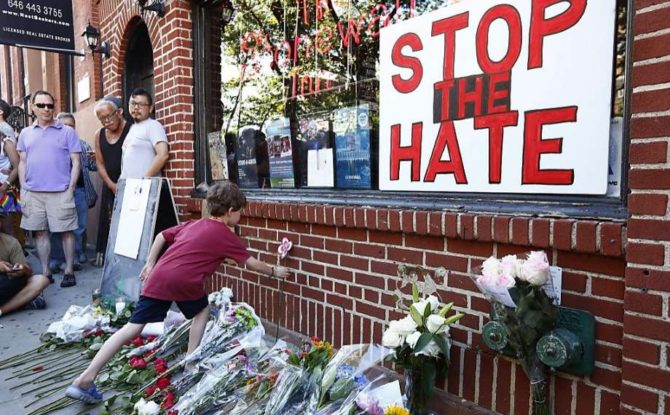
When given a chance to follow the lead of our presumptive presidential nominee and reach out to the LGBT community in the wake of the awful terrorist massacre in Orlando on the gay nightclub Pulse, the Platform Committee said NO.”

As NCRM has been reporting all week, along with passing an amendment calling for an unconstitutional “religious freedom” bill, the First Amendment Defense Act (FADA) to become law, the GOP platform committee passed a plank that effectively says children raised in a “traditional” family are better off than children raised by same-sex parents or single parents.

thenewcivilrightsmovement.com, July 13, 2016

Click here to read the entire article.

10 Insights of Remarkable Parenting from a Family Therapist

At any given time you’ll find 4 or more parenting books on my Amazon wish list, a few by my nightstand, and an email box chock full of remarkable parenting theories and approaches. 

Granted, child development is my career, but I speak with plenty of parents in my practice who find themselves in similar circumstances. With information around every corner and our culture projecting constant messages (many times contradictory) regarding how we should raise our kids, feeling like a confident and intentional parent can seem out of reach many days.

In my 12 years as a family therapist, I’ve seen many well-intentioned parents mistakenly employing strategies that aren’t meeting the emotional or developmental needs of their children or families. I’ve also observed an increasing number of parents that are successfully mapping out new and healthier ways of raising children. 

These insights, collected over time and gleaned from experience, parallel what we know from current brain and behavioral research about what kind of parenting is most likely to contribute to the healthy development of children. more gay couples are embracing surrogacy

1 | Know that kids will act like kids

Often parents forget that the way a child’s learning begins is by screwing up. Making mistakes. Behaving immaturelyThe ‘magic’ happens when a supportive caregiver then steps in to steer them in the right direction. We get frustrated and impatient, becoming annoyed with whininess and ‘back talk’ when really, this is how kids are wired. 

The part of the brain responsible for reason, logic and impulse control is not fully developed until a person reaches their early 20’s. Immature behavior is normal for immature human beings with immature brains. This is a scientific reality that helps us to be patient and supportive in order to guide our children when they struggle. 

2 | Set limits with respect, not criticism

Due to the fact that our kids need to learn literally everything about the world from us, they will require many limits throughout their day. Without proper limits in their environment, kids will feel anxious and out of control. 

Limits can be delivered in the form of criticism and shaming, or they can be communicated in a firm but respectful way.  Think about how you appreciate being spoken to at work and go from there.

3 | Be aware of developmental stages

Have you ever questioned where your easy-going toddler disappeared to as he was suddenly screaming bloody murder while getting dropped off at daycare? Hello separation anxiety! 

There are literally hundreds of very normal, very healthy transitions kids go through to become adults. Being aware of these puts their puzzling behaviors into context, and increases the odds of reacting to them accurately and supportively. 

4 | Know your child’s temperament and personality.

It seems pretty obvious, but if we are in tune with the characteristics that make our child unique, we will have a better understanding of when they may need additional support, and when and where they will thrive. 

Once you know the basics of what makes your child tick, many important areas become much easier to navigate, such as pinpointing the best environment for homework, or understanding why your daughter needs to come home from overnight summer camp.

5 | Give your child plenty of unstructured play time

Unless you studied play therapy in school, most adults will never fully understand and appreciate the power of play. 

Play is how kids learn all the things and develop all the stuff. This means leaving time each day for straight-up unstructured, kid-controlled, exploration of the world kind of play. 

6 | Know when to talk and when to listen

Kids learn to be pretty good problem solvers if we let them. Because we love the life out of them and want them to succeed, it’s hard not to jump in and solve problems for them by virtue of lecture or criticism.2

If parents more often held their tongues and waited it out, they’d be shocked at how often their children can successfully reach their own conclusions. Being heard is powerfully therapeutic, and it allows us to think things through and reach a solution.3

Kids want and need to be heard, and feel understood. Just like the rest of us.2

7 | Have an identity outside of your child

Many of us often claim that our children are our world, and this is certainly true in our hearts. In terms of daily life however, parents need to have more. We need to nurture the friendships, passions and hobbies that make us who we are as individuals. 

Doing this can feel like a battle, as our protective anxieties try to convince us our children can’t be without us, and also that we can’t be without them. But we can be, and need to be,in order to stay sane, and avoid saddling our kids with the task of meeting all of ouremotional needs.

by Angela Pruess, June 15, 2016  parent.co

Judge: Lesbian has no parental rights because she didn’t marry partner

A woman whose same-sex relationship ended before same-sex marriage became legal doesn’t have parental rights to a child born to her partner in 2008, the Michigan appeals court said Wednesday.

The decision, which comes a year after the U.S. Supreme Court cleared the way for same-sex marriage across the country, will stand as a key precedent in similar disputes in Michigan involving children who were raised by gays and lesbians in relationships that ended.

adoption for gay couples

over a white background

Michelle Lake and Kerri Putnam were together for 13 years until 2014 but didn’t marry during that time. Lake said she deserves to enjoy the rights that would have been granted to her if they had been married.

Putnam gave birth to a boy, now 8, during their relationship, but she no longer allows Lake to see him.

“We simply do not believe it is appropriate for courts to retroactively impose the legal ramifications of marriage onto unmarried couples several years after their relationship has ended,” the appeals court said. “That, in our view, is beyond the role of the judiciary.”

The court said Lake has no parental rights under Michigan law because the boy wasn’t born during a marriage.

Associated Press – July 7, 2016

Click here to read the entire article.

SCOTUS same-sex marriage ruling has allowed kids to have 2 legal parents, more stable homes and futures

When gay marriage became the law of the land last summer, Lin Quenzer and Barbara Baier were one of numerous gay couples in Nebraska eager to wed.

However, after 27 years together, a wedding cake and a marriage certificate weren’t their top priority. It was their son. They needed to wed to ensure their teenager would be legally bound to both parents for a lifetime and beyond — from every form that required a parental signature to each woman’s last will and testament.

After their summer wedding, the couple’s attorney immediately began drawing up adoption papers. A little over three months later, Robert Quenzer-Baier, then 15, was legally recognized as Quenzer’s son.

“He cried, we cried. We took pictures. It just meant the world to him. … He said ‘Nothing can take us apart now,’ ” recalled Quenzer, who is the Lincoln city ombudsman.

It was exactly a year ago today that the U.S. Supreme Court issued its historic same-sex marriage ruling, known as Obergefell v. Hodges. The ruling ended decades of debate and one of the biggest culture wars in America. It gave every gay couple in all 50 states the right to walk down the aisle.

But, as Quenzer’s adoption proceeding showed, the ruling had implications far beyond marriage. One of its greatest impacts was on the children of same-sex couples, many of whom were legally tied to only one parent because states such as Nebraska prohibited unmarried couples from adopting a child together.

Nebraska was one of the 13 states that did not allow gay marriage when the high court ruling came down. It had been legalized in the nation’s other states through a patchwork of court or legislative actions. In neighboring Iowa, for example, gay marriage had been legal since 2009 because of an Iowa Supreme Court decision.

On the day of the ruling, some Nebraska couples rushed to their local county clerk’s offices to secure marriage licenses. For a few days, gay marriage ceremonies were a novelty on the wedding circuit.

Some people continue to oppose such unions. But for many people — especially among the nation’s younger generation — same-sex marriages have become an accepted fact of life.

It is hard to know exactly how many same-sex couples married in the wake of the court ruling. States like Nebraska do not keep statistics for gay or straight marriages.

In Douglas County, workers in the County Clerk’s Office kept track of the number of same-sex unions for about the first six months. After that, they stopped.marriage equality

“It’s kind of amazing that, once it happened, it’s really just like any other couple,” said County Clerk Dan Esch. No one in his office even bats an eye these days.

However, Esch and his staff did go back and come up with a tally in anticipation of today’s anniversary. Over the past year, through June 13, the county had issued 173 same-sex marriage licenses — just a fraction of the nearly 4,000 marriage licenses issued overall in Douglas County during that time period.

Nationwide it is estimated there have been 123,000 same-sex marriages since the ruling, according to a Gallup survey.

Last year’s court decision hasn’t ended the nation’s culture wars, of course. But today’s battles are more about what’s happening in bathrooms and bakeries than in bedrooms and courthouses.

Laws have been introduced over the past year that would, among other things, compel transgender people to use the bathroom that conforms with their gender at birth or protect bakers from having to make a cake for a same-sex union.

“The fight to preserve religious liberty is the first critical battle of the post-Obergefell era,” according to a report filed this past week by the Family Leader, an Iowa organization that opposes same-sex marriage.

The gay community sees the baker and bathroom debates as “manufactured” fights so that anti-gay groups can remain relevant, now that the high court has settled the marriage debate. “It’s the last gasp of the dying beast. They’re grabbing for things,” said Donna Red Wing, executive director of One Iowa, an LGBT rights advocacy organization in Iowa.

As with same-sex marriage statistics, it is hard to know exactly how many children have been adopted by same-sex couples since the ruling. Adoptions are done by individual courts, which do not keep track.

However, several lawyers in Nebraska said they have worked with same-sex couples eager to adopt their son or daughter in the wake of the U.S. Supreme Court ruling.

“I’ve personally worked on eight to 10 step-parent adoptions, where the same-sex spouse has been able to adopt children who for all intents and purposes was that person’s child,” said Susan Sapp, a Lincoln attorney. “They were very relieved. Whether you agree or disagree with the marriage decision, there were existing families where children didn’t have legal stability.”

In states such as Nebraska, these families that were created with the help of sperm donors, single-parent adoption or other procreation routes were in legal limbo. The state did not allow non-married couples to adopt children. Given the state’s ban on same-sex marriages, that policy was essentially a ban on gay adoptions as well.

That meant that children of these unions did not have all the same protections afforded to other children. In the event of a parent’s death, the child was not legally viewed as an heir to the non-legal parent. And the non-legal parent had no inherent right to the child. In the event of a separation, one parent could deny — or attempt to deny — visitation to the other. Or one of the two parents could walk away without being responsible for child support.

There were few legal guarantees afforded to such families.

June 26, 2016

By Robynn Tysver / World-Herald staff writer – Omaha.com

Click here to read the entire article.
Ron and Greg’s Story

Ron and Greg are personal friends of mine and have been mentors to gay dads around the world.  Enjoy their amazing story and meet their kids, Elinor and Tomer.


How Can Gay Parents Explain Orlando to Their Kids?

Ever since the tragedy in Florida, many are asking, how do gay parents explain Orlando to their kids?

Today’s column is written with a sense of emergency. The baffling massacre in Orlando has insinuated itself into me in unexpected dimensions, and caused me to ask all kinds of questions that, amazingly, I’d managed to sidestep until now. How do gay parents explain Orlando and talk about violence against LGBTQ people? What can I do differently, if anything, to keep them safe when the toll of violence is made so clear? How do I balance talking about uncertainty with the need to reassure them? And, perhaps most troubling, how do I deal with this fact: My fear for my children is bound up in my fears for myself, usually safely stowed in the overhead compartment but subject to falling out when I encounter unexpected turbulence. (I should add here that I don’t have to create or answer these questions on my own; I have a level-headed husband who’s been just as involved in working through this mess.)LGBTQ

I’ve been a regular contributor to Slate for years, but an introduction seems in order. This will be the first in a series of monthly columns I’ll be writing on one type of parenting: ostensibly, gay parenting, but more accurately, just my own up-and-down efforts at the task. Tolstoy’s opening line in Anna Karenina is famous but wrong—all families, not just the unhappy ones—are unique. So while the pieces will run each month in this Outward blog, any broader lessons that might be drawn for LGBTQ families—let alone other families—will be some combination of luck and the (soon-to-be-legion) readers’ own connections to whatever I happen to be discussing.

My kids have been lucky so far. They haven’t had to deal with any of the bullying and collateral trauma that their fathers did, and, in our progressive Philadelphia community, our family structure hasn’t caused them any problems, either. So figuring out what to say to them about violence against LGBTQ people is quite different from, say, the anguishing task Ta-Nehisi Coates set for himself in Between the World and MeThough he recognizes the generational changes that complicate understanding his son’s experience, his eloquent, heartbreaking account of the thousand natural shocks to which African American bodies are heir is their shared, lived reality.

Our kids, by contrast, are usually safe—to the extent that any kids are safe, at least. That makes explaining anti-LGBTQ violence a different kind of challenge. They’ve had infrequent, and mostly painless, reminders of the stubborn fact that their family is different. Here’s a memorable example:

Scene: Coffee shop, circa 2010. An early Saturday morning. Me, alone with the kids.

Waitress: “Oh, is it mom’s day to sleep in?”

Kids, age 6 [in chorus]: “We don’t have a mom. We have two dads.”

Waitress, not missing a beat: “Wow, you’re lucky! I don’t even have one dad, and you have two!”

See? Kind of a positive experience.

So when Orlando happened, we were starting from zero. Our kids have no experience with fear or rejection of their family. They’re much less at risk, it seems, than we were as children. (I mostly avoided being bullied, but only through a series of baroque stratagems, the creating and sustaining of which imposed their own costs.) But we needed to talk about the incident, especially since we were taking them to a vigil to mourn and mark the event, collectively.

We found ourselves explaining how and why some madman would even want to harm gay people. A simple script seemed sensible: Most people, as you know, treat gay people the same way they treat everyone else. A few people still don’t like gays, though. And a very, very tiny number of people, with serious mental health problems, do crazy, horrible things like what happened over the weekend in Orlando. (From what I understand, the daily CNN news report the kids consume in school discussed the massacre on Monday, but, incredibly, the teacher didn’t follow up the harrowing broadcast in any way.) We opted for reassurance over nuance.

by John Culhane, Slate.com – June 14, 2016

Click here to read the entire article.

FAMILIES OF CHOICE SERIES Anna and Kaya

Families of choice can provide increased connection, security and joy to the lives of LGBTQ people. Our in-depth look at families of choice across our communities continues this week with Anna DeShawn and Kaya Powell. Anna and Kaya, engaged to be married in 2017, are both active in a number of LGBTQ community organizations. In their first interview as a couple, Anna and Kaya share with Windy City Times their experiences of families of choice.

Interviewee names: Anna DeShawn, Kaya Powell

Ages: 32, 38 respectively

Relationship Status: Engaged

Neighborhood: Bronzeville

Activities :

—Anna: Owner and Operator of E3 Radio; www.e3radio.org

—Affinity Community Services Board Member; http://affinity95.org/acscontent

—Kaya: Project Curve Appeal; http://pinkcitycorp.com/pink-city-corp/project-curve-appeal.

—Kaya’s Creations, Co-Owner Drinks By A Diva

Windy City Times: What is your definition of family?

Anna DeShawn: Family to me are persons who care and love you for exactly who you are. Using the word unconditional is a figment of our imagination, there’s conditions on everybody’s love to an extent, but it’s people who you can absolutely depend on.

Kaya Powell: I concur, I feel like that is the same definition for me. It doesn’t have to be your blood family. A person who is there when times are rough as well as when times are good, I would call that person family.families of choice

WCT: By your definition of family, who is in that inner circle?

KP: For me, that number is really really small, only a handful. They’ve been there when I need them, in my corner, pushing me to do better for myself. That number only consists of one blood related person.

AD: It’s probably five or six people. I can trust them and if I need anything I know I can call them up and they’d be right here.

WCT: Kaya, could you speak to why your inner circle is mostly family of choice?

KP: I love my family, but I don’t share as much with them. I share more with outside individuals because I know they are non-judgmental, don’t say things that eventually get back to me. I know they will be there for me, more than my own family.

WCT: What are the needs family of choice fulfill in your life?

AD: For me, its 100-percent acceptance and no judgment. I have no doubt in my mind that my family of origin loves me, but at the same time they all have their own hangups about my sexuality. It doesn’t play out in every scenario, but there is a boundary that I know exists. As I get older, I don’t always feel like having a conversation, I just want to show up and have a good time and we all love each other for where we’re at. With my friends there’s nothing extra, other than just me showing up.

WCT: In your family of origin are you sometimes the gay spokesperson?

AD: Oh yeah, when I came out it was so funny, they meant well but I got two copies of Brokeback Mountain! [Hearty laughter] My sister gave me one and my aunt mailed one from Arizona, it was crazy but I know they were trying.

I equate it to being Black in a lot of ways; there’s a certain understanding we have as people of color. When you are a person who lives at the intersections of being Black, a woman and being queer, if people don’t know how to deal with you on your levels, then you tend to be the spokesperson on any of those three identities. With my family of choice we don’t need that, we all know what we are going through every day.

WCT: Kaya, can you speak to the needs you have that are met by family of choice?

KP: Family of choice accepts me for who I am, I don’t have to explain anything. It was an eye opener for my blood family when I came out, even though there were other stud females in my family. I was femme and they didn’t understand. I feel like I’m too old to have to explain what I like. I choose not to be around them because I don’t want the stares, or looks, or whispers. With family of choice I don’t have to deal with that, we accept each other as we are.

WCT: Is everyone of your family of choice LGBTQ-identified?

AD: Yes, pretty much. And all around the same age, and people of color. There’s some older folks because of Kaya, you know. [Both laugh.]

KP: I could say [there are] some infants! [Laughs continue]

WCT: How have you created family of choice as a couple?

KP: We were introduced by a mutual friend, Brandee, who has since become my family, and her wife Dionne is Anna’s buddy. We came together with a few other individuals around the same time. I find that interesting. We recently met someone who is a stud lesbian in the lifestyle and she has become our nephew.

AD: I know it’s rare for it to unfold that way with Brandee and Dionne. I work with Brandee on the radio and she’s my radio wife, we’ve been doing that since before Kaya and I. At a very basic level, it’s a true blessing everyone gets along. E3 Radio is my passion, so it would be difficult if it hadn’t worked out that way.

WCT: What attracted you to each other?

AD: She had her own life. I could never have someone who is just waiting at home for me, it causes animosity and jealousy. She had her own friends, and life. We were able to bring those together and it’s awesome. It’s been surprising, but that’s how I knew it was right.

KP: Yep!

Same-Sex Couple Details Adoption Hurdles

For the majority of their relationship, Alphonso Reyes, 34, and his husband Melvin, 41, have dreamed of becoming fathers. In fact, they started talking about parenting on their first date.


Some six years later, the conversation may be closer to a reality for the Bronx, New York residents. The process, however, has not been simple.

“There is just a lot of red tape regardless of if you are LGBT or not,” Reyes told NBCOUT. He did acknowledge there are additional hurdles for gay couples.

“A lot of agencies do not want to adopt to same-sex couples. The way we have experienced it was through a lot of feet dragging.”adoption

Over the past year, the couple has fostered two children. The first, a newborn baby girl, was an emergency placement and temporary. The agency they worked with placed the child with another foster parent after only two months.

The couple has been fostering their son, whose name they prefer not to share, since February. They are in what is called pre-adoptive status – where the birth parents’ rights have been revoked and the child is eligible for adoption.

“Right now, everything is still in court; we do not have a date,” Reyes explained. “From the day he came in our home, he started calling us Daddy and Papi … So, he will always be our son, officially adopted or still in foster care.”

Fostering a child may be the best route to becoming adoptive parents for couples like Alphonso and Melvin Reyes. According to AdoptUSKids, a Maryland-based organization that assists LGBTQ couples in the adoption process, there has been an increase in children adopted out of foster care for at least the past 10 years.

“In 2014, 52 percent of the children and youth adopted were adopted by their non-relative foster parents,” Kathleen Ledesma, national project director for AdoptUSKids, told NBCOUT via email.

“The ‘enterprise’ of child welfare adoption,” Ledesma added, “centers on the best interest of the child, and that includes consideration for the child’s attachments to his or her caregiver and minimizing the number of moves a child has while in foster care.”

There are currently 415,000 children and youth in foster care in the United States, according to Ledesma, and of that number, 108,000 are available for adoption.

While there is no reliable data at the national level regarding the number of same-sex couples being approved for adoption, Ledesma said LGBTQ families and individuals are at greater risk for dropping out of the approval process to foster or adopt. The reason for this may be the additional challenges these families face.

In 2008, AdoptUSKids worked with the Children’s Bureau to draft Report to Congress: Barriers and Success Factors in Adoption. The report was an effort to help lawmakers understand better the issues facing LGBTQ families in the adoption process.

NBCNews.com, June 7, 2016 by Mashaun D. Simon

Click here to read the entire article.

Gay custody battles force law to define what a parent is

A spate of gay custody battles are forcing the law to reconsider what constitutes a parent, with one particular case in New York set to have major implications for many more LGBTI couples.

The New York Court of Appeals is to decide whether the ex-girlfriend of a child’s biological mother should have legal parenting rights – despite having never adopted the child in question, or been married to the biological mother in one a several gay custody battles that could define LGBT family law in New York and around the country.

Brooke Barone claims she acted as the child’s ‘Mamma B’ when her girlfriend Elizabeth Cleland gave birth after artificial insemination. But when the couple split up, Cleland reportedly denied Barone visitation rights to the child – which is what Barone is now fighting for in court. Cleland claims she does not feel safe leaving her child with Barone.

lesbian family law

drawing of a happy couple of lesbians and adopted child

Tangled gay custody battles

The argument against awarding parental rights outside of biology, marriage or adoption centers on the potential for opening up bogus parenting claims. These, lawmakers argue, could come from friends, nannies, or even abusive partners seeking to gain control and cause distress.

However, those in favor of broadening the definition of a parent point out heterosexual men have been recognized as parents without genetic or adoptive connections, in order to compel child support payments.

The legalization of same-sex marriage in the US has thrust the tangled legalities of same-sex families into the spotlight, with several similar cases currently being fought in other US states, including another typically gay-friendly state, Massachusetts. And in Canada, the premier of Ontario has pledged to change the law so that both parents in an LGBTI couple are immediately entered onto the birth certificate, hopefully avoiding gay custody battles. This is a huge change to the province’s current law, where a non-biological parent in a same-sex couple is forced to begin the lengthy and costly adoption process in order to be legally recognized.

Speaking to The Wall Street Journal, Columbia Law professor Suzanne Goldberg said that ‘It’s only an accident of law that leads one of those parents to be unrecognized [in these cases].’

New York decision to set precedent

Even when a partner has adopted the child, however, a biological parent looking to disavow their former partner of parentage has legal recourse – as a recent case involving a lesbian couple in Alabama showed. The Alabama courts were eventually obliged by the US Supreme Court to find in favor of the adoptive parent, however.

Click here to read the entire article.

GayStarNews.com – June 5, 2016 by Laura Chubb

Meet One of China’s 1st LGBT Couples to Use Assisted Reproduction

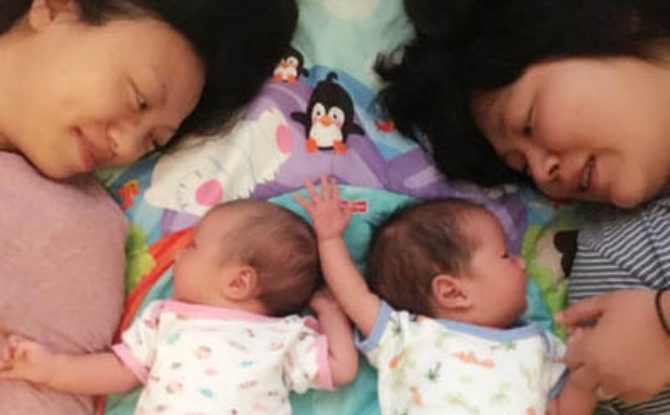
Rui Cai and Cleo Wu recently became mothers to twins, placing them among the LGBT parent minority in China. They are also one of the first couples in China to use assisted reproduction to have children.

Their story is amazing since same-sex marriage is still outlawed in China and only heterosexual couples can use assisted reproduction to have children.


Cai and Wu found a sperm donor in a US sperm bank. Cai was inseminated with two of Wu’s eggs and the sperm donor’s sperm in a clinic in Portland, Oregon. After returning to China, the couple had their twins in a private hospital in Beijing.anonymous sperm donors

For many LGBT persons in China, it can be difficult to come out to their parents, much less have a family. Cai and Wu were lucky enough to have their parents accept their sexuality.

Cai told NPR, “They think it’s OK for us to choose this homosexual lifestyle. But we’ve got to have offspring. It’s a compromise or a precondition we must meet for them to accept our lifestyle.”

Though their’s is a happy story of family acceptance, Cai and Wu will face some hurdles in the near future such as obtaining proper documentation for their children, like government ID cards, and registering their twins with a school.

“To have a child is really a personal right, is a human right,” Xu says. “But then you have to have permission from the state. It might be difficult for non-Chinese people to imagine or understand this situation, but this is the reality we face.”

May 25, 2016, TheNextFamily.com

Click here to read the entire story.