

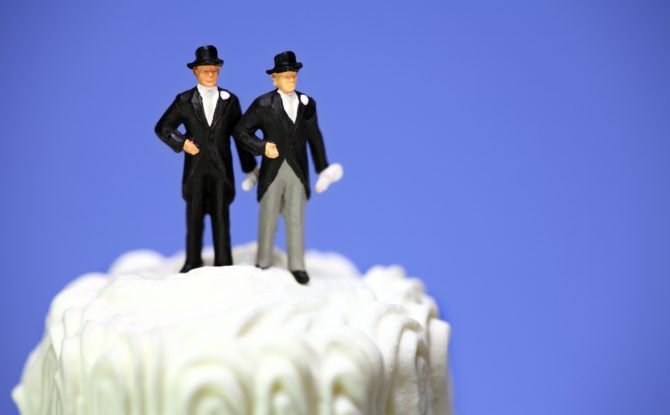
The Masterpiece Cake Shop Decision demonstrated the Supreme Court of the United States threading the religious needle.
In Masterpiece Cake Shop, while making it a point to explain that no determinations were actually being made on whether people with religious convictions can openly discriminate against gay people, or, more alarmingly, whether gay people deserve protections against such discrimination at all, the Supreme Court went out of their way to emphasize the importance of respect for religion.
 Don’t get me wrong, I have great respect for most religious belief. My family holds hands and says what we are thankful for before every meal. We acknowledge the need for divine intervention with friends and family who are dealing with health issues. We have ingrained just such a respect in our son to be tolerant of others, even those who would mock and deride our family just because it has two dads.
However, most Americans do not take the time to parse Supreme Court decisions to get to what the Justices are actually saying and, with the Masterpiece Cake Shop Decision, the message most people will hear is that religious beliefs now trump the dignity and equality of the LGBTQ community.
I feel the need to explain what I interpreted as the main message of The Masterpiece Cake Shop decision. In the majority decision, Justice Kennedy, the author of almost every positive gay rights decision out of the high court, gave short shrift to a complete analysis of the freedom of speech and free exercise of religion claims which strike to the heart of this decision. He did, however, along with the majority of the court, focus on the treatment that the baker received from the Colorado Civil Rights Commission.
 Justice Kennedy held that, “When the Colorado Civil Rights Commission considered the case, it did not do so with the religious neutrality that the Constitution requires. In other words, because of the Commission’s original treatment of the baker’s claim, no matter whether the result of their analysis was correct, the process was tainted from the start and therefore the holdings of all subsequent courts agreeing that the baker violated the rights of the petitioning gay couple, who, as Justice Ginsburg stated in her dissent, “simply requested a wedding cake: They mentioned no message or anything else distinguishing the cake they wanted to buy from any other wedding cake Phillips (the Respondent) would have sold.” But because the process was tainted with anti-religious bias, the underlying discrimination was no longer relevant.
Because the Colorado Civil Rights Commission “showed hostility” toward the baker and his beliefs, that in and of itself, “cast doubt on the fairness and impartiality of the Commission’s adjudication of the … claim.” Even if the Commission was right in their determination that impermissible discrimination existed, they weren’t adequately respectful to religion. Thus the message that religion is more important than discrimination may be misinterpreted.
I have been searching for a meaning behind this seemingly incorrect finding. Many of the greatest LGBT legal minds have attempted to make the distinctions in this decision that would stave off its potential future anti-gay wake of behavior and court reaction to that behavior. This quote is a bit long but captures the proverbial threaded needle. Mary Bonauto, the civil rights director of GLAD and who argued the Obergefell marriage case before the Supreme Court in 2015 said:
“… this limited ruling provides no basis for this Bakeshop or other entities covered by anti-discrimination laws to refuse goods and services in the name of free speech or religion.
The Court was mindful of how far adrift we could go if every individual could apply his or her religious beliefs to every commercial transaction. The Court contrasted permission for a clergy person to refuse to marry a couple as an exercise of religious belief, on the one hand, with the unacceptable “community-wide stigma” that would befall gay people if there was a general constitutional right to refuse to provide goods and services.”
I fear that this distinction will not be made by those who are less invested in understanding how these cases actually affect the lives of LGBTQ individuals, couples and families. My concern is for the families out there who now are questioning the legal certainty of their families, or whether their families will receive equal treatment in courts of less gay friendly jurisdictions. We are, after all, a portable nation and our families are everywhere.
While this decision does not actually give license to shop owners to deny gay people services, it is important to note that employment discrimination based on sexual orientation is still legal in 28 states.
At the risk of sounding like a lawyer, full disclosure – I am a lawyer, this case should serve as a wake up call that nothing can be taken for granted. If you have put off doing your estate planning, do it now. If you are a religious person, please pray that Justices Kennedy, Breyer and Ginsburg live long and healthy lives because these decisions can turn on a dime once right wing conservatives attain an indisputable majority on the court. If you have questioned about whether you should get a second or step parent adoption, do it now. If you have legal questions about your immigration status, or that of your partner or spouse, find out about it now.
While my sincere hope is that more cases like this, with better fact patterns, will ultimately force the court to answer the questions that we all thought would be addressed in the Masterpiece cake Shop decision, namely whether religious “free speech” trumps anti-discrimination protection for LGBTQ people, until that time, we cannot sit idly by while others find solace and fortitude in their own anti-gay beliefs, whether religiously held or not.
Anthony M. Brown, Time For Families – June 5, 2018
For more information, please email anthony@timeforfamilies.com.