Louisiana surrogacy bill to protect surrogacy arrangements advances, despite opposition from both sides of aisle

Louisiana surrogacy is legal, but right now, there are no protections for either the biological parents or the birth mother. In the eyes of the law, the woman who gives birth to a baby is the mother, so a surrogate could ultimately decide to break an agreement and keep the child, and the biological parents would have no legal recourse.

Similarly, the biological parents could decide midway through a pregnancy they no longer want the child, and the surrogate mother would be legally responsible for the child, another wrinkle in Louisiana surrogacy arrangements.

Loren McIntyre is in the process of adopting her firstborn son.

Born in January, he is 100 percent genetically her and her husband’s offspring, but the couple used a gestational carrier, or surrogate, to give birth. And in Louisiana, legally she is not the mother until the adoption is finalized this June.

gay surrogacy

Pregnant woman belly with rainbow symbol LGBT

McIntyre, who has severe endometriosis, is unable to give birth to her own children. She underwent seven unsuccessful rounds of in vitro fertilization before deciding to seek surrogacy.

McIntyre shared her story on Monday with a legislative House committee in the State Capitol in hopes lawmakers will pass a bill that creates legal safeguards in Louisiana surrogacy, where virtually none exists.

House Bill 1102 sets up a legal framework for surrogate arrangements, which bans compensation to the surrogate mother, sets age requirements, requires medical testing and counseling, and mandates background checks. Importantly, it ensures the surrogate mother cannot make a legal claim to the child, and it forbids the biological parents from being able to back out on the agreement.

An identical version of the bill was passed by the full Legislature last year but was vetoed by Gov. Bobby Jindal. On Monday, the House Committee on Civil Law and Procedure advanced the measure without objection. It goes to the full House of Representatives for consideration.

But the measure had ample opposition from both sides of the aisle.

On the left, LGBT groups opposed the language that defines the intended parents as a “man and a woman,” preventing same-sex couples from being able to use surrogacy as an avenue for parenting. The bill also requires that the embryo come from the egg and sperm of the intended parents, which again, precludes same-sex couples.

LSU Law Professor Andrea Carroll testified that while she believes there’s a need for HB1102, she believes that wording would render it unconstitutional, per last year’s U.S. Supreme Court decision legalizing same-sex marriage.

On the right, conservative anti-abortion groups testified that the act of surrogacy often requires multiple unused embryos that are frozen or discarded.

“Life starts at the embryonic stage,” said Ben Clapper, with Louisiana Right to Life. “It’s a human life that needs to be protected.”

State Rep. Stuart Bishop, the Lafayette Republican who sponsored the bill, stressed that in vitro fertilization and surrogacy already are legal.

April 18, 2016 – TheAdvocate.com by Rebekah Allen

Click here to read the entire article.

Lesbian Moms Give Tips on Picking a Donor

Brandy and Susan describe the process of picking a donor and give tips to lesbian moms about known donors vs anonymous as well as things to watch out for.

The Next Family is a diverse community where modern families meet. It is the start of an on-going, open-minded and sincere dialog between urbanite families, adoptive families, in vitro parents, interracial families, same sex parents, lesbian moms, gay dads, single parents and so on. It is a way to remind people that the Next Generation of families already exists in larger numbers than the old model of a “family unit”.


Click here for more information on your path to parenthood.

Anonymous Sperm Donors threatened by growth of genetic testing

The rise of personal genetic testing and growth of international DNA databases could put an end to anonymous sperm donors and anonymous egg donation as donor-conceived individuals may unintentionally discover biological relatives, according to UCL researchers.


The paper, published today in the journal Human Reproduction, reinforces the need for parents using  anonymous sperm donors and anonymous egg donors to be fully informed that their children’s DNA will identify that they are not the and that they should be encouraged to disclose their use of . Anonymous sperm donors should also be informed that their anonymity is not guaranteed, irrespective of whether they are donating in a country that practises anonymous donation or not.

Over 3 million people have already used direct-to-consumer genetic testing, often via online companies without the input of healthcare professionals, to find out information about their ancestry and health and many are participating in international genetic genealogy databases that will match them with relatives.Surrogacy Abroad

Professor Joyce Harper (UCL Institute of Women’s Health) explained: “DNA tests are increasingly being used to solve unknown parentage cases for adoptees and donor-conceived persons. People are finding half-siblings and even biological parents in online databases that are open to the public. A sperm donor does not have to be in the database to be identified as identification can be made from matches with other close relatives such as second or third cousins.”

Using these genetic databases, donor-conceived adults who have not been informed of their status may find out that they are donor-conceived, which may lead to traumatic breakdown of trust with parents.”

Recently, there has been a concerted effort within the scientific community and more widely to foster greater openness about genomic data. These developments indicate that many more healthcare clients are going to know information about their genomes in the future. The situation is further complicated by the fact that different countries, even with the EU, have different laws surrounding gamete donation, donor anonymity and parental disclosure.

by Rowan Walker, MedicalExpress.com, April 14, 2106

Click here to read the entire article.

Coca-Cola Will Offer More Inclusive Parental Leave, Including Surrogacy

Citing the influence of its millennial employees and the need to promote gender equality at work, Coca-Cola on Monday announced a far more inclusive paid parental leave policy.


Previously, Coke only gave six to eight weeks paid parental leave to female employees who gave birth. But starting in January, all new parents at Coke — including dads, adoptive and foster parents — will be entitled to six weeks off upon the arrival of their kids. Birth mothers will also be entitled to an additional six to eight weeks leave. The new benefit is not available to unionized Coke workers. Overall 40,000 employees are eligible, out of 60,000 in the U.S.2nd parent adoption, second parent adoption, second parent adoptions, second parent adoption new york

“Fostering an inclusive workplace means valuing all parents – no matter their gender or sexual orientation,” Ceree Eberly, Coke’s chief people officer, said in an announcement on the company’s website. “We think the most successful way to structure benefits to help working families is to make them gender-neutral and encourage both moms and dads to play an active role in their family lives.”

The company, which took in $44 billion in revenue last year, said the policy was “championed” by a formal group of millennial employees who had been asked to come up with ideas for attracting and retaining younger workers. By 2020, Coke expects more than half of its workforce will be of the “millennial generation,” born between 1981 and 1997.

HuffingtonPost.com, April 18, 2016, by Emily Peck

Click here to read the entire article.

Adoption For Gay Couples is Still the Best Answer – The Message of Matter of Kelly S. v. Farah M.

Does this case render adoption for gay couples as unnecessary or is it simply an affirmation of another state’s more progressive parentage laws?

There has never been a stronger case for adoption for gay couples than Matter of Kelly S. v. Farah M.  I reported this week about a case out of the Second Department Appellate Division in New York affirming a Suffolk County Family Court decision granting visitation to a non-biological lesbian mother. At first glance, this appears to create new law in New York, doing away with previous NY law holding that a non-biological mother does not have standing to seek custody or visitation.  But on further inspection, its true message is that the only way to avoid costly and bitter court battles is through adoption for gay couples.

adoption for gay couples

Facts of the case – Kelly Steagall and Farah Martin met and entered into a relationship in 2000 and became registered domestic partners in California in 2004. They were legally married there in 2008.  Ms. Martin conceived two children through artificial insemination who were born in March of 2007 and April of 2009.  The couple used the same known donor for each child and, instead of using a doctor or fertility clinic to assist with the insemination, they privately inseminated at home.  After moving to New York in 2012, the couple separated in 2013 and Kelly moved to Arizona.  Kelly filed a visitation petition in Suffolk County New York in 2014.

Ms. Martin objected to Ms. Steagall’s status as a legal parent stating that New York law did not support her position and, in what the court saw a self-serving move, sued the known donor to establish that he was the other “true” parent.

What the court said – Appellate division Judge Roman, in her affirmation of the lower Family Court’s ruling, stated that because the couple was in a registered domestic partnership and subsequent marriage in California when the children were born, California law, which is far more progressive that New York family law, should govern and therefore, Ms. Steagall’s parentage could be recognized under California law.

New York Law – In New York County, Surrogate Judge Kristin Booth Glen, in a case entitled In the Matter of Sebastian, discusses the issue of establishing parental rights for a non-biological parent specifically.  The case involves married lesbian couple who used an anonymous sperm donor to have a child. Glen concludes, when discussing the non-biological mother’s relationship with the child that, “the only remedy available here that would accord the parties full and unassailable protection is a second-parent adoption pursuant to New York Domestic Relations Law (“DRL”) § 111 et seq.”  Glen further states, “that a judicial order of adoption in one state must be afforded full faith and credit in every state, and that there can be no “public Policy” exception to that mandatory recognition…”.

This case essentially relies on a marital presumption of parentage. In California, a registered domestic partnership at the time was viewed for all intents and purposes as a marriage.  While it is true that many states have what is called a “martial presumption of parentage,” it is applied differently in different states.  In New York State, there is specific case law that holds that the marital presumption of parentage does not apply to same-sex couples.  That case is called “Matter of Paczkowski v. Paczkowski.”  In that case, the appellate division of the Second Department of New York, the same court that decided the Matter of Kelly S. v. Farah M., held that the “presumption of legitimacy… is one of a biological relationship, not a legal status.”

In essence, the court says that a marriage does not create a legal right between a non-biological parent and a child.  While it may be an indication of intent to be a parent, as would a non-biological parent’s name on a birth certificate, the only way to actually create the legal relationship that guarantees the security that all same-sex families need, is through adoption for gay couples, and in some states, a parentage order.  Unfortunately, New York currently does not have the capacity to issue a parentage order but there is legislation in committee in Albany that may change that.

How does this case affect Gay couples? – The take away from this case may not be what many of us in the LGBT legal community want, particularly in New York. While the language in the decision is expansive and is certainly heading in the right direction, it does not change the law in New York.  Had Kelly Steagall and Farah Martin lived in New York, conceived and gave birth to their children in New York, the outcome of this case could have been vastly different and Kelly Steagall would still, under current New York law, have had to fight in the courts for visitation to the children she had helped to raise since their birth.  No one factors into their family equation to emotional and financial costs of fighting to see the children to whom they area  parent, nor should they.  But the reality of the situation is much more nuanced.  If you are a New York resident, second or step parent adoption for gay couples is the best and only way to ensure that the emotional and financial costs of litigation can be avoided.

Anthony M. Brown, head of Nontraditional Family and Estates division of Albert W. Chianese & Associations, has extensive experience in helping same-sex couples through the adoption process, having gone through the process himself. If you have yet to create a legal relationship with your child or children, call 212-953-6447 or email Anthony at Anthony@timeforfamilies.com.

Parent Adoption – Is it Right for Your family?

The “parent adoption” process is also referred to as Second Parent or Step Parent Adoption. Here is what you need and what you need to know!

When one partner or spouse in a relationship adopts the biological child of their parent or spouse that is referred to as a “Parent Adoption.” If the parties are unmarried, it is called a Second Parent Adoption.  When the parties are married, it is called a Step Parent Adoption.  While gay couples across the country enjoy equal marriage rights, the laws for New York State adoption are still muddled, and it’s advisable for most same-sex couples to petition for a second or step parent adoption to build that legal relationship between non biological parent and child. If there is another biological parent involved, or if a couple uses a known sperm donor, their consent will be required for the adoption to move forward.  If, however, the child is the product of an anonymous sperm donation, then no consent is required.2nd parent adoption, second parent adoption, second parent adoptions, second parent adoption new york

New York State Adoption Step by Step

In a nutshell, you need to compile a lot of paperwork and have a good family lawyer, preferably one that specializes in adoptions for same-sex couples. Here is a rundown of what you will need:

  • The completed intake from your attorney. This is a general questionnaire that includes information for both parents and the child.
  • The original birth certificate for the child. A copy will not suffice. You will, however, get a new original birth certificate after the adoption which will add the name of the adoptive parent if it is not already on the original birth certificate.
  • A letter from the employer of the petitioning parent, and in some counties the biological parent, stating their position and salary. If you are not currently employed, they will need your last year’s tax returns.
  • A letter from the doctor of both parents stating that they are in general good health.
  • A letter from the child’s pediatrician stating that he or she is in general good health.
  • A completed form 1-D (a more elaborate medical assessment) by the child’s pediatrician
  • In cases of a surrogacy, you will need copies of your carrier and donor agreement.
  • In cases of artificial insemination, in vitro fertilization and surrogacy, a letter verifying insemination.
  • If married, a copy of your marriage license.
  • Previous divorce decrees if either parent has been previously married.
  • If either parent has ever been arrested or convicted of a crime, the details and disposition records for any offense must be submitted.
  • A list of every residence the petitioning parent has lived at for the past 28 years, including months and years associated with every address.
  • Financial information, including the value of your home, any owned real estate, stocks and bonds, life insurance information and any sources of income other than employment.
  • The petitioning parent must be fingerprinted for a criminal background check
  • A home study, which is generally arranged for once your lawyer has been retained.

Keep in mind that this process may vary slightly from state to state and county to county, so it’s important to find an attorney familiar with the legal details in your specific location. While the New York State parent adoption process may seem harrowing, keep in mind that your adoption attorney is there to help you, advise you and even help keep you organized every step of the way.  Read more about the process here.

Anthony M. Brown, head of Nontraditional Family and Estates division of Albert W. Chianese & Associations, has extensive experience in helping same-sex couples through the adoption process, having gone through the process himself. If you have yet to create a legal relationship with your child or children, call 212-953-6447 or email Anthony at Anthony@timeforfamilies.com.

Gay Family Planning: Options For Your Family

For thousands of New York couples each year gay family planning is a daunting and intricate process. If you are part of a same sex couple, there are extra complications as you must decide what route to go down in order to have or adopt a child.

Gay family planning options include adoption, a surrogate NYC carrier, pregnancy by donated sperm, or IVF. Here we cover the basics for each of these options to help you consider the right option for your family:

Adoption

There are over 130 adoption agencies in New York State, and each of the 58 social services unit districts has an adoption unit. There are no fees for adopting children who have special needs or are in custody of the local social services commissioner, although there may be fees for adopting those children in the legal guardianship of local voluntary agencies. The fees are based on the adoptive family’s income, however, and help may be available in the form of grants or fee waivers, so don’t let finances put you off from looking into this as an option to start your family.

gay adoption

After deciding on an agency, the application forms must be completed. Information is taken about your current family, your background and the type of child you feel you would be able to give the best life to. Criminal history checks will also be made, with particular attention paid to whether someone in the prospective adoptive family’s home has previous mistreated or neglected a child. A criminal record does not necessarily mean that you will be refused for adoption, as it depends on several factors including the type of crime committed.

Within four months of submitting the application, a home study is started and carried out on the prospective adoptive family. This is a series of meetings, training sessions and interviews that enables the family and social services to ascertain the readiness of the family to adopt, and any issues that they may need help with. After the home study has been completed the caseworker writes a summary about the family, which the adoptive couple can also add comments to. Training is also required to cover some areas that are specific to adoptive parenting, such as the needs of foster children and what kind of child they would be most suited to as a parent.

Once the study and summary are complete, the work then begins to match the family with a child. There is no set process for this as it is individual according to the child’s situation and needs. The Family Adoption Registry provides information about waiting children, and adoptive parents can ask for more information about children they are interested in, in exchange for a copy of the home study. The process goes from there and hopefully ends with a child or children finding a loving home with their new parents!

Pregnancy via sperm donor

Lesbian couples have many options in their own gay family planning. Sperm donors may be someone known to the couple or, alternatively, screened samples from a sperm bank. Donors can be anonymous or known, and even with anonymous donors there is usually information available about the donor’s height, hair colour, eye colour, education level and nationality. Ensuring that you use an approved fertility clinic is essential in order to avoid potential diseases that can be transferred through sperm. If you are using a known donor, insist on having him medically pre-screened before insemination and it is a very good idea to consult with an attorney familiar with known sperm donation.

Traditional Surrogate

gay surrogacy

Traditional surrogacy involves the sperm of the intended ‘adoptive’ parent fertilizing the egg of the traditional surrogate, so the child will be biologically related to both parties. Surrogacy contracts in NYC are not legally binding as they are declared ‘contrary to public policy’. This means that you cannot pay someone to carry a baby for you, or create a contract that mandates that the traditional surrogate mother has to give the child to the intended parents, (IPs) upon delivery. Surrogates, whether traditional or gestational, cannot accept money apart from expenses and medical fees directly related to the pregnancy, and heavy fines are levied for anyone involved in a surrogacy agreement – $500 for those involved and up to $10,000 for anyone found to be arranging such contracts (which are void and unenforceable in NYC).

Despite this, surrogacy has continued to be a pathway to family life that many gay male couples choose to take, and there are agencies that help to match potential parents with potential surrogates who live in other, surrogacy-friendly States. When needed, New Yorkers are able to complete second or step parent adoptions in New York to finalize parental rights for a child that has been delivered through a surrogate from another State.

Gestational Surrogate

The difference between gestational and traditional surrogacy is that the baby resulting from gestational surrogacy is not related to the surrogate mother. An egg and sperm create an embryo which is then transferred to the surrogate via IVF. For a male same sex couple, both partners can contribute sperm so that each have an equal chance of being biologically related to the child; they would also need a female third party to donate the egg.

Having the options of different pathways for gay family planning (adoption, surrogacy or pregnancy via donor sperm) can be reassuring to a couple looking to have children, but it can also be overwhelming when trying to decide what is best for you. For a reputable and trustworthy attorney in New York who specializes in helping same sex couples have families, call Anthony M. Brown, head of Nontraditional Family and Estates division of Albert W. Chianese & Associations, at 212-953-6447 or email questions to Brown@awclawyer.com.

Contact Time For Families

Contact Form
* indicates required field

Gay Adoption New York

Gay Adoption New York: is adoption necessary in the case of a sperm donor?

For same-sex couples, the fight for marriage equality is over and done with. As they start to building families, however, the struggle remains as the intricacies of family law in New York and across the U.S. haven’t quite caught up to this landmark change. This has led to much confusion on the part of same-sex, particularly lesbian, couples. One question is frequently asked: if two married women conceive a child through artificial insemination, does the non biological parent need to go through the process of gay adoption New York?


Gay Adoption New York is still necessary for married women using a sperm donor

Unfortunate case law in the State of New York, entitled Paczkowski v. Paczkowski, held that when married women have a child through artificial insemination, the marital presumption of parentage does not apply to them. This was the case in New York before gay marriage was nationally legalized and it still applies.

Marriage means parentage then?

Marriage does not convey legal parentage for same-sex couples. If your spouse had your child before you were married, gay adoption in New York is still necessary, particularly when you were not listed as a parent on the birth certificate. Despite marriage equality, adoption laws still vary from state to state so it’s important to check the state laws if you plan on adopting your child outside of New York.

What about the sperm donor?

In the case of an anonymous donor, typically the donor has given up all parental rights through the donation process. For this reason, using an anonymous donor is beneficial in New York because a married lesbian couple using an anonymous donor can have both parents’ names on the birth certificate. However, that alone does not create parentage, only second parent adoption does this.  Many couples opt for a known sperm donor for various reasons. In this case, the child and the donor will likely come into contact at some point. It’s vital to establish before conception the role the donor will play in the child’s life, and execute any legal documentation outlining anything pertaining to parenting or visitation rights of the donor. Any lesbian couple using a known sperm donor, regardless of whether they identify him as the father on the birth certificate, must undergo the second parent adoption process to secure the non biological mother’s rights to the child.


If you need help determining your parental rights or adopting the child (either biological or adopted) of your spouse, call Anthony M. Brown, head of Nontraditional Family and Estates division of Albert W. Chianese & Associations. Anthony is available to answer all questions concerning non traditional family law and adoption for GLBT families. Call 212-953-6447 or email Anthony with any questions or concerns.


The Family I Never Thought I’d Have

By Anthony M. Brown – November 21, 2015

What is it about families?   Wars have been fought over them. History has been made because of them. Comedians and therapists have made millions talking about them. But when it all boils down, family makes us who we are, whether standing with them or running from them.
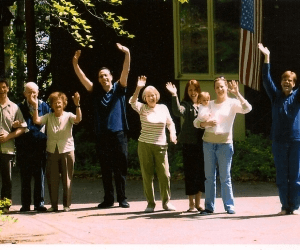
familyMy husband Gary’s blind Aunt Elda died about 5 years ago. We got her cancer diagnosis a year or so  before her death, and it took a while for it to hit home that there was no successful treatment for her ovarian/GI cancer. She had lived outside Gary’s family for many years, in large part due to her husband Chuck. Chuck was perhaps the most prejudiced, bigoted, intolerant man I had ever met. His willingness to make racist or homophobic statements in my husband’s and my presence was almost as strong as his love for Elda. But he physically removed Elda from the family by moving out of state and at one point actually said to her, “you better hope you die first because your family will never be there for you.” Chuck died first.  And we were there for her.

In the perfect ironic twist, Chuck’s mentor and most respected business manager, a man named Ralph Thomas, was also my father’s best friend. He cringed when I would talk about Ralph and his wife in very personal terms as I saw them often before my father died. On Uncle Chuck’s deathbed, everything changed.

Chuck had suffered a series of strokes, the last one leaving him unable to communicate. Gary and I were visiting him in the hospital when I noticed that he was agitated. I knew from my father’s deathbed experience how to shift a person up in the bed by lifting the small blanket placed under the patient and on top of the bed linens. I asked Chuck if he wanted to move up. He blinked his eyes rapidly. Gary and I lifted the blanket, and Chuck, successfully up in the bed. As our eyes met, I could swear I saw him crying and with that, a world of misunderstanding and homophobia flew right out the hospital window.

I don’t know what chuck would have made of the fact that I am a donor dad and have two beautiful little girls with two wonderful women who are their parents or that my husband and I have a son  who has a surrogate mom, but both my family and Gary’s family get it.  And it couldn’t have happened at a better time.

Gary’s father throughout this time had been enduring a prolonged battle with Parkinson’s disease, which, toward the end of his life, left him mentally aware, yet unable to communicate. If he could have, he would have probably yelled. Italians yell, that’s just the way it is. It took me, a southern WASP, years of therapy to realize that Gary’s screaming had more to do with his heritage than anything I may have done. He learned that from his parents. And while they didn’t really communicate, they yelled, A LOT.

Even with the Parkinson’s, Gary’s parents yelled at each other. It used to bother me, but now I get it. While home over one weekend fairly close to may father-in-law’s death, we watched the ultimate tearjerker movie, The Notebook, based on the novel by Nicholas Sparks. It tells the tale of a man who reads a handwritten story to a woman in a nursing home everyday until she realizes, through her dementia, that it is their love story. For a few minutes, she remembers, then he is a stranger again.

At the conclusion of the movie, Gary’s mom was sitting in Gary’s lap, both crying, and I was holding my father-in-law’s hand, also crying. Tears everywhere. Gary’s parents hugged each other and, in a moment that I will remember for the rest of my life, Gary’s dad, who had not been able to communicate clearly for months,  looked at his wife of over 60 years and said, “I didn’t know that this was what you’ve been dealing with.   I am sorry.” In that amazing, crystalline moment – we all lost it. Gary’s mom replied that she loved him and that she wanted to take care of him. Gary and I hugged while this exchange occurred knowing that a gift had just been given to everyone in that room.

Enter Michael, Gary’s older brother, who had been watching this whole emotional experience transpire with his then girlfriend, now wife, Xiao from the other room. Xiao is Chinese and had never met a gay person, much less a gay couple, before dating Michael. They had only been dating for a few months when this happened. Michael told me that Xiao had also seen the hug–fest and asked, “How long have Tony and Gary been together?” Michael replied, “almost 20 years.” Xiao said, “Do you think we will be like that in 20 years?” Michael said, “I hope so.”

Regardless what people think about their in-laws, there are lessons to be learned from them, joys and sorrows to be experienced because of them. These are the things that only a family can provide and while many on the less tolerant side of the aisle would either discount or misunderstand my family, no one can change the fact that I am married to a man and that I married into a family that loves and respects both me and my husband. I have children that will learn their values from this amazing family and my children will continue to teach me theirs.  It doesn’t get much better than that.


Anthony M. Brown currently heads the Nontraditional Family and Estates Law division of the law firm of Albert W. Chianese & Associates, PC, specializing in estate planning and second and step-parent adoptions. Anthony is the Board Chariman of Men Having Babies, and is the Executive Director of The Wedding Party.  He can be reached at: Anthony@timeforfamilies.com.


About MHB

Men Having Babies, Inc. is a nonprofit organization that was spun off in July 2012 from a program that ran at the NYC LGBT Center since 2005. It started as a peer support network for biological gay fathers and fathers-to-be, offering monthly workshops and an annual seminar. Over time, elaborate online resources were developed, the group’s mailing list expanded to about 2000 couples and singles from around the world, and it teamed up with LGBT family associations to develop similar programs in Chicago, San Francisco, LA, Barcelona, Tel Aviv and Brussels.


Our mission includes:

  • The provision of educational and practical information to assist gay prospective parents achieve biological parenting.
  • Promoting the affordability of surrogacy related services for gay men through financial assistance and the encouragement of transparency and customer feedback.
  • Promoting surrogacy practices that minimize the risks and maximize the potential short and long-term benefits to all involved.
  • Raising awareness about the potential benefits and meaningful relationships surrogacy arrangements can bring about.


Beyond the seminars and workshops, Men Having Babies runs several programs to promote its educational, advocacy and affordability mission, including:

Assistance in academic studies about gay parenting and surrogacy.
Should A Same Sex Couple Get Fertility Benefits?

Are A Same Sex Couple Entitled to Fertility Benefits?

Same sex couple Sarah Soller-Mihlek, a Brooklyn guitar instructor, and Jill Soller-Mihlek say, “We want to start a family,” speaking into a camera focused on Sarah and “We’ve always dreamed of becoming parents,” adds her wife, Jill.

The couple made the video last year and posted it to Indiegogo, a crowdfunding website, in hopes of raising enough money to pay for fertility treatments. Jill Soller-Mihlek, now 33, was hoping to get pregnant via a sperm donor and intrauterine insemination, which can costs tens of thousands of dollars depending on how long it takes to conceive.

Although the couple’s insurance plan typically covers fertility treatment, their insurer, United Healthcare, would not cover the cost. The reason? Jill Soller-Mihlek didn’t meet its definition of infertility because she did not have sex with men.

The couple’s insurance policy defines infertility as an “inability to achieve pregnancy after 12 months of unprotected heterosexual intercourse.” But women who use sperm donors must pay for costly, physician-supervised therapeutic donor insemination for 12 months before they meet the definition of infertility. (Women 35 and older need to go through six failed attempts before meeting the clinical definition of infertility.)

After the Soller-Mihleks paid $13,507 out of pocket for nine unsuccessful cycles of insemination, they decided to chronicle their travails on Indiegogo and Change.org. While the United Healthcare policy tacitly acknowledges single women and same-sex couples, many policies do not. Some even exclude unwed women. Notably, major insurers like United Healthcare often do cover insemination treatments when the issue is male infertility.

The Soller-Mihleks believe their plan’s criteria for granting medical coverage of fertility treatment reveals a subtle form of discrimination against lesbians. (Needless to say, gay men face even greater obstacles in attempting to gain coverage, given that coverage wouldn’t extend to the woman who’d be carrying for them.)

The Soller-Mihleks say their concern is that a female same sex couple, by definition, is incapable of getting pregnant through heterosexual intercourse and requires medical intervention to conceive. They say the subtext of the United Healthcare policy is that a lesbian could get pregnant by having sex with a man, she just chooses not to.

Shannon Price Minter, head of the legal division at the National Center for Lesbian Rights in San Francisco, said: “To me, the central injustice is that when a person has a known condition that precludes them from becoming pregnant, such as a woman who has had her ovaries removed, there is no requirement to go through a period of unprotected intercourse before being recognized as requiring fertility treatments. The same should be true for same-sex couples.”

Tyler Mason, a spokesman for UnitedHealthcare, said the company’s policy is based on the clinical disease of infertility, as defined by the American Society of Reproductive Medicine.

“Our coverage criteria are based on clinical trial data, published literature and recommendations from a wide variety of medical specialty societies and state laws,” Mr. Mason wrote in a statement. “We constantly review and update coverage criteria.”

Aetna also uses the clinical definition of infertility to support its reimbursement policies for fertility treatments.

“It’s not a pregnancy benefit,” said Cynthia B. Michener, an Aetna spokeswoman. “It’s based on the clinical disease of infertility, supported by medical evidence and medical society guidelines, including those set out by the A.S.R.M., and it’s the same for everyone.”

Click here to read the entire article.


New York Times, November 2, 2015, by Stephanie Fairyington