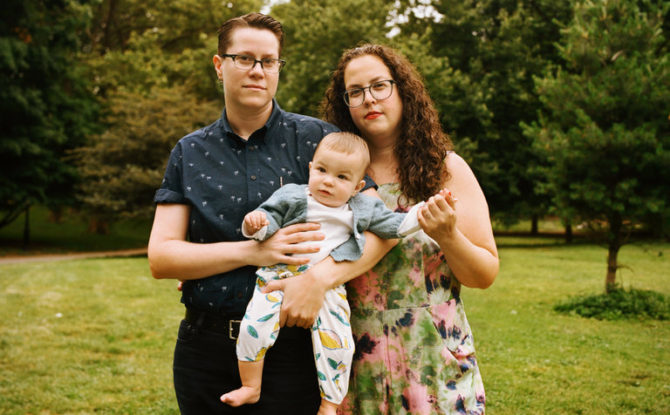

Tennessee judge rules gay couples have equal parental rights

Same-sex couples in Tennessee have the same rights as heterosexual couples who have children born through artificial insemination, a judge ruled.

Four married lesbian couples sued after the state passed a law that requires using the “natural and ordinary meaning” of words in state law. Gay rights groups said the requirement was a sneaky way to deny same-sex couples the legal rights and protections granted to a “husband,” a “wife,” a “father” or “mother.”

Davidson County Chancellor Ellen Hobbs Lyle’s dismissed the couples’ lawsuit on Friday, saying they didn’t prove their rights had been violated, The Tennessean reported . Each of the four couples has conceived a child using a sperm donor and the first baby is not expected until September.Tennessee

Still, the couples heralded the ruling as a victory because it will give them equal parental rights when the children are born.

“We have a Tennessee court order saying same-sex couples are to be treated the same as opposite-sex couples,” said attorney Julia Tate-Keith, who represented the couples.

The decision comes about a month after the U.S. Supreme Court ruled in favor of same-sex couples who believed an Arkansas law discriminated against them. Under that law, married lesbian couples had to get a court order to have both spouses listed as parents on their children’s birth certificates.

In previous court filings, Attorney General Herbert Slatery had argued that the new Tennessee law actually does “nothing new at all.”

The new law should be considered alongside a more-specific state law requiring gender-specific words to be interpreted as inclusive, a filing by the state said. Previously, Slatery issued an opinion that said a judge would likely side with the state law requiring gender-inclusive interpretations.

Fox17.com via Associated Press, July 25, 2017

Click here to read the entire article.

German President OKs Gay Marriage Law, Takes Effect in Fall

Germany’s president has signed legislation legalizing gay marriage, his office said Friday, paving the way for the bill to take effect this fall. 

BERLIN — Lawmakers approved the bill on June 30 in parliament’s last session before Germany’s September election. The move became possible after Chancellor Angela Merkel, whose conservative party had long been reluctant to budge on the issue, said she would allow its lawmakers to vote according to their conscience.Germany

The presidential office said President Frank-Walter Steinmeier signed the legislation on Thursday. That means it will come into force Oct. 1 at the earliest. 

Germany has allowed same-sex couples to enter civil partnerships since 2001, but until now has not granted them full marital rights including the possibility of jointly adopting children. The change brings it into line with many other western European countries.

NBCNews.com via Associated Press – July 21, 2017

Click here to read the entire article.

Gay Rights Groups Seek One More Win From Justice Kennedy

Justice Anthony M. Kennedy, the greatest judicial champion of gay rights in the nation’s history, will turn 81 on Sunday. Rumors that he would retire in June turned out to be wrong, but he will not be on the Supreme Court forever.

Gay rights groups hope to score one more victory before he leaves the court. The goal this time is nationwide protection against employment discrimination.

Justice Kennedy wrote the majority opinions in all four of the court’s landmark gay rights rulings, culminating in the 2015 decisionestablishing a constitutional right to same-sex marriage. But there is more work to be done, said Suzanne B. Goldberg, a law professor at Columbia.

“Marriage equality did not bring an end to sexual-orientation discrimination in this country,” she said.

The same-sex marriage decision left gay men and lesbians in a strange position, said David S. Cohen, a law professor at Drexel University.

“You can get married, put a picture on your desk from the wedding and then be fired because the boss sees the picture,” he said.

“Marriage was certainly an important step, but it doesn’t change the fact that there is no federal law protecting against sexual-orientation discrimination in employment or housing or education or public accommodations,” Professor Cohen said. “Only about 20 states offer protection under their own state laws.”

This month, the gay rights group Lambda Legal announced that it would ask the Supreme Court to hear a case that could prohibit employers from discriminating against gay and lesbian workers. The group argues that Title VII of the Civil Rights Act of 1964, which prohibits workplace discrimination based on sex, also bans discrimination based on sexual orientation.

Most federal appeals courts have rejected the theory. But in April, by an 8-to-3 vote, the United States Court of Appeals for the Seventh Circuit, in Chicago, said Title VII covered gay people. “It would require considerable calisthenics to remove the ‘sex’ from ‘sexual orientation,’” Chief Judge Diane Wood wrote for the majority.

She relied on the language and logic of Title VII, and on Supreme Court precedents.

In 1989, for instance, the Supreme Court said discrimination against workers because they did not conform to gender stereotypes was a form of sex discrimination. Being a lesbian, Judge Wood wrote, “represents the ultimate case of failure to conform to the female stereotype (at least as understood in a place such as modern America, which views heterosexuality as the norm and other forms of sexuality as exceptional).”

By Adam Liptak, July 17, 2017

New York Times

Click here to read the entire article.

As Surrogacy Surges, New Parents Seek Legal Protections

As more couples turn to surrogates to carry their child, some states are considering further protections for the intended parents, many of whom are gay, by handling custody issues before a child is born.

When Brad Hoylman and his husband wanted to start a family, they looked to a woman nearly 3,000 miles away to carry their child.Hoylman

The two Manhattanites turned to a surrogate in California, a state with a robust commercial surrogacy industry, because the practice is banned in New York.

The advent of gay marriage, advances in reproductive technology, and the fact that more people are waiting longer to start families have fueled a surge in the surrogacy industry.

In 2015, 2,807 babies were born through surrogacy in the U.S., up from 738 in 2004, according to the American Society for Reproductive Medicine. Women are often paid at least $30,000 to carry a baby created from the egg and sperm of others.

But in many places, once the baby arrives, outdated state laws fail to answer an important question: Who are the parents?

In many states the law is murky or even silent on surrogacy. The industry is free to operate but the contracts signed between surrogates and intended parents may not be legally binding. The baby may be born in a state that views the woman who gave birth as its mother, even if she has no genetic connection to the child.

The legal uncertainty is particularly concerning to the intended parents, who usually spend about $100,000 (including payments to a surrogate and the company she works with as well as doctors and lawyers) and risk ending up without the child they counted on. Gay male couples have an additional fear: that they might be discriminated against if they are embroiled in a legal fight over custody.

In states that ban commercial surrogacy and those with no laws at all, legislators are pushing bills that would legalize the practice, determine parentage before a child arrives, and ensure that contracts are enforceable and followed by all parties. In many cases, they would require surrogates to be at least 21, to have already given birth to their own children, and to undergo medical and psychiatric evaluations before signing a contract.

Hoylman, a state senator from New York, introduced a bill this year that would legalize surrogacy in his state and establish the legal framework of intended parentage.

Surrogacy became legal in Washington, D.C., in April, and lawmakers in Minnesota and Massachusetts debated bills this year but didn’t approve them. In New Jersey, state lawmakers passed similar bills in 2012 and in 2015, but Republican Gov. Chris Christie vetoed them. The Senate passed another bill this week.

Women and Babies as Commodities?

Critics of surrogacy, including both religious conservatives and some feminists, object to what they view as the commodification of both women and children. Opponents point to numerous European countries that have banned the practice and say states should be wary of letting American women be used by others, including foreigners searching for surrogates beyond their borders.

For many, the financial aspect of surrogacy is most troubling.

“Women will be exploited by wealthy people,” said Jason Adkins, executive director of Minnesota’s Catholic Conference. “We see all kinds of Hollywood stars contracting with surrogates, but we don’t see any Hollywood stars serving as surrogates for their nannies and maids.”

Surrogacy companies prefer to work with women they consider financially stable in order to avoid women who may be acting out of financial desperation. Medicaid does not cover surrogacy costs, and women who are enrolled in the program would risk losing coverage for themselves and their families if they carry a surrogate baby.

By Rebecca Beitsch, Huffingtonpost.com, june 29, 2017

Click here to read the entire article.

Parliament in Germany Approves Same-Sex Marriage

Lawmakers in Germany voted on Friday to allow same-sex marriage after a brisk but emotional debate in Parliament, setting the stage for the country to join more than a dozen European nations — including Ireland, France and Spain — in legalizing such unions.

BERLIN — The historic decision came with a swiftness rare in Germany’s usually staid politics, after Chancellor Angela Merkel unexpectedly eased her conservative party’s opposition to gay marriage and said she would allow lawmakers to vote their conscience on the measure, although she ultimately voted against it.

Ms. Merkel’s softened resistance paved the way for her coalition partners in the Social Democratic Party and two other political groups to press for Friday’s vote, which passed 393 to 226, with four abstentions.marital trust

“If the Constitution guarantees one thing, it is that anyone in this country can live as they wish,” Thomas Oppermann, the parliamentary leader of the Social Democrats, said in opening the floor debate. “If gay marriage is decided, then many will receive something, but nobody will have something taken away.”

His remark was clearly intended to defuse conservatives — including Ms. Merkel — who argued that the Constitution protected conventional marriage.

The chancellor explained her stance in a two-minute statement after the vote, saying that she had come to support the right of same-sex couples to adopt but maintained her view that marriage remained a union between a man and a woman.

“I hope that with today’s vote, not only that mutual respect is there between the individual positions, but also that a piece of social peace and togetherness could be created,” Ms. Merkel said.

Axel Hochrein, a board member of the Lesbian and Gay Federation in Germany who attended the parliamentary debate, expressed no bitterness toward Ms. Merkel, even though he had said Thursday evening that he thought she was leaning toward supporting the measure.

Click here to read the entire article.

Gay Couples Entitled to Equal Treatment on Birth Certificates, Justices Rule

The Supreme Court on Monday reaffirmed its 2015 decision recognizing a constitutional right to same-sex marriage, ruling that states may not treat married same-sex couples differently from others in issuing birth certificates.

WASHINGTON — The decision was unsigned. Justice Neil M. Gorsuch, joined by Justices Clarence Thomas and Samuel A. Alito Jr., dissented.

The case concerns an Arkansas law about birth certificates that treats married opposite-sex couples differently from same-sex ones. A husband of a married woman is automatically listed as the father even if he is not the genetic parent. Same-sex spouses are not.gay parents adopting, same sex paretners

The case, Pavan v. Smith, No. 16-992, was brought by two married lesbian couples who had jointly planned their child’s conception by means of an anonymous sperm donor. State officials listed the biological mother on the children’s birth certificates and refused to list their partners, saying they were not entitled to a husband’s presumption of paternity.

New York times, by Adam Liptak, June 26, 2017

Click here to read the entire article.

Federal Court Lifts Injunction on Mississippi Anti-Gay Law

A federal appeals court on Thursday lifted an injunction on a Mississippi law that grants private individuals and government workers far-reaching abilities to discriminate against lesbian, gay, bisexual and transgender people on religious grounds, though lawyers said the law was likely to remain blocked for the time being during the appeals process.

Thursday’s decision, issued by a three-judge panel of the United States Court of Appeals for the Fifth Circuit, is part of a legal drama being closely watched by gay-rights advocates and religious conservatives. The state law, titled the Protecting Freedom of Conscience from Government Discrimination Act, was signed by Gov. Phil Bryant, a Republican, on April 5, 2016. It is considered the most aggressive of several state-level conservative responses to the United States Supreme Court’s legalization of same-sex marriage in 2015.Discrimination

According to a legal analysis released last year by Columbia University, the Mississippi law would, among other things, allow government clerks to opt out of certifying same-sex marriages (though only if the marriage is not “impeded or delayed” by their decision) and allow businesses to deny wedding-related services to same-sex couples if their marriage contravened “a sincerely held religious belief or moral conviction.”

It would allow religious organizations to engage in job and housing discrimination against L.G.B.T. people; allow public school counselors to refuse to work with L.G.B.T. students; and potentially force child-welfare agencies to place L.G.B.T. children with anti-gay foster or adoptive parents.

The law also contains provisions that could potentially affect single heterosexual people. “For example,” the authors of the analysis wrote, “it would allow a religious university to fire a single mother working in its cafeteria, who supports her children on her own, because the university has a religious opposition to sex outside marriage.”

Last June, just before the law was to take effect, a federal district judge issued the injunction, finding that the law violated the First and 14th Amendments to the Constitution.

Thursday’s 16-page ruling states, in essence, that the plaintiffs challenging the law, many of whom are gay Mississippi residents, lacked standing because the law had not yet injured them.

Click here to read the entire article.

Working with LGBT couples and families – Nicholas has two dads

This series of videos tell my and my husband’s story of how we came to the decision to be parents and how it changes our lives with a magical New York story.  I do believe in miracles.

Columbia Teachers College has created a series of videos for students who want to work with the LGBT community. I am privileged to have been featured as a mentor and to be able to tell my story. This video discusses my dedication to my family and why Nicholas has two dads.

timeforfamilies.com

Working with non profits and how it changed my life – The Wedding Party and Men Having Babies

Columbia Teachers College has created a series of videos for students who want to work with the LGBT community. I am privileged to have been featured as a mentor and to be able to tell my story. This video discusses my dedication to non-profit work and how it has tracked my own personal life.

These series of videos tell my story and why giving back to my community makes me a better lawyer and a better citizen.  I hope that you enjoy this series as much as I have enjoyed living it.

Property Columbia teacher’s College and rights were granted to TimeForFamilies.com to post these for your viewing.


Same Sex Parents Still Face Legal Complications

At gay pride marches around the country this month, there will be celebrations of marriage, a national right that, at just two years old, feels freshly exuberant to many lesbian, gay, bisexual and transgender Americans.

But while questions of marriage are largely settled, same sex parents still face a patchwork of laws around the country that define who is and who can be a parent. This introduces a rash of complications about where L.G.B.T.Q. couples may want to live and how they form their families, an array of uncertainties straight couples do not have to think about.

“There are very different laws from state to state in terms of how parents are protected, especially if they’re unmarried,” said Cathy Sakimura, deputy director and family law director at the National Center for Lesbian Rights. “You can be completely respected and protected as a family in one state and be a complete legal stranger to your children in another. To know that you could drive into another state and not be considered a parent anymore, that’s a pretty terrifying situation.”gay parents adoption

Adoption laws, for example, can be extremely contradictory. In some states, like Maryland and Massachusetts, adoption agencies are expressly prohibited from discriminating based on sexual orientation. At the same time, other states, like South Dakota, have laws that create religious exemptions for adoption providers, allowing agencies to refuse to place children in circumstances that violate the groups’ religious beliefs.

Alan Solano, a state senator in South Dakota, sponsored his state’s adoption legislation. He said he was concerned that if those groups were forced to let certain families adopt, they might get out of the adoption business entirely, shrinking the number of placement agencies in the state.

“I wanted to ensure that we have the greatest number of providers that are working on placing children,” Mr. Solano said. “I’m not coming out and saying that somebody in the L.G.B.T. community should not be eligible for getting a child placed with them. What I hope is that we have organizations out there that are ready and willing to assist them in doing these adoptions.”

But as a practical matter, lawyers who specialize in L.G.B.T.Q. family law say that in some areas, religiously affiliated adoption organizations are the only ones within a reasonable distance. Moreover, they say, such laws harm children who need homes by narrowing the pool of people who can adopt them, and they are discriminatory.

“There is a very serious hurt caused when you’re told, ‘No, we don’t serve your kind here,’ and I think that gets lost in the public discourse a lot,” said Susan Sommer, director of constitutional litigation for Lambda Legal. “There’s just this narrative that absolutely ignores, and almost dehumanizes, L.G.B.T. people. They’re missing from the equation here.”

There are a number of laws that can affect L.G.B.T.Q. families, from restrictions on surrogacy to custody, and the landscape is constantly shifting.

by Elizabeth A. Harris, New York Times – June 20, 2017

Click here to read the entire article.