Same Sex Couples on Birth Certificates in Arkansas

Same Sex Couples on Birth Certificates Statewide in Arkansas

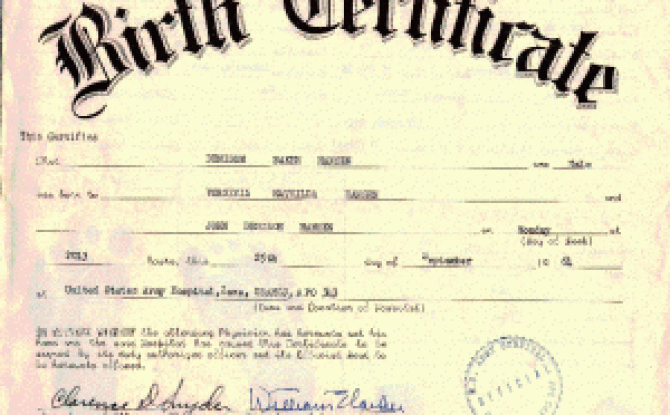
A state judge ruled on Tuesday that Arkansas must list both members of same sex couples as parents on official birth certificates issued across the state, broadening his earlier finding on behalf of three married lesbian couples with children.

Little Rock Circuit Judge Tim Fox held that a state law restricting parentage identification to heterosexual couples was unconstitutional in light of the U.S. Supreme Court’s decision this year legalizing same-sex marriage nationwide. “(The) decision affords the plaintiffs, as same-sex couples, the same constitutional rights with respect to the issuance of birth certificates and amended birth certificates as opposite-sex couples,” Fox wrote in his decision.

Same sex couples, gay parents, lesbian parents

A spokesman for Arkansas Attorney General Leslie Rutledge said she would review Fox’s order before commenting.

“It was a wonderful decision,” said Cheryl Maples, attorney for the plaintiffs. “It was exactly what we wanted.”

The state had resisted identifying same-sex couples as parents on Arkansas birth certificates largely on technical grounds, arguing the protocol was established by the Legislature and the state Health Board and could not be changed without action by either, or both.

Click here to read the entire post


New York Times vis Reuters, December 1, 2015

Marital presumption discrepancy Wisconsin’s laws

Despite gay marriage legalization, LGBTQ community still struggles with marital presumption laws

One Wisconsin couple tried working their way through the courts to “ungender,: or change marital presumption paternity laws. Wisconsin’s 2nd District Court of Appeals upheld a judge’s decision Nov. 4 to dismiss a gay couple’s request for one partner to become the legal parent of her wife’s child. Marsha Mansfield, a University of Wisconsin law professor, said the court dismissed the request because the couple did not go through the correct legal process. She said they filed their case as an adoption, when they were actually aiming to change the constitutionality of a law.

When they first filed their request, Mansfield said the couple would have needed to notify former Attorney General J.B. Van Hollen, an opponent of gay marriage, which they failed to do.

Emily Dudak Taylor, the attorney on the couple’s case, said the Attorney General was present during the process and at the appeal, and the case being filed as an adoption should not have mattered. She said writing the decision off as a simple procedural error was a skewed way of viewing the issue.

“It’s completely unfair and unequal,” Taylor said. “It’s not just a minor procedural issue at all.”

The decision indicates the court’s avoidance of the greater issue at hand, stating that marriage equality has “hit a wall” with implementation on the state level, Taylor said.

She said the goal of her case was to “ungender” the parental presumption of paternity, a law that grants husbands the status of legal parent and placement on the birth certificate of their wives’ children simply by signing a document at the hospital, without investigating how the child was conceived.

The law’s wording needs to be ungendered from husband to spouse, and father to parent, so the parental presumption can also apply to a female spouse, Taylor said.

Currently, since the law only deals with heterosexual couples, it is unclear what gay couples are supposed to do in cases where one partner has a biological child through artificial insemination, Taylor said. Sometimes her wife becomes the legal parent, and sometimes they have to go through an unnecessary adoption process, she said.

Lesbian women shouldn’t have to adopt their own children simply because they were conceived through artificial insemination, Taylor said.

Click here to read the entire article.


by Emily Hamer, December 1, 2015, The Badger Herald

Gestational Surrogacy Contract Enforced in PA

Surrogacy ContractSuperior Court of PA Rules to Enforce Gestational Surrogacy Contract


In the first ruling of its kind from the Superior Court of Pennsylvania, an appellate level court, the court ruled that a gestational surrogacy contract is enforceable.

This is a great step forward for ethical, regulated surrogacy.  It essentially opens the door a bit wider for couples living in states such as New York, who have not yet embraced regulated surrogacy.  As more becomes available, I will share.  However, if you would like to read the decision, click the link below.


Click here to read the opinion.

November 23, 2015

Second parent adoption key to creating security

Growing evidence around secure, same-sex families shows that their children are happy and healthy.  Securing those families through second parent adoption or step parent adoption is key to creating this security.

Second parent adoption is needed and recommended as one tenet of the debate surrounding same-sex marriage has focused on whether same-sex parents provide poorer conditions for raising children compared with different-sex parents. Political and public dialogue ensures that this notion remains pervasive and persuasive, even though the Supreme Court decision this summer ensured marriage equality in the U.S.

And it isn’t just talk: Laws exist that implicitly reflect the rhetoric that somehow same-sex parents are different.

For example, even though same-sex couples make decisions together to have a child, and even if both parents appear on the birth certificate, the nonbiological parent may have limited legal rights over the child.

In Texas, two parents of the same sex are even prohibited from being listed on supplemental birth certificates, only allowing for parents where “one of whom must be a female, named as the mother, and the other of whom must be a male, named as the father.”

Laws and Policies That Undermine Same-Sex Parenting Are Not Based on Science

Although all states offer second parent adoption to same-sex parents in legally recognized unions, only 15 states and the District of Columbia offer second-parent adoption to same-sex parents in cohabiting relationships. This means that in cases where the parents are not married, the nonbiological partner may be denied access to the children.

An underlying assumption about parents in same-sex couples seems to be that same-sex parents are less invested or are unable to follow through on the types of parenting that matter for children.

This type of argument is often rooted in the idea that biological parents who are partnered with each other have an advantage over a parent partnered with someone other than their child’s biological parent, with nonbiological parents less likely to invest or commit to children who are not their “own.”

This is wrong and must stop.

Laws and policies that undermine the rights of same-sex parents are more based on politics than on actual science of how they parent. Same-sex parents who conceive children via assisted reproductive technology, for example, should have the same parental rights as heterosexual parents who conceive via assisted reproductive technology and do not have to jump through the same legal hoop.

Very little research has directly tested whether there are different types of parenting investments by same-sex couples. However, in one study that we conducted, we found no difference in the amount of time parents spend with children between same-sex parents and different-sex mothers. But there is a catch.

Mothers in same-sex relationships, fathers in same-sex relationships, and mothers in heterosexual relationships spent about the same amount of time in child-focused activities, about 100 minutes a day.

Men in heterosexual relationships, however, spent significantly less child-focused time than all three other groups of parents — about 50 minutes per day. That means the only difference that we found tended to favor same-sex couples (and heterosexual mothers).

Importantly, these differences persisted when we controlled for factors that have well-known influences on time spent with children, including parent’s education, the number of children, the age of the children, and parent’s time spent working or commuting.

Here’s the catch to this “no difference” conclusion. When combining estimates across mothers and fathers to look at time investments at the family level, not just by individual parents, children raised in same-sex families would receive an average of 3.5 hours of child-focused time a day, compared with 2.5 hours for children in heterosexual families.

Click here to read the entire article.


News.UTexas.edu, by Kate Prickett & Alexa Martin-Storey, November 19, 2015

California Judge Orders Frozen Embryos Destroyed

embryoFrozen Embryos to be Destroyed Judge Says


In the first decision in California to address a dispute over the fate of frozen embryos after a couple’s divorce, a state judge in San Francisco on Wednesday ordered the destruction of five embryos after a man challenged his ex-wife’s right to use them.

The woman, Mimi C. Lee, a 46-year-old cancer survivor, argued that she would not have another chance to bear biological children. But in 2010, when she and her husband at the time, Stephen Findley, took part in in vitro fertilization, they signed an agreement that the embryos would be destroyed if they ever divorced.

Judge Anne-Christine Massullo of San Francisco Superior Court upheld the agreement.

“Decisions about family and children often are difficult, and can be wrenching when they become disputes,” Judge Massullo wrote. “The policy best suited to ensuring that these disputes are resolved in a cleareyed manner — unswayed by the turmoil, emotion and accusations that attend to contested proceedings in family court — is to give effect to the intentions of the parties at the time of the decision at issue.”

Her ruling is consistent with the pattern across the country. Judges in at least 11 other states, starting with Tennessee in 1992 and including New York and New Jersey, have ruled in post-divorce embryo custody cases. And at least eight of them found in favor of the party who did not want the embryos gestated.

One party’s right not to procreate has usually been considered to trump the other’s right to procreate, said a bioethics professor at the University of California, Davis, School of Law, Lisa Ikemoto — even in cases in which the couples did not sign an agreement as this couple did.

In three states, though, courts have ruled in favor of women who argued that their frozen embryos provided their only chance to have biological children — intermediate appellate courts in Pennsylvania and Illinois and a trial court in Maryland.

Click here to read the entire article.

New York Times, by Andy Newman, November 18, 2015

Same Sex Parenting: OK Supreme Court Landmark Ruling

Same Sex Parenting Wins Increased Rights in Oklahoma

The Oklahoma Supreme Court on Tuesday issued a landmark ruling same sex parenting increasing the rights of noncustodial parents who have been in same-sex relationships. The decision acknowledged the rights of a non-biological parent in a same-sex relationship who has acted as a parent.

The state’s high court ruled that an Oklahoma County judge improperly dismissed the case of Oklahoma City resident Charlene Ramey. The court reversed that decision and remanded the case for further proceedings so Ramey could pursue a hearing on custody and visitation of the child, who was born in 2005. Ramey was in a same-sex relationship with Kimberly Sutton. At the time of the relationship, Oklahoma did not recognize same-sex marriages, which changed following the U.S. Supreme Court’s decision last year not to take up an appeal of Oklahoma’s marriage-equality lawsuit ruling.

The couple agreed to have a child, born by Sutton with a donor. Sutton and Ramey later separated after almost 10 years of same sex parenting, as co-parents. Sutton denied Ramey’s status as a parent and sought to end all interaction between Ramey and the child, according to the opinion.

“Ramey, the plaintiff, is not a mere ‘third party’ like a nanny, friend, or relative, as suggested by the district court,” the ruling states. “On the contrary, Ramey has been intimately involved in the conception, birth and parenting of their child, at the request and invitation of Sutton. Ramey has stood in the most sacred role as parent to their child and always been referred to as ‘mom’ by their child.”

The decision is intended to recognize same-sex couples who, prior to the U.S. Supreme Court legalization of same-sex marriage, entered into committed relationships, engaged in family planning with the intent to parent jointly and share those responsibilities, the ruling states.

“Public policy dictates that the district court consider the best interests of the child and extend standing to the non-biological parent to pursue hearings on custody and visitation,” the ruling says.

Click here to read the entire article.


by Barbara Hoberock, November 18, 2015 TulsaWorld.com

LGBT Advocates Outraged at Utah Judge

LGBT Advocates Outcry: Rights Violation!

Utah Judge Takes Foster Child From Couple Because They’re Lesbians

LGBT advocates and even Democratic presidential candidate Hillary Clinton were outraged and April Hoagland and Beckie Peirce of Carbon County, Utah, were stunned when Judge Scott Johansen ordered their foster child removed from their home. The judge said the baby would be better off with heterosexual parents.

The couple, who legally wed in October 2014, have taken care of the 1-year-old girl for three months, and her birth mother has asked them to adopt the child. The Utah Division of Child and Family Services has been forced to find new housing for the child, but officials say they will appeal the judge’s decision.

utah-lesbians

“We love her and she loves us, and we haven’t done anything wrong,” Peirce told the Salt Lake Tribune. “And the law, as I understand it, reads that any legally married couple can foster and adopt.”

Attorneys for DCFS are currently reviewing the decision. “If we feel like [Johansen’s] decision is not best for the child, and we have a recourse to appeal or change it, we’re going to do that,” DCFS director Brent Platt said. “For us, it’s what’s best for the child.”

“Any loving couple if they are legally married, and meet the requirements, we want them to be involved,” he added.

The child’s state-appointed attorney supports the couple. The birth mother’s lawyer, who was in court with the couple when the decision was handed down, has said the mother is upset and wants her baby to stay with the women.

Judge Johansen, who the Tribune reported has repeatedly been reprimanded by the Utah Judicial Conduct Commission for “demeaning the judicial office,” claimed to have research proving children are better off when raised by heterosexual parents. In reality, all credible major studies show that a parent’s sexual orientation has no effect on a child’s social development and mental health.

Click here to read the entire article.

Advocate.com, November 12, 2015 by Bill Browning

Colombia’s Gay Adoptions Ruling

Colombia’s Constitutional Court ruling found that barring gay adoptions had deprived children of the right to be raised by families.

In a landmark gay adoptions ruling that eliminated a glaringly discriminatory policy, Colombia’s highest court ruled on Wednesday that gay individuals and couples may adopt children. In a 6-to-2 decision, the Constitutional Court found that barring gay people from adopting had unreasonably deprived children of the right to be raised by families.

The decision was the latest victory for gay activists in Colombia who have challenged discriminatory policies in a string of smartly litigated cases. The ruling will make it easier for gay individuals and couples to adopt children in state foster care. It also will allow people to be legally recognized as the parent of a same-sex partner’s biological child.

Anticipating criticism from political and religious leaders, the justices wrote that “doubts and fears about whether society is ready to accept this decision won’t be dissipated by being blind to an irrefutable reality.” The judges argued that there was no evidence that same-sex couples were unfit parents and no compelling reason to bar them from the universe of potential adoptive families.

Wednesday’s decision sparked criticism from Catholic Church leaders, who argued that the issue should have been decided by Congress or approved in a referendum. While some Colombian lawmakers have introduced bills seeking to expand the rights of gay people, those initiatives have stalled. The country’s top court has picked up the slack. In doing so, it has set a commendable example in a region where gay people continue to face widespread discrimination and scorn.

Click here to read the entire article.

A version of this editorial appears in print on November 10, 2015, in The International New York Times.


New York Times, November 9, 2015

Should A Same Sex Couple Get Fertility Benefits?

Are A Same Sex Couple Entitled to Fertility Benefits?

Same sex couple Sarah Soller-Mihlek, a Brooklyn guitar instructor, and Jill Soller-Mihlek say, “We want to start a family,” speaking into a camera focused on Sarah and “We’ve always dreamed of becoming parents,” adds her wife, Jill.

The couple made the video last year and posted it to Indiegogo, a crowdfunding website, in hopes of raising enough money to pay for fertility treatments. Jill Soller-Mihlek, now 33, was hoping to get pregnant via a sperm donor and intrauterine insemination, which can costs tens of thousands of dollars depending on how long it takes to conceive.

Although the couple’s insurance plan typically covers fertility treatment, their insurer, United Healthcare, would not cover the cost. The reason? Jill Soller-Mihlek didn’t meet its definition of infertility because she did not have sex with men.

The couple’s insurance policy defines infertility as an “inability to achieve pregnancy after 12 months of unprotected heterosexual intercourse.” But women who use sperm donors must pay for costly, physician-supervised therapeutic donor insemination for 12 months before they meet the definition of infertility. (Women 35 and older need to go through six failed attempts before meeting the clinical definition of infertility.)

After the Soller-Mihleks paid $13,507 out of pocket for nine unsuccessful cycles of insemination, they decided to chronicle their travails on Indiegogo and Change.org. While the United Healthcare policy tacitly acknowledges single women and same-sex couples, many policies do not. Some even exclude unwed women. Notably, major insurers like United Healthcare often do cover insemination treatments when the issue is male infertility.

The Soller-Mihleks believe their plan’s criteria for granting medical coverage of fertility treatment reveals a subtle form of discrimination against lesbians. (Needless to say, gay men face even greater obstacles in attempting to gain coverage, given that coverage wouldn’t extend to the woman who’d be carrying for them.)

The Soller-Mihleks say their concern is that a female same sex couple, by definition, is incapable of getting pregnant through heterosexual intercourse and requires medical intervention to conceive. They say the subtext of the United Healthcare policy is that a lesbian could get pregnant by having sex with a man, she just chooses not to.

Shannon Price Minter, head of the legal division at the National Center for Lesbian Rights in San Francisco, said: “To me, the central injustice is that when a person has a known condition that precludes them from becoming pregnant, such as a woman who has had her ovaries removed, there is no requirement to go through a period of unprotected intercourse before being recognized as requiring fertility treatments. The same should be true for same-sex couples.”

Tyler Mason, a spokesman for UnitedHealthcare, said the company’s policy is based on the clinical disease of infertility, as defined by the American Society of Reproductive Medicine.

“Our coverage criteria are based on clinical trial data, published literature and recommendations from a wide variety of medical specialty societies and state laws,” Mr. Mason wrote in a statement. “We constantly review and update coverage criteria.”

Aetna also uses the clinical definition of infertility to support its reimbursement policies for fertility treatments.

“It’s not a pregnancy benefit,” said Cynthia B. Michener, an Aetna spokeswoman. “It’s based on the clinical disease of infertility, supported by medical evidence and medical society guidelines, including those set out by the A.S.R.M., and it’s the same for everyone.”

Click here to read the entire article.


New York Times, November 2, 2015, by Stephanie Fairyington

Civil Union Vermont; No Equitable Distribution NY

New York Trial Court Holds New York Property Acquired During a Vermont Civil Union is Not Subject to Equitable Distribution in New York Dissolution Proceeding

In a rather complicated opinion, New York Supreme Court Justice Richard A. Dollinger ruled on October 23 that New York property acquired by Deborah O’Reilly-Morshead during her Vermont Civil Union with Christine O’Reilly-Morshead is not subject to equitable distribution under New York law in the current divorce proceeding between the women, who married in Canada after the property was acquired. O’Reilly-Morshead v. O’Reilly-Morshead, 2015 N.Y. Misc. LEXIS 3843, 2015 NY Slip Op 25354 (Supreme Ct., Monroe County).

Deborah and Christine began their relationship in 2001 while living in Indiana, where they had a “union ceremony” with no legal significance. They moved to New York in 2002, Deborah selling a house she owned in Indiana. They went to Vermont in 2003 and contracted a civil union, while continuing to reside in New York. In 2004 Deborah used the proceeds from the sale of her Indiana house and her other resources to buy a house in Rochester, New York, which was recorded in her name only. In 2006, the women ventured up to Canada to marry, continuing to maintain their residence in Rochester. Five years later, Deborah filed a divorce action in Monroe County Supreme Court, seeking equitable distribution of “marital property.” She excluded from that category the house, which she had purchased with her own assets prior to the marriage. Christine counter sued for divorce and dissolution of the Vermont Civil Union (calling on the equitable powers of the court for the latter), and contended that the house, purchased %after% the parties contracted their civil union, should be considered property of the civil union subject to distribution under Vermont law, and so should be included as part of the marital property subject to dissolution in the New York proceeding. As the parties could not resolve their dispute about the status of the house, it fell to the court to decide both whether it had the power to dissolve the civil union and also whether it had the authority or power to make an order regarding ownership rights to the house.

Relying on prior court decisions finding that New York Supreme Court justices can dissolve civil unions drawing upon their general equitable powers, Judge Dollinger had no trouble deciding that he could grant Christine’s request to dissolve the civil union, but dealing with the house was a more complicated matter.

The court’s authority to distribute property in a divorce proceeding is not based on general equitable principles, but rather on the equitable distribution provisions of New York’s Domestic Relations Law, a statute passed by the Legislature that provides that “marital property,” defined as property acquired during the marriage of the parties, is subject to distribution between the parties upon divorce. Clearly, this house was not acquired “during the marriage.” While it was clear to the court that if Christine brought an action to dissolve the civil union in Vermont, a Vermont court could treat the house as “property of the civil union” and thus subject to distribution between the civil union partners under Vermont law, it was not clear that a New York court would have that authority, and a review by Justice Dollinger of New York case law provided, in his view, little support for Christine’s argument.

He wrote, “This court considers ‘marital property’ as defined by the Legislature in the Domestic Relations Law as the linch pin on which New York’s entire system of marital property distribution rests. If the property is ‘marital,’ the court can equitably distribute it. If not, the court has no jurisdiction to change title or ownership to it. Because of the central importance of creating an exact context in which courts could order a transfer to title to property, the Legislature adopted a black line test for determining when ‘distributable property’ existed in a marriage. The date of marriage – and no other date – is the time when ‘marital property’ exists,” citing Dom. Rel. L. sec. 236(B)(1)(c). While the courts have adopted a broad definition of “property” for purposes of enforcing this statute, Dollinger wrote, they had not adopted a broad definition of “marital,” adhering strictly to the statutory definition. On top of this, of course, when adopting its Civil Union Act in 2000, the Vermont legislature included a provision expressly declaring that a civil union is not a marriage, and Dollinger saw no basis for arguing that a New York court should or could treat a Vermont civil union as a marriage.

He also rejected the notion that the court could apply the doctrine of “comity” in order to treat the property the way it would be treated under Vermont law, pointing out the difficulties that would ensue in dealing with property claims based on a civil unions and domestic partnerships from the various jurisdictions where those statuses were created during the period between 2000 and the Supreme Court’s marriage equality decision on June 26, 2015. This would require New York courts to inquire into the nature of legal relationships in other jurisdictions and how they treated property distributions upon dissolution.

While he noted that some other states had dealt with this problem through express statutory provisions when adopting their marriage equality laws – notably Vermont and New Hampshire – and that the Massachusetts Supreme Judicial Court had accorded marital-like status to Vermont civil unions for some purposes, he observed, “Neither the New York Legislature nor the Court of Appeals has yet moved New York’s law into the same orbit as our neighboring sister states. The Legislature, in the Marriage Equality Act, simply made same-sex marriage legal in New York. It did not mandate that same-sex couples, who were united in civil unions in other state, acquired property rights through that civil union that are equal to the property rights granted to married couples.” By contrast, Vermont’s marriage equality law says that civil unions from other states would be treated as equivalent to marriages in Vermont. If the New York legislature were to amend the NY Marriage Equality law to add similar language, this problem would disappear.

For those tracking the development of these issues in New York, Justice Dollinger’s opinion provides a useful summary of the court opinions that have had to grapple with how civil unions elsewhere should be treated by New York courts. Unfortunately, none of them provides direct guidance about how to decide this case. Most of them deal with disputes involving custody, visitation and child support.

The judge also considered an alternative theory of treating the Vermont civil union as equivalent to a contract under which the parties agreed that property acquired during their civil union would be deemed jointly-owned property. There is precedent under New York law for the enforcement of express pre-nuptial agreements, for example, that would control the distribution of property, and the Court of Appeals has extended that concept to express agreements by non-marital cohabiting couples about their property rights, but has refused to enforce “implied” agreements based on cohabitation. While acknowledging that Christine’s argument along these lines “has a power logic,” Dollinger concluded that it went beyond what he was authorized to do under current law. “In this court’s view,” he wrote, “the proof problems and other complications that drove the Court of Appeals to deny recognition of an implied agreement for asset distribution between an unmarried couple are not present, in the same degree, in a civil union.” The Court of Appeals was worried about the problem of “amorphous” agreements that would not provide the kind of “black line” test that the term “marital property” provides. Dollinger acknowledged that this problem might not pertain to civil unions, which had well-defined contours in statutes such as Vermont’s Civil Union Act. “However,” he wrote, “whether this court should, in interpreting the Court of Appeals use of the word ‘amorphous’ in these opinions, conclude that the common use of this word was a springboard to change the definition of ‘marital property’ to include property – acquired during a statutory well-defined union in another state, but not acquired during a marriage – is, in view of this court’s limited authority, unwise. This interpretative reed – based on the use of the same word by justices more than two decades apart – is too tender to carry such weight.”

Ultimately, Dollinger concluded that the failure of the New York legislature to pass any statute recognizing out-of-state civil unions for any purpose effectively tied his hands. “There is no general common law of equity that is equivalent to the statutory creation of an equitable distribution power in the Domestic Relations Law,” he wrote, pointing out that the Court of Appeals has frequently ruled that a “marriage – of whatever type or from whatever jurisdiction – is the only touchstone for equitable distribution of property in New York.”

“In reaching this conclusion, the court is struck by the anomaly this case represents: this court is dissolving a pre-existing civil union, but only allowing equitable property distribution based on the couple’s marriage. Any ‘civil union’ property – which would be subject to distribution if this matter were venued in Vermont – remains titled in the name of the current title holder and is not subject to distribution,” he wrote. “In short, this court provides one remedy to the couple – dissolving the civil union – but declines to provide any further remedies based on their civil union. This court has no solution for this conundrum without violating longstanding principles of New York marriage-based laws. Any further answer rests with the Legislature.”

Click here to read the entire article.


October 30, 2015 - by Art Leonard, artleonardobservations.com