
More Than 100 Rabbis and Cantors Urge NY State to Legalize Surrogacy

The 118 Rabbis and other clergy members urged the passage of the NY Child-Parent Security Act, surrogacy.

The 118 Rabbis and other clergy members urged the passage of the NY Child-Parent Security Act  (surrogacy) in a letter Tuesday to the state’s House speaker, Carl Heastie, and Senate majority leader, Andrea Stewart-Cousins, both Democrats. Among the signatories are rabbis representing the Reform, Conservative and Orthodox movements.rabbis NY surrogacy

The bill, which has the support of Gov. Andrew Cuomo, would legalize paid gestational surrogacy, in which a woman is compensated to carry a child not conceived using her eggs. Proponents say it allows those facing infertility and LGBTQ couples to have children, while detractors say the practice is immoral. The measure also would ease the process through which parents who enlist a third party to conceive establish a legal relationship with the child.

The letter — organized by the Protecting Modern Families Coalition, an alliance of organizations in support of the legislation — references Jewish tradition in arguing for the bill’s passage.

“From birth to Bar/Bat Mitzvah, marriage, and burial, at the core of most of the major Jewish life cycle events is family,” it reads. “As rabbis, we know the visceral, central importance for so many of our congregants of building a family.”

Among the signatories are Rabbis Sharon Kleinbaum of the LGBTQ synagogue Congregation Beit Simchat Torah; Rick Jacobs, who heads the Reform movement; Dov Linzer, president of the liberal Orthodox Yeshivat Chovevei Torah rabbinical school; and Rabbi Avram Mlotek, an Orthodox rabbi who announced last month that he will perform same-sex weddings. The UJA-Federation of New York and the Central Conference of American Rabbis, the Reform movement’s rabbinical arm, also joined the letter.

The Jerusalem Post – JPost.com, BY JOSEFIN DOLSTEN/JTA, May 15, 2019

Click here to read the entire article.

US Department of State Fighting Citizenship of Gay Couple’s Son

Pompeo, Department of State, appeals court ruling that bi-national family’s children are American

More than a year after the US Department of State shrugged off existing same-sex marriage and immigration laws and rejected citizenship for a child of two gay dads, the agency is now appealing a federal judge’s ruling that the child is an American citizen.department of state

As it turns out, the Department of State has stuck to its posture in this kind of case for years — dating back before the Trump administration.

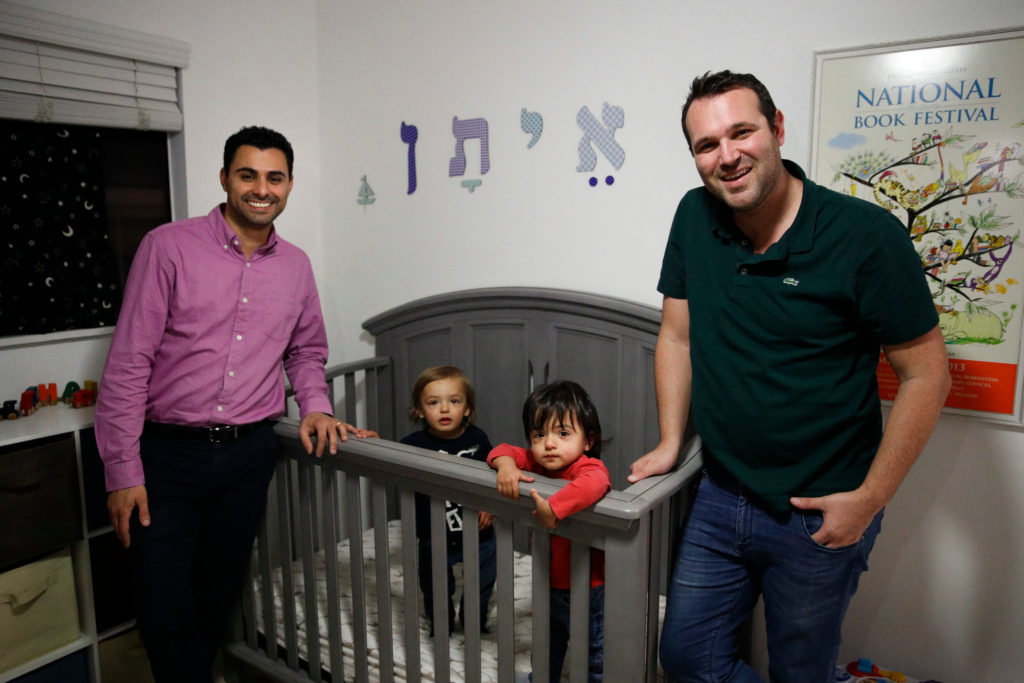
Israeli citizen Elad Dvash-Banks and American citizen Andrew Dvash-Banks were married in Canada in 2010 and had two sons via surrogates there in 2016 before moving to California. Andrew is the biological father of Aiden and Elad is the biological father of Ethan, but both fathers are legal parents of both kids. The Immigration and Nationality Act (INA) stipulates that the children — born in Canada — should both be American citizens because at least one of their parents is an American citizen.

Yet, the Rex Tillerson-led State Department argued otherwise, saying that Ethan — the boy whose biological father is not an American citizen — is also not American. In deciding the question of US citizenship for the two Canadian-born children, the State Department went so far as to order DNA tests on both of the boys.

The State Department conclusion would leave young Ethan as the only member of the Dvash-Banks not eligible for permant residency in the US; his father qualifies as the spouse of an American citizen.

Andrew and Elad, represented by the LGBTQ-focused legal group Immigration Equality, decided in January 2018 to challenge that finding in federal court in the Central District of California. The court ruled in February of this year that the boy is a “US citizen at birth” and gave the State Department — now headed up by Mike Pompeo — 60 days to appeal.

On the 60th day, the Trump administration moved forward with an appeal in the Ninth Circuit Court of Appeals, despite that court having twice ruled that the INA should be interpreted that there need not need be a biological link between children and their legal parents in order for them to be recognized as US citizens as long as one parent is an American citizen.

gaycitynew.nyc, May 12, 2019 by Matt Tracy

Click here to read the entire article.

Legal Basics for LGBTQ Parents

It’s never been easier for LGBTQ people to become parents.

We can now adopt and serve as foster parents in every state in the country. Thanks to advancements in assisted reproductive technology, otherwise known as ART, and innovative co-parenting and known-donor arrangements, we’re also having biological children in greater numbers. llgbtq parentingDespite this progress, a complex network of state laws, regulations and restrictions affect many of our most common paths to parenthood, meaning would-be LGBTQ. parents can face a far more complicated legal landscape than our straight counterparts. 

Legal concerns for LGBTQ people are generally impacted by three factors: the state you live in, your preferred path to parenthood and your relationship status. To gain a better understanding of each, I interviewed four experts at some of the country’s top LGBTQ legal and policy organizations.

THE GIST

  • Know the laws in your state; your legal outlook can vary widely depending on where you live. 
  • Your preferred path to parenthood (donor arrangements, adoption or fostering) will present you with a specific set of legal considerations. 
  • Other legal concerns arise depending on your relationship status: whether you’re single, in an unmarried relationship or married.
  • If you are not biologically related to your child, legal experts recommend taking steps to protect your legal status as a parent, even if you’re married to your child’s biological parent. 
  • Parenthood for LGBTQ people doesn’t always come cheap — but there are some ways to offset the costs. 
  • If you encounter obstacles, don’t give up. An experienced family lawyer is often familiar with legal workarounds, even in states with unfavorable laws for the LGBTQ community.

NYTParenting.com by David Dodge, May 7, 2019

Click here to read the entire interactive article.

Supreme Court to Decide Whether Discrimination Because of Sexual Orientation or Gender Identity Violates Title VII’s Ban on Discrimination Because of Sex

The U.S. Supreme Court announced on April 22 that it will consider appeals next term in three cases presenting the question whether Title VII of the Civil Rights Act of 1964, which prohibits employment discrimination because of an individual’s sex, covers claims of discrimination because of sexual orientation or gender identity.

gay rights, lgbt adoption rights, adoption rights, gay adoption rights, gay adoption new york

Because federal courts tend to follow Title VII precedents when interpreting other federal sex discrimination statutes, such as the Fair Housing Act and Title IX of the Education Amendments of 1972, a ruling in these cases could have wider significance than just employment discrimination claims.

The first Petition for certiorari was filed on behalf of Gerald Lynn Bostock, a gay man who claimed he was fired by the Clayton County, Georgia, Juvenile Court System, for which he worked as Child Welfare Services Coordinator, because of his sexual orientation.  Bostock v. Clayton County Board of Commissioners, No. 17-1618 (filed May 25, 2018).  The trial court dismissed his claim, and the Atlanta-based 11th Circuit Court of Appeals affirmed the dismissal, 723 Fed. Appx. 964 (11th Cir., May 10, 2018), petition for en banc review denied, 894 F.3d 1335 (11th Cir., July 18, 2018), reiterating an old circuit precedent from 1979 that Title VII does not forbid discrimination against homosexuals.

The second Petition was filed by Altitude Express, a now-defunct sky-diving company that discharged Donald Zarda, a gay man, who claimed the discharge was at least in part due to his sexual orientation.  Altitude Express v. Zarda, No. 17-1623 (filed May 29, 2018).  The trial court, applying 2nd Circuit precedents, rejected his Title VII claim, and a jury ruled against him on his New York State Human Rights Law claim.  He appealed to the New York-based 2nd Circuit Court of Appeals, which ultimately ruled en banc that the trial judge should not have dismissed the Title VII claim, because that law applies to sexual orientation discrimination.  Zarda v. Altitude Express, 883 F.3d 100 (2nd Cir., Feb. 26, 2018). This overruled numerous earlier 2nd Circuit decisions.

The third petition was filed by R.G. & G.R. Harris Funeral Homes, three establishments located in Detroit and its suburbs, which discharged a funeral director, William Anthony Beasley Stephens, when Stephens informed the proprietor, Thomas Rost, about her planned transition.   R.G. & G.R. Funeral Homes v EEOC, No. 18-107 (filed July 20, 2018).  Rost stated religious objections to gender transition, claiming protection from liability under the Religious Freedom Restoration Act (RFRA) when the Equal Employment Opportunity Commission sued the funeral home under Title VII.  Stephens, who changed her name to Aimee as part of her transition, intervened as a co-plaintiff in the case.  The trial judge found that Title VII had been violated, but that RFRA protected Harris Funeral Homes from liability.  The Cincinnati-based 6th Circuit Court of Appeals affirmed the trial court’s holding that the funeral home violated Title VII, but reversed the RFRA ruling, finding that complying with Title VII would not substantially burden the funeral home’s free exercise of religion.  EEOC v. R.G. & G.R. Harris Funeral Homes, 884 F.3d 560 (6th Cir., March 7, 2018).  The 6thCircuit’s ruling reaffirmed its 2004 precedent in Smith v. City of Salem, 378 F.3d 566, using a gender stereotyping theory, but also pushed forward to hold directly that gender identity discrimination is a form of sex discrimination under Title VII.

In all three cases, the Court has agreed to consider whether Title VII’s ban on discrimination “because of sex” is limited to discrimination against a person because the person is a man or a woman, or whether, as the EEOC has ruled in several federal employment disputes, it extends to sexual orientation and gender identity discrimination claims.

artleonardobservations.com, by Art Leonard, April 22, 2019

Click here to read the entire article.

Parental Rights In New York To Graduate From The Dark Ages, Hopefully

The changes, if they go through, will significantly improve the state of New York law, and protect parental rights and donors’ rights.

New York parental rights

Many New York parents are currently in a very scary legal environment, and they may not even know it. Did you know that a hopeful single parent who turns to a known sperm donor to conceive in New York has no way to sever the donor’s parental rights? That’s right. And that means that a sperm donor can, at any time, seek parental rights to the child. Vice versa, the parent can seek child support from the sperm donor. That’s concerning! The situation is also true for egg and embryo donations.

New York attorney and adoption and assisted reproductive technology powerhouse, Denise Seidelman, spoke to me about the current problematic legal environment, as well as her ongoing efforts to fix the situation, and to protect parents and children. Seidelman and her law partner, Nina Rumbold, are among those in New York zealously advocating for the passage of the Child-Parent Security Act (CPSA).

Even The Governor Wants It!

The CPSA was introduced in 2013 by Assemblymember Amy Paulin and State Senator Brad Hoylman. Hoylman is himself a parent of two children born through surrogacy. Hoylman and his husband were forced to go outside of New York to have their children through surrogacy because, in addition to the bleak donor situation, compensated surrogacy is illegal in New York.

The CPSA has undergone a number of revisions since its initial proposal, and is still undergoing a few finishing touches. But not until this year did anyone have as much hope that this legislation could pass. Key among factors giving New Yorkers newfound optimism is the vocal support of New York Governor Andrew Cuomo. The Governor has publicly supported the bill, explaining that “New York’s antiquated laws frankly are discriminatory against all couples struggling with fertility, same sex or otherwise.” Even more exciting, the Governor initially included the CPSA in his executive budget plan. However, it was removed in the last few weeks — possibly out of an interest in letting the legislature pass the bill with the latest updates.

What’s So Special About This Bill?

It protects children, for one! No kid should be stuck in the middle of a legal battle questioning who his or her legal parent is, merely because New York’s laws are decades out of date. Specific protections for families and those who help them include:

  • Clarifying and protecting parental rights when a sperm donor, egg donor, or embryo donor assists with conception. About time! Seidelman explained that while the surrogacy aspects of the bill are getting most of the attention, she is especially excited about the positive impact of the donor-related provisions. The bill provides that those who turn to a donor can be assured that they are the legal parents of their child, and that a donor can’t claim parental rights to the child. And, on the other side, that donors can rest easy that their good deed of helping another family no longer opens them to the risk of later being sued for child support for the child. This protection could encourage more couples to donate remaining embryos to others to form their families, rather than destroying them or donating them to research.
  • Legalizing compensated gestational surrogacy. At the moment, New York is among a small minority of U.S. states which dictate that a woman is not permitted to receive compensation if she chooses to act as a gestational surrogate for another. In fact, it’s criminal.

AboveTheLaw.com, by Ellen Trachman, April 10, 2019

Click here to read the entire article.

Challenge to Trans Student Bathroom Access Advances

Federal court says valid sexual harassment, religious freedom claims asserted on trans bathroom Access

In a first round advance for the anti-LGBTQ litigation group Alliance Defending Freedom, a federal court judge has allowed a lawsuit challenging the Palatine, Illinois, high school district’s policy that allows trans students to use restrooms and locker rooms consistent with their gender identity to proceed on theories of sexual harassment and free exercise of religion.

The March 29 ruling by District Judge Jorge L. Alonso came in response to a suit filed by students and their parents in the district who claim the policy unfairly discriminates against cisgender students who don’t want to be exposed to trans students when using what the plaintiffs refer to as “privacy facilities.”

However, Alonso dismissed a claim the policy violated the cisgender students’ right to bodily privacy or their parents’ right to direct their children’s education.

In ruling on a motion to dismiss, the court assumed that the plaintiffs’ factual allegations as true in deciding whether they have stated a potentially valid legal claim. The school district, which moved to dismiss all the claims, has not filed an answer to the complaint, so the plaintiffs’ rather argumentative characterization of the facts has not yet been challenged. 

The Illinois Safe Schools Alliance, which advocates on behalf of LGBTQ students, has been granted intervenor status, as have three trans students. The Alliance and the student intervenors are represented by the American Civil Liberties Union of Illinois and the ACLU LGBT & HIV Project.

The complaint uses terminology typical of ADF’s anti-LGBTQ propaganda.

“The crux of this suit is that defendants seek to affirm the claimed genders of students by allowing male students who claim female gender to use privacy facilities (i.e., bathrooms and locker rooms) designated for use by the female sex and female students who claim male gender to use privacy facilities designated for the male sex,” the ADF complaint reads. “Plaintiffs refer to the policy as District 211’s ‘compelled affirmation policy.’… District 211 adopted the policy solely to affirm the claimed genders of those students claiming a gender different from their sex at birth.”

The policy, the plaintiffs allege, has caused cisgender students “embarrassm­ent, humiliation, anxiety, fear, apprehension, stress, degradation, and the loss of dignity.” Those students, the suit contends, “are at continual risk of encountering (and sometimes do encounter), without their consent, members of the opposite sex while disrobing, showering, urinating, defecating, and while changing tampons and feminine napkins.”

GayCityNewsNYC.com, by Arthur Leonard, April 3, 2019

Click here to read the entire article.

Brunei to Punish Adultery and Gay Sex With Death by Stoning

When Brunei announced in 2013 that it was bringing in harsh Islamic laws that included punishments of death by stoning for adultery and gay sex, the move was met with international protest.

Some investments by the country’s sovereign wealth fund, including the Beverly Hills Hotel, were targets of boycotts and calls for divestment.

Following the outcry, Brunei, a sultanate of about 430,000 on the island of Borneo, delayed carrying out the harshest provisions of its Shariah law.

Now, it is quietly going ahead with them.

Beginning on April 3, statutes allowing stoning and amputation will go into effect, according to an announcement posted by the country’s attorney general last year that has only recently received notice.

That has set off a renewed outcry from human rights groups.

“Brunei’s Penal Code is a deeply flawed piece of legislation containing a range of provisions that violate human rights,” Rachel Chhoa-Howard, a researcher for Amnesty International, said in a statement. “As well as imposing cruel, inhuman and degrading punishments, it blatantly restricts the rights to freedom of expression, religion and belief, and codifies discrimination against women and girls.”

Brunei has had the death penalty on the books since it was a British protectorate, but in practice executions are not typically carried out.

Homosexuality is already illegal in Brunei, with a punishment of up to 10 years in prison, but the new laws allow for penalties including whipping and stoning. The new laws also introduce amputation of hands or feet as a punishment for robbery.

“To legalize such cruel and inhuman penalties is appalling of itself,” Ms. Chhoa-Howard said. “Some of the potential ‘offenses’ should not even be deemed crimes at all, including consensual sex between adults of the same gender.”

Brunei is ruled by a sultan, Hassanal Bolkiah, who lives in a 1,788-room palace and whose wealth amounts to tens of billions of dollars thanks to Brunei’s oil riches. In recent decades he has advocated a conservative vision of Islam that has clashed with the more moderate strains generally practiced in the region, and with the royal family’s own luxurious lifestyle.

New York Times, by Austin Ramzy, March 29, 2019

Click here to read the entire article.

Recent wins for LGBTQ families

March arrived like the proverbial lion with a wave of good news for LGBTQ families.

LGBTQ Families

New Jersey Gov. Phil Murphy (D) signed a bill Feb. 19 expanding the state’s paid family leave law in a number of ways, including by expanding the definition of “family” to include chosen families and expanding the definition of “parent” to include foster parents and those who become parents via gestational surrogacy.

“New Jersey is now the first state in the nation to offer paid family leave that is inclusive of all families,” according to the Center for American Progress. 

A bill also passed the New York Assembly Judiciary Committee Feb. 27 that would more effectively protect families created through assisted reproductive technologies. The Child-Parent Security Act would legalize gestational surrogacy in the state and simplify the procedure for securing the legal rights of non-biological parents. It has yet to pass the full Assembly and Senate, but Gov. Andrew Cuomo (D) has expressed his support.

And in Virginia, the General Assembly on Feb. 22 passed an update to its surrogacy laws that will now give same-sex couples and single parents the same rights as different-sex couples. The legislation, known as Jacob’s Law, is named after the son of two dads who had to fight for their rights to him after he was born with the help of a surrogate. A Virginia court had refused to recognize their Wisconsin surrogate contract, precipitating a long legal battle.

On the federal level, Judge John F. Walter of the U.S. District Court for the Central District of California on Feb. 21 recognized the birthright citizenship of Ethan Dvash-Banks, the son of U.S.-citizen Andrew Dvash-Banks and his Israeli husband Elad Dvash-Banks. Two-year-old Ethan was previously denied recognition of his citizenship—even though his twin brother was granted it.

That means that at least one other family, that of U.S. citizen Allison Blixt and her spouse Stefania Zaccari, an Italian citizen, must continue to fight for their children’s right to be U.S. citizens. Like the Dvash-Banks’, they married abroad while the Defense of Marriage Act was still in effect, and then had two sons, Lucas and Massi. The U.S. State Department refused to recognize their marriage and said that Massi was Allison’s son because she had given birth to him, but Lucas, who was carried by Stefania, was not. It thus has refused to recognize Lucas’ citizenship. The Dvash-Banks victory is thus a step forward, but not the end of the story.

Washington Blade by Dana Rudolph, March 18, 2019

Click here to read the entire article.

Gay Dads and Stigmas

A new study finds that families with gay dads still face discrimination and stigma, especially in states and settings that offer fewer legal and social protections.

LGBTQ families

Public acceptance for gay marriage in America has grown since the Supreme Court legalized same-sex unions in 2013. By May 2015, a Gallup poll reported that 60 percent of Americans approved of gay marriage.

Despite that shift in attitudes, though, a recent Tufts study found that gay fathers still feel the brunt of stigma, experiences that the researchers linked to states with fewer legal and social protections for gays and their families.  

The study, a collaboration between Ellen Pinderhughes, professor of child study and human development at the Eliot-Pearson Department of Child Study and Human Development, and Ellen Perrin, professor of pediatrics emerita at the School of Medicine, analyzed survey responses from 732 men in forty-seven states, revealing how social contexts shape personal experiences of stigmatization. It was published last month in the journal Pediatrics.

“The key takeaway is that states’ legal protections do matter,” Pinderhughes said. “In states that provide more protections, the dads are experiencing less stigma.”

Pinderhughes said the most striking finding was that about 63 percent of respondents reported that they had experienced stigma based on being a gay father in at least one aspect of their lives. Half also reported that they had avoided situations out of fear of stigma in the past year. Forty percent of those who attempted to adopt a child said they faced barriers on their pathway to fatherhood.

More than 30 percent reported stigma in religious environments, and about one-fourth reported experiencing stigma in the past year from family members, neighbors, gay friends, and/or service providers such as waiters, service providers, and salespeople.

These encounters in settings “that are traditionally expected to be sources of support and nurturing is particularly troubling,” reported the researchers. “It is important for pediatricians caring for these families to help families understand and cope successfully with potentially stigmatizing experiences.”

To understand the influence of the social environment on responses, the Tufts researches used equality ratings that reflect each state’s lawsfor protection of LGBT families. They also used rankings of religious groups based on the explicit beliefs of each group regarding homosexuality and marriage equality.  

Among fathers who identified with a particular religion, the likelihood of having experienced stigma in a religious context was directly associated with the tolerance ranking of the religious group with which they affiliated. Almost one-third of respondents affiliated with a religious community had avoided such contexts in anticipation of stigma.

Pinderhughes said that the research also has implications on how to support gay fathers and their children. Increasing evidence, she said, links feeling stigmatized “with reduced well-being of children and adults,” including psychiatric problems.

Potentially harmful to families and children, stigma must be recognized and called out, she said. “We all have biases, and we must own them,” she said. And if one feels stigmatized, “you must resist it and learn how to arm yourself and your children against it.”

The Big Picture for Families

Pinderhughes and Perrin have been working together for more than ten years on their shared interest in sexual minority parents.

by Laura Ferguson, tufts.now.edu, March 11, 2019

Click here to read the entire article.

Twins Were Born to a Gay Couple. Only One Child Was Recognized as a U.S. Citizen, Until Now.

Aiden and Ethan Dvash-Banks are twin brothers who were born minutes apart.

But only one of them was considered to be a United States citizen by the State Department. A federal judge ruled this week that was a mistake.

The twins are the sons of two married gay men, an American citizen and an Israeli citizen. Aiden was conceived using sperm from his American father and Ethan was conceived using sperm from his Israeli father, court records show. A surrogate mother gave birth to the boys in Canada in 2016.

The family sued the State Department for denying Ethan citizenship, drawing attention to a department policy that says that a child born abroad must be biologically related to an American parent to become a citizen. Gay rights activists argued that the policy harms same-sex couples, who often use assisted reproductive technology to have children.

“Two kids who have almost identical life experiences and parenting,” said Aaron C. Morris, a lawyer for the family and the executive director of Immigration Equality, a legal advocacy group that worked on the case. “To treat them differently is absurd.”

In a ruling on Thursday, Judge John F. Walter of Federal District Court for the Central District of California said that Ethan should be recognized as a citizen since birth. The judge ruled that federal law does not require a child born to married parents to prove a biological relationship with both parents.

The State Department said in a statement on Friday that it was reviewing the ruling, but did not respond to questions about what it would mean for the policy going forward.

The twins, now 2 years old, were born to Andrew Dvash-Banks, an American citizen, and Elad Dvash-Banks, an Israeli citizen. The couple met in Israel and married in Canada in 2010 before having their sons with the help of assisted reproductive technology, according to their lawsuit.

After the twins were born, their parents went to the United States Consulate in Toronto to certify the children’s American citizenship and get United States passports. But they were told that the twins had to take a DNA test to prove a genetic connection to Andrew, the lawsuit said.

Ethan was denied citizenship because Andrew was not his biological father, according to a copy of a letter from the State Department included in the lawsuit.

by Sarah Mervosh, New York Times, February 22,2019

Click here to read the entire article.