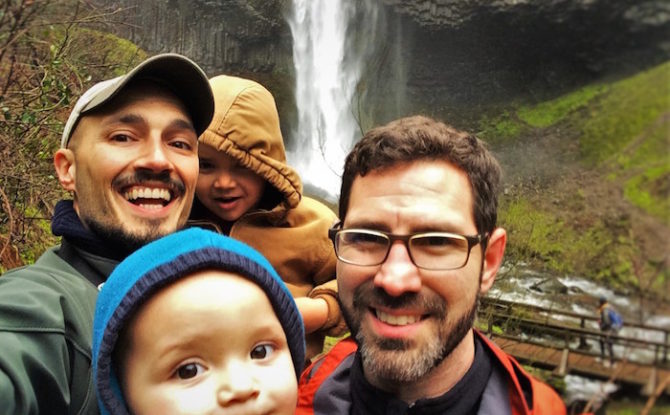
Rob and Chris: 2 Travel Dads, Two Travel Kids

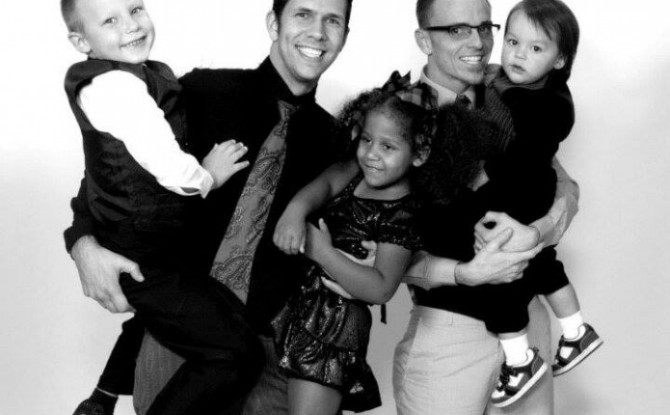
“We had kids to spend time with them,” says Rob Taylor. “To show them the world, teach them and see how they respond to things — it’s really fascinating to see how their little brains work.” – Travel Dads

Calling the forests of Suquamish, Washington, home, Rob and his husband Chris run the popular 2TravelDads blog, and are hailed by The Huffington Post as one of the “world’s top male travel bloggers.” Tales of adventure with sons “Panda”, 4½-years-old, and 14-month-old “Koala” (codenamed for privacy) to Mexico, Napa, and even across Puget Sound to Seattle, Rob and Chris not only paint vivid pictures of destinations perfect for kids, but sprinkle in a few kernels of wisdom on how to travel with charges so young.2nd parent adoption, second parent adoption, second parent adoptions, second parent adoption new york

Planes, Trains, and Automobiles

Together for 11 years and consummate travelers before fatherhood, Rob and Chris were determined to give their kids the travel bug. Conventional wisdom dictates once children are in the picture, the freewheeling lifestyle of footloose parents must radically change to something more rooted and sedentary. Not so, says Rob.

“There’s no reason to change how we live and travel,” he adds. “You just keep on going and keep on having fun so they keep on having fun. With our oldest, we took him on his first flight when he was around 5 months old, and he has the cutest little passport picture. With our youngest, he was 2 months old when he went on his first flight.”

Parents may balk at the idea of globetrotting with young children, but Rob extols the virtue of getting kids in the air, on the road, or over the waves as soon and as often as possible. The logic is straightforward: the sooner the child learns how to travel, the sooner travel becomes that much easier. Judicious use of iPads, Yahtzee and the Endless Series family of educational games also makes for an easier commute, and with his kids, Rob has traveled only between Canada, the United States, and Mexico so far. With regards to air travel, Panda and Koala are never in a plane for more than six hours. Another tip: always use your own car seat even if airlines or ships offer one; you know the settings and your children are used to it.

Click here to read the entire story.

via gayswithkids.com – April 21, 2016

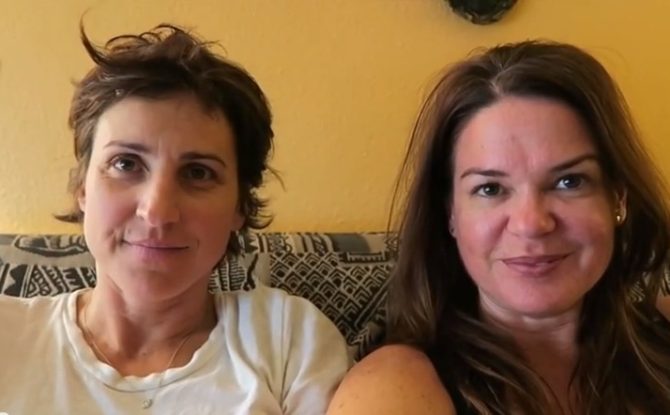
Two Moms Talk About Second Parent Adoption

Not all LGBT parents in the U.S. can put both parents’ names on their children’s birth certificate.  Second Parent adoption can help.

And even if they can, many lawyers still advise that gay couples go through a second parent adoption as a means to protect their parental rights to their children.

Brandy and Susan from The Next Family discuss their second parent adoption experience so other LGBT parents can gain some insight.

The moms explain the importance of second parent adoption by providing the example of traveling internationally to countries that don’t recognize same-sex marriage or families. By going through the process, step parent adoptions give both parents the same rights to their children thus protecting them in the U.S., overseas, and even in custody cases.second parent adoption

“And at the end of the day, I think it’s wise to do it,” Brandy said.

Though she does share her displeasure with the entire process that LGBT parents have to go through that straight parents do not:

“We fight so hard for our LGBT rights and we’ve gotten to this point and this place in our country…and [step parent adoptions] sort of takes you back. Like, really?”

Brandy and Susan explain the process that their family went through when it came to their step parent adoption. It involved finding a good lawyer, filling out an adoption application, and speaking with a social worker.

When speaking about the social worker experience, Brandy said, “They were asking us sort of ridiculous, in my opinion, parenting questions.” She also adds that you should prepare yourself for this experience which may be uncomfortable: “I think it was really insulting to me that they were asking her these questions and me these questions and I had had this child and we had together made this decision together to have this child.”

Following the social worker meeting, families will have to go to court to complete the adoption process.

For Susan’s court date, the judge asked her, “Why should I grant you this right to adopt this child?” Susan said she responded quite awkwardly with, “Well, I’m kind of doing a lot of mother things.” She was happy though with how the judge responded, “You’re the mother and that’s why I’m doing it.” Susan said she could tell that the judge thought that the entire process was also a “silly precursor” to establish her parental rights.

Click here to read the entire article.

By Alex Temblador – TheNextFamily.com – April 15, 2016

Family Time With Frank, John and Zachary

John and Frank live in Oakland Park with their four-year-old son, Zachary. In 2012, the couple fostered Zachary right out of the hospital after he was born and then 18 months later, Frank adopted him as a single father and they became a gay family.

John is from San Francisco. He recently graduated from college and works in human resources. Frank is from New York. He is a registered nurse at Broward General Medical Center and a former New York firefighter. In fact, he was one of the initial responders on 9/11. The couple met eight years ago playing softball.

The two got married in Broward County just after midnight on Jan. 6.2nd parent adoption, second parent adoption, second parent adoptions, second parent adoption new york

In addition to the legal benefits, a huge motivating factor for the couple getting married was so John could join Frank as Zachary’s legal father on his son’s birth certificate. In many cases, unmarried gay couples were not allowed to adopt in Florida, with single fathers having to pass off their significant other as a “roommate”.

“(Before) If something happened to Frank, I wouldn’t have (had) a place to live and I would (have) lost Zachary,” John said.  Meet this gay family!

Visit gayswithkids.com.

Foster Families Share Their Stories of Love and Loss

Foster families tell their personal stories of what it is really like to have a foster child.


“Foster care changes a person,” wrote Stephanie Bennington, a former foster child from Fremont, Neb., after we asked readers to send us their foster care stories. The stories came in response to “Losing a Foster Child,” the most recent essay by Meghan Moravcik Walbert, who chronicled the time her family spent with the foster child she nicknamed BlueJay.

Many readers worried that BlueJay’s new family wouldn’t be able to offer him all the love, attention and resources she could. But from another perspective, his story was a success: He is being reunited with his biological siblings and members of his extended family.parent adoption
With over 400,000 children in the foster families system nationally, there’s been a movement toward such placements, known as “kinship care” — placing children whose parents cannot care for them in the homes of grandparents or other extended family members. Kinship care is believed to preserve family ties and support a continued relationship with parents, siblings and other relatives, providing children with family roots. It is also a way for strapped foster care systems to save money — according to a 2007 report, more than $6.5 billion annually.

One reader, Claudia Tracy, whose grandchildren had been in a loving foster home, wrote to say that she and her husband had decided to bring the children, whom they scarcely knew, to live with them.

“I am that relative from a town hours away that you fear,” Ms. Tracy wrote. Her absence stemmed not from lack of interest, she said, but from factors in the parents’ lives that may have been what led to the children’s being placed into foster care in the first place.

“It took us several months to find out where they were, and as soon as we did we headed out to find them,” she wrote. She worried about moving the children again, but knew that the foster families system might move or separate them. She wrote:

As family, we know we will support them as long as we are alive. We are a permanent home for them. We know that we are the connection to their parents. Our grandchildren know their parents; they love their parents. We will always honor this love even if our son and his ex lose their parental rights. While with us they will always be in contact with the rest of their extended family, their half siblings and cousins, aunts, uncles and other grandparents. And they will stay together. Never will we be in a position where we can’t take three children, they will never have to schedule visitation with a sibling. And yes all this is new to them, but my grandchildren, like BlueJay, did not know their foster family when they moved in. They had spent exactly zero days with them, and they were able to form a strong and loving attachment. This gives me hope, and I am grateful to their foster family for helping them build this skill.

Laura Scarborough, Manteca, Calif.

I am forever grateful to my foster parents. I was 3 years old when I came to live with Uncle Matt and Aunt Betty, as I called them. With them I came to know love without any conditions whatsoever. I was 6 and ready to start first grade when my mother came back into the picture and the judge reunited us. I wish I could conclude that we all lived happy ever after when the judge reunited us with Mom. Sadly, the chaos of mental illness, alcoholism, physical and emotional abuse that was my reality that led to our placement into foster care never went away.

Years ago I managed to reconnect with my foster mom. She told me that after my brother and I left they stopped fostering. Their hearts were broken after we left, she told me. I never realized the loss they must have felt until then.

Stephanie Bennington, Fremont, Neb.

When I was 3 years old, my parents were incarcerated for running a prostitution service out of our home. Almost all the homes we had were full of hatred, except one. Her name was Jan and she desperately wanted me to call her mom. I never did, and I’m sure that hurt her. The rest of the time was a blur of abuse and neglect until my mother got out of jail and got clean, and we went back to her. Ten years later, when I was 17, she relapsed and put herself into heart failure. She died six months later. She hurt me, again.

Life is really hard sometimes. Reading this essay by Meghan Moravcik Walbert, I cried. I cried for her, but most importantly I cried for BlueJay, because life will always be harder for him. Foster care changes a person. I’m 28 now and going into my third year of medical school. I’ll be a physician soon. I have a 3-year-old son. Sometimes I look into his eyes and I see me, the day I went into foster care. I’ve almost quit medical school multiple times in fear of putting him in day care. I can’t explain in words how much this hurts.

New York Times, April 12, 2016 by Kj Dell’Antonia       

Click here to read the entire article.
HIV Positive Dads Follow Their Family Dream

These HIV positive dads fathered children. Science has come a along way to help HIV+ dads have families of their own.

Aslan always believed he would be a father—if not with a partner, then by teaming up with one of his straight, single female friends. But “at the age of 36, I became infected with the [HIV] virus,” he said. “I thought my whole world collapsed. Everything crashed with that. I believed that there would be no child.” He was gay and single, living in a cosmopolitan city in his southern European country, when a female friend asked him to pair up to make a baby. He had heard that it could be done safely, but when he told her his HIV status, her reaction, he said somewhat morosely, was “very naturally, not very brave.” Unwilling to face that rejection again, he spent years trying to bury his profound desire become one of many HIV positive dads.

Things were different for Brian Rosenberg and Ferd van Gameren, who were already in their forties by the time they began thinking about having kids. Their early years together focused on keeping Brian, who is HIV+, healthy and Ferd negative. But once protease inhibitors emerged and Brian’s health was stable, the couple decided to focus on enjoying life. They moved from Boston into a one-bedroom Chelsea co-op in New York City, started summering in Fire Island, and hopped around their friends’ parties having “a gay old time,” as Brian put it.Donor

After several years, though, all that began to pale. “We started thinking that life had to be more meaningful for us than the next party, the next fabulous vacation.” They wanted a family, and all the responsibility, love, and exhaustion that went with it. They tried adoption first, but when one birthmother backed away, their hearts were broken–so they discussed surrogacy. Given his HIV status, Brian assumed that Ferd would be the biological dad–but Ferd wanted to raise Brian’s bio children. And so in 2009 Ferd went online and found the Special Program for Assisted Reproduction, or SPAR, dedicated to helping HIV-positive men father children safely. The program is run by the Bedford Research Foundation and its director Dr. Ann Kiessling.

Back in southern Europe, by 2011, Aslan was learning about the same option. He was seven months into a new relationship that seemed as if it would stick—and despite himself, he began to imagine having a family with this man. Coincidentally, an American friend forwarded him an article about Circle Surrogacy, which worked with HIV-positive gay men in the States. “And it gave me, like, a wow, big hope, a new window to plan my life again!” Aslan quickly contacted Circle Surrogacy, which connected him with Dr. Ann Kiessling. “She was very kind and explained all the procedures, that it’s completely safe. And this was the start.”

But how can HIV positive dads father children?

“How” has both a practical and a technical answer. This article will tell you the practical steps to take, one by one, with some technical information mixed in along the way. Experts agree that it can be done safely. According to Dr. Brian Berger of Boston IVF, over the past 15 years fertility centers have helped conceive thousands of babies fathered by HIV-positive men—and not a single woman or child has been infected as a result.

So how can an HIV-positive gay man become a biological father? Let’s look at the process, step by step.That’s because, apparently, HIV cannot attach to or infect spermatozoa—the single-cell swimmers that deliver chromosomes to an egg. Sometimes the surrounding fluid—the semen, the ejaculate that carries the sperm along, and which is made separately—does include HIV. But sperm is made only in the testes, which are walled off from the rest of the body, heavily fortified against the illnesses or infections that might affect the rest of the body, for obvious evolutionary reasons. Because sperm doesn’t get mixed with semen until the very last moment, at ejaculation, it remains safe. And after decades of research, the medical profession has figured out how to use only the uninfected sperm to fertilize an egg.

Step 1: Make sure dad is healthy. 

The first, and most important, step is to ensure that the prospective dad is healthy—that his HIV levels are undetectable or nearly so, his T-cell count is high, he’s free of other complications or infections, and he is working closely with a doctor to stay in good health. Says Dr. Bisher Akil, a New York City physician who specializes in caring for HIV-positive patients, “Can HIV positve dads become parents? The answer in 2014 is absolutely yes.” In 2014, no one should use his HIV infection to stop from having a full and normal life, he emphasizes. “The only point I make to potential fathers is that they need to take care of themselves and make sure they have their infection under control. The occasional medical problem that might appear, whether or not related to HIV, needs to be treated very aggressively. They need to be compliant with medications and treatment. That’s not any different from any father with a chronic illness. Now that they have responsibility of having a child, we want to take them through their lives.”

Click here to read the entire article.

April 5, 2016 via gayswithkids.com

Kiwi dads speak out from Mexico – Their Story

Meet Lachlan, Kelly and Blake: the newborns who are about to find themselves at the center of an international legal storm.

The “triplings” were born to surrogate mums in Mexico, in an arrangement with their Auckland parents, David and Nicky Beard, and an Argentinian egg donor.

Kiwi dads, the Beards have now decided to publicly identify themselves on Stuff, to raise awareness of their battle. They believe they were the last gay couple allowed to use international surrogates to give birth to their children, as Mexico tightens its IVF laws to bring them in line with most other nations.

David Beard, 41, the biological dad, is a prominent lawyer and the owner of Auckland law firm LegalStreet. His husband Nicky Leonard Beard, 32, is originally from Ireland. The couple issued a simple plea early on Tuesday morning: “David, Nicky, Lachlan, Blake and Kelly simply want to come home to their family.”

international surrogacy

Speaking openly early on Tuesday, David Beard shared his emotions at becoming a father.

“I cannot describe the feeling. It was beautiful. It was instant love and caring, like a lion with its cubs, I looked at them and could not believe that they had come from me.

“I looked at their eyes and their faces and I cried. I only cry when I am happy – which is weird in itself! They are beautiful, and no matter how smelly the nappies are, they are still beautiful.”

The couple desperately wanted to get their children home from Villahermosa. They were pleading for help from friends and family around the world but, most of all, from the New Zealand and Mexican governments.

Click here to read the entire article.

by JONATHAN MILNE, NICOLE LAWTON AND ANNA BURNS-FRANCIS – Stuff.co.nz March 29, 2016

Time For Families Celebrates The Wedding Party

IN 1999, a group of friends saw a need and acted – starting The Wedding Party.

The Wedding Party was an all volunteer nonprofit organization that celebrated same-sex partnership and assisted national and international media outlets with presenting images and video footage that draw national attention to and educate the public about the need for securing equal marriage rights for same-sex couples.

the wedding party

Executive Directors Renee Rotkopf and Anthony M. Brown

Our vision was to empower our community by honoring commitment in relationships, inspiring each other to live a life of dreams fulfilled.  And we did it!

Our goal is to foster understanding and tolerance of same sex unions and to educate the public on the need to secure the freedom for same-sex couples to enter into legally recognized marriages and be granted all the 1,138 federal benefits, legal protections and rights that civil marriage provides. In so educating the public our goal is to secure those freedoms for same-sex couples. We plan to change the climate of our country, ensuring equality for all lesbian, gay, bisexual and transgender people.

Jason and David: Gay Dads Before They were 30


Gay dads David and Jason Bragg-Sutton are a different kind of gay dads. Living north of Tulsa, Okla., in America’s heartland, they have become the parents of three children adopted through the foster care system.

But that’s not what’s different about them. What is? The fact that both did so while under the age of 30.


For David Bragg-Sutton, it was a no-brainer. He and his husband became a couple some six years ago, when they were 21 and 26, respectively. Soon afterward, they decided they wanted to start a family, and soon.

Adopted in infancy by a pair of older parents, David says he knew that he wanted to be an active participant in his kids’ lives, when they’re young children and as well as adults. In short, he wants to experience the world with them.

Gay dads

“I want to hang out with them,” he said. “I don’t want to say no to going on a vacation [because of physical limitations]. That was important to me. I want to grow with my children,” David says. “I want to live my life with my children.”

But when David and Jason embarked upon their journey to create a family, they had to change plans and adjust expectations in a big way. They knew they wanted multiple children, for example, but they planned to add them gradually. They also wanted to raise an infant.

After plans for surrogacy with a mutual friend didn’t pan out, they found themselves looking at Oklahoma’s foster care system, and facing some hard truths.

“When we got into the foster care system, our worker told us, ‘You are going to face barriers, as gay parents and as gay parents seeking an infant,’” David says.

Their initial experiences seemed to bear this out. After filling out reams of paperwork, David and Jason opened their home for potential children. And then they waited for 13 months.

Most gay dads have experienced that wait, in one way or another. Fundamentally, it doesn’t matter if the wait is three months or three years. It’s still a period of reflection and anxiety. For the Bragg-Suttons, it was a time of adjusting their expectations, of rethinking what they were willing to do.

At the beginning, they were only interested in seeing children who were young and available to adopt on their own.

But then their social worker began to prod them to change their approach. Eventually they said they were willing to consider sibling groups and somewhat older kids.

They began spending hours at the offices of the Department of Human Services, looking through packets of children who were legally free for adoption.

“We wanted to be very researched,” Jason says. “We really dug into what we signed up for.”

Finally, they were connected with a sibling group of three children, Taylor, 10; Madelynn, 6; and William, 5. On Oct. 5, 2013, they heard they were matched. On Oct. 17, they met the kids at a pizza parlor in Tulsa.

via GaysWithKids.com – February 19, 2016

Click here to read the entire article.

Open Adoption: Not So Simple Math

Open Adoption: Not So Simple Math

I WANTED my son to become the kind of person who appreciates the beauty of the world around him, so I smiled when, at 6, he asked to borrow my camera in case he saw “something beautiful.”

Open AdoptionWe were taking a walk in the woods outside Boston, and following behind him I was surprised by how much he moved like his father. We spent that afternoon showing each other icicles and hollow trees, breaking frozen patterns in the river ice, inching too close to the water to get a better view of the bridge above.

When we arrived home, Ben said that the reason he wanted to go for a walk was to spend time with me. It had been three months since I last saw him. I smiled sheepishly and stepped into the living room, where the woman who had adopted him six years earlier sat reading the newspaper.

Is open adoption the next big thing?

It is a far cry from the moment he was born, when my 23-year-old body seemed to know exactly what to do, when I suddenly and surprisingly wanted nothing more than to admire him nursing at my breast. When, after a drugless labor, my surging hormones helped me to forget that I was a college student, that I lived in Cincinnati, that I was passionate about architecture. During those days I was roused by the slightest sound of his lips smacking, innocent newborn desire that offered my deepest fulfillment.

In the months before I gave birth, when my boyfriend and I were just getting to know the couple we had chosen, I was able to comprehend the coming exchange only on the most theoretical of levels, but it seemed like gentle math: Girl with child she can’t keep plus woman who wants but can’t have child; balance the equation, and both parties become whole again.

During those months, my son’s mother, Holly, observed that birth mothers have to accomplish in one day the monumental task of letting go that most parents have 18 years to figure out. Days after his birth, when I struggled with letting go, Holly sat with me and cried — for the children she never got to have, for the fact the adoption would bring her joy while causing me pain, and out of fear that she had already grown to love a child I might not give her.

I decided to let her take him for a night, to see if I could handle it. She drove him to Dayton, Ohio, where she was staying with family, then called and asked: “Do you want him back? I’ll bring him right now.”

UPDATED: You can now listen to our Modern Love podcast, featuring the actress Sarah Paulson reading this column and a conversation with the writer. Look for the “play” button below.

Click here to read the entire article.

New York Times – Modern Love by Amy Seek April, 2007

Anonymous egg donor, the secret I’m tempted to keep from my kids

I’m keeping a very big secret from my kids, that they have a anonymous egg donor, and my biggest fear is that once they find out, they will want nothing to do with me.

My preschool-age twin boys were born with the help of an anonymous egg donor. I’ve never second-guessed my decision to use IVF via donor eggs as my path to becoming a mother, but as my children get older, I’m more and more afraid of how they will react to learning the truth about their origins.anonymous egg donor

After trying and failing to get pregnant on my own in my late 20s, a preliminary blood test revealed my hormone levels were that of a post-menopausal woman. An internal ultrasound confirmed what a team of reproductive endocrinologists suspected: My ovaries had only four follicles them, and none of them were healthy enough make IVF a viable option. Devastated as I was, I took comfort in the fact that the rest of my reproductive system was perfectly healthy and more than capable of handling a pregnancy. All I needed was some donor eggs.

We looked into adoption, but in the end my husband wanted to share a biological connection to our kids, and I really wanted to experience pregnancy and labor. So after some long talks that lasted until the wee hours of the morning, a hard look at our finances and a bit of research into how much Ramen the human body can actually handle eating before it gives out, we decided to pursue a donor-assisted pregnancy.

Leafing through a binder of headshots and short biographies to choose a woman who will provide half of your children’s DNA is like a very high-stakes episode of The Bachelor. It’s bizarre to listen to your husband discuss other women he finds attractive while you try to balance any jealousy with the idea that your own children could inherit those good looks. In the end, we decided on a beautiful donor who looked nothing like me but whose application indicated she had similar interests and a personality close to my own.

We were lucky, and I became pregnant with twins on my first attempt at IVF. Through some quirk of genetics, neither of my kids inherited the donor’s red hair or hazel eyes. One favors his father’s coloring, and the other has my lighter locks. When we’re out as a family, the comment we receive most often is how we have “his-and-hers twins.”

Because we memorialized my pregnancy with tons of photos and videos, and because on the surface my children look like they could be my own, if I wanted to I could probably never tell the children the truth without them suspecting otherwise.

The idea of doing just that is tempting. Although my infertility story had the happiest of endings, the emotional pain of coming to terms with my diagnosis and undergoing the IVF process still lingers, and there’s a part of me that would love to lock it all away in a box, never to be spoken of. Not telling them would let me forget about that chapter of my life. It would also eliminate the risk of my being rejected by the kids or them feeling I’m somehow not their “real” mother in spite of carrying them and caring for them their whole lives.

But not telling them the truth is selfish. From a practical standpoint, they need to know about the donor’s medical history so they can be aware of any potential family hereditary issues. And it might be a plot line out of a soap opera, but I still want them to know they could have half siblings out in the world before they start exploring love and sex.

Knowing that telling them they were conceived with the help of an anonymous egg donor is the right thing to do doesn’t make it any less terrifying. I love my children completely.

by Anonymous – sheknows.com, January 4, 2016

Click here to read the entire article.  For more information about known v. anonymous egg donors, click here.