Florida settles federal birth certificate suit, agrees to recognize same-sex married parents

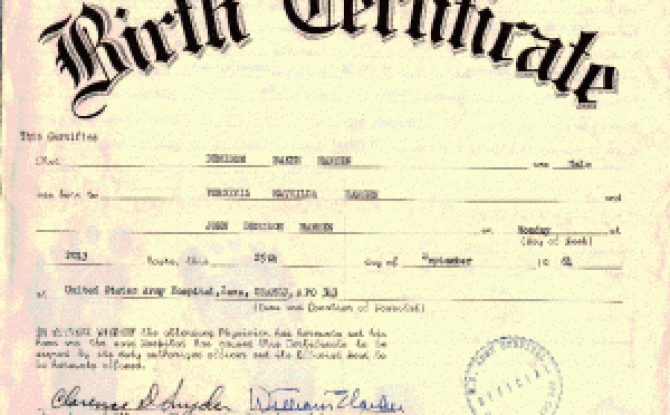
Two years after gay marriage became legal in Florida, the state has agreed to settle a federal lawsuit over birth certificates issued to children born into same-sex marriages.

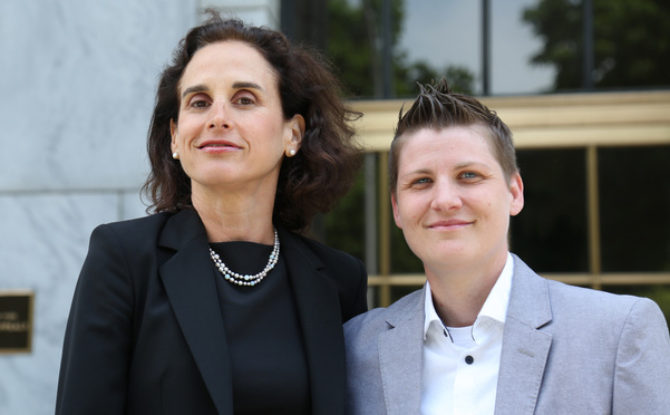
Two married lesbian couples and the advocacy group Equality Florida Institute sued the state in 2015 after health officials refused to include both parents’ names on the documents. The lawsuit came months after same-sex marriages became legal in Florida and two months after the U.S. Supreme Court struck down state bans on gay marriage as unconstitutional. 

LGBT family rights in a Trump presidency

American Flag 3D Illustration

“Now more than ever, it’s imperative that our families have every protection available under the law,” Miami family law attorney Elizabeth Schwartz said in an Equality Florida news release. “As a Florida native, I’m grateful my home state has recognized the validity of our marriages and is willing to honor legal parents on this most essential of documents.”

State Department of Health officials had contended they lacked the authority to change birth-certificate forms without lawmakers taking action, a position that led to only birth mothers — and not their spouses — being listed on the documents. But the Republican-dominated Legislature, which last year met from January until mid-March, did not approve changes to the law to recognize that same-sex marriage is legal in Florida.

The Department of Health in May asked U.S. District Judge Robert Hinkle to dismiss the lawsuit, arguing that it was moot because the state had started listing both spouses on birth certificates of children born into same-sex marriages and had started a rule-making process to allow the designation of “parent” — in addition to “mother” and “father” — on the birth records.

But lawyers for the same-sex couples and Equality Florida objected, arguing that the health department’s “recent remedial measures are both substantively incomplete and procedurally lacking in finality” and that the issues are not moot.

Last week, lawyers for the plaintiffs and the state filed a document telling Hinkle they had reached a settlement in the case.

Under the settlement, the state agreed to issue corrected birth certificates free of charge to the plaintiffs and to all same-sex couples who received incorrect documents. The state also pledged to apply the statute regarding birth certificates “and any forms promulgated based on that statute to same-sex spouses in the same manner as they are applied to opposite-sex spouses.”

The state also agreed to pay $55,000 to in legal fees and costs to the plaintiffs.
By Dara Kam, The News Service of Florida – Miamiherald.com – January 11, 2017
Click here to read the entire article. 

Arkansas Court Upholds Gay Marriage Birth Certificate Law – Blow to Same Sex Couples

Arkansas‘ highest court on Thursday threw out a judge’s ruling that could have allowed all married same-sex couples to get the names of both spouses on their children’s birth certificates without a court order, saying it doesn’t violate equal protection “to acknowledge basic biological truths.”

The state Supreme Court also issued a rare admonishment to Pulaski County Circuit Judge Tim Fox, saying he made “inappropriate remarks” in his ruling that struck down the birth certificate law. Fox had cited the U.S. Supreme Court’s decision legalizing gay marriage in his ruling last year that said married same-sex couples should have both names listed on their children’s birth certificates, just as heterosexual married couples do, without requiring a court order.Family law

In the state Supreme Court’s decision Thursday, the justices sided with the state attorney general’s office, saying Arkansas has a vested interest in listing biological parents on birth certificates.

“What is before this court is a narrow issue of whether the birth-certificate statutes as written deny the appellees due process,” Justice Josephine Linker Hart wrote in the court’s majority opinion. “…In the situation involving the female spouse of a biological mother, the female spouse does not have the same biological nexus to the child that the biological mother or the biological father has. It does not violate equal protection to acknowledge basic biological truths.”

Cheryl Maples, who sued on behalf of three same-sex couples, said she hasn’t decided yet whether to appeal to the U.S. Supreme Court. The three couples who sued were allowed to amend their children’s birth certificates last year under a ruling issued by Fox.

“There’s no requirement that DNA be given or that there be a biological relationship to a child to get on a birth certificate for a father, for the non-birth parent,” she said. “All you have to do is legitimize the child and you’re entitled, if you’re heterosexual. This is wrong.”

Judd Deere, a spokesman for Arkansas Attorney General Leslie Rutledge, said the state is “gratified” by the court’s decision.

“If any changes are appropriate it is the job of legislators to do so, not the circuit court,” he said.

Associate Justice Paul Danielson dissented and Justice Rhonda Wood concurred in part and dissented in part.

by Jill Bleed, ABCNews.com, December 8, 2016

Click here to read the entire article.

LGBT Family Rights in a Trump Presidency

Many are asking, “Will there be LGBT family rights in a Trump presidency?” While there certainly is cause for concern about the direction of our country, there are also certain realities that are reassuring.

I never thought I would be writing about LGBT family rights in a Trump presidency. But I also never received as many concerned calls from previous and prospective clients asking whether their marriages would be invalidated, or whether their second or step parent adoptions would be overturned.  These serious questions have led me to write about what I see as LGBT family rights in a Trump Presidency.

First, there is strong precedent holding that when a marriage is validly performed, it will be respected and honored under the law. This means that those LGBT Americans who are already married should not have to worry about a new Supreme Court taking their marriages away from them.LGBT family rights in a Trump presidency

For those who are not married but may wish to in the future, the question is a bit more nuanced. Shannon Minter, the legal director of NCLR, the National Center for Lesbian Rights, and one of the smartest legal minds in our community, said in a recent press release, “it is also highly unlikely that the fundamental right of same-sex couples to marry will be challenged or that the Supreme Court would revisit its 2015 holding that same-sex couples have that fundamental right.”  Mr. Minter is basing this belief on the long held tradition of the court to honor its previous decisions, a term called stare decisis.

The question many legal scholars are asking is whether a newly conservative Supreme Court will ultimately hear a case challenging the right of LGBT couples to marry and overturn the Obergefell marriage decision. While unlikely, it is possible. We can only wait to see who Trump appoints to the Supreme Court.

The most moving calls that I have received in the past days have been from people either in the process of having their families or plan to have families in the near future. They are deeply concerned about the security of their families.  I recently wrote about New York’s changing family law and how second and step parent adoption are now critical to create unassailable family protections, particularly for non-genetically related parents.  These specific forms of adoption are state based and largely shielded from Federal meddling.  That said, if you have a child and have not gone through the adoption process, it is strongly recommended that you do so now rather than later, when our Federal judicial system may be less friendly to LGBT families.

Among LGBT lawyers, one issue of great concern regards transgender Americans and obtaining accurate gender markers on federally issued identification, such as passports. While there is a transgender rights case which the Supreme Court has agreed to hear, we do not yet know whether a ninth more conservative justice will be appointed in time to hear it.

My husband reminded me that politics is cyclical. We have bounced between conservative and liberal presidents and congresses many time before, however, we have never before been faced with a president who based his entire campaign on dividing America by fearful and bigoted rhetoric.  We have never before had a President who, during his campaign, threatened to ban all Muslims from the country, or “lock up” his presidential opponent or degrade women as objects of his own control and pleasure.

Now more than ever it is time to be proactive. Many of us have experienced the shock and sadness associated with the loss of what we had hoped would be a liberal president in the White House.  We are entering uncharted territory.  LGBT family rights in a Trump Presidency will undoubtedly take some hits, but we are a strong, resilient and loving community.  And we have the tools to protect our families.   Don’t fail to use them!

By Anthony m. Brown, Esq.  November 11, 2016 – For more information, visit www.timeforfamilies.com or email Anthony at anthony@timeforfamilies.com.

New York’s Changing Family Law

New York’s changing family law finally appears to be catching up to the realities of LGBT families, at least incrementally.

A series of decisions from various New York courts is informing New York’s changing family law in ways never before imagined. Currently, in Manhattan, a court is struggling with how best to protect a child born in Ethiopia, which would only allow a single mother to adopt, now that his lesbian parents have split up.  Another recent decision out of the Kings County Family Court is one of the first to acknowledge the complexities of how we create our families, and offers sage advice as to how best we can protect them.


This new line of cases comes hot on the heels of the New York Court of Appeals case known as The Matter of Brooke S.B., which I have written about extensively.  Up until this decision, many lesbian parents who had not adopted the biological children of their partners or spouses were considered legal strangers to the children that they had raised since birth.  They were blocked by the court from seeking custody and visitation when their relationships faltered.  The Matter of Brooke S.B brings New York’s changing family law in line with many other states which recognize “de facto” parents for the purpose of custody and visitation and prioritizes the best interests of the child in making these critical decisions.

The court in Brooke S.B. was careful not to expand the definition of parentage beyond the facts of each specific case, which means that we will be seeing more and more litigation attempting to address situations that do not fall squarely in the fact pattern of Brooke S.B., like the current case in Manhattan.

In a move to address confusion created by a 2013 decision from Kings County Surrogates Court, where Judge Margarita Lopez Torres denied a lesbian couple a step parent adoption because she held that a marital presumption of parentage existed when a  child is born to a married couple, Brooklyn Family Court has offered its opinion.  New York’s Appellate division, Second Department held the opposite of Lopez Torres (Paczkowski v. Paczkowski, — N.Y.S.3d —- (2015)), creating much confusion for the LGBT community.  Brooklyn Family Court Judicial Hearing Officer (JHO) Harold Ross, in a decision titled The Matter of L., et. al, held that as long as uncertainty exists for LGBT couples who create their families with assisted reproductive technology (ART), then second parent adoptions are the best way to secure those families from this uncertainty.

The bottom line of New York’s changing family law is that with each new case that tests the limits of the court’s definition of family, hundreds of thousands, if not millions, of dollars will be spent to “make new law,” when there already exists a remedy that is affordable and is respected across the country and around the world, second and step parent adoption.  The process may be time consuming but the benefit is priceless and I believe that JHO Ross understood this and made New York’s changing family law easier for us all to grasp.

For more information, please email anthony@timeforfamilies.com.

A Complex Case Tests New York State’s Expanded Definition of Parenthood

The two women avoided each other’s gaze in the compact courtroom last week, separated by their lawyers, file boxes and three-inch binders filled with old emails and documents.

Somewhere in all the paper was the answer to a question that is being tested as never before in New York State: Were both women the parents of the energetic 6-year-old boy they loved? Or just one of them?

Deciding who is a parent in New York used to be a relatively simple matter. A parent was either biologically related to the child or had legally adopted the child. But in State Supreme Court in Manhattan, the first custody case is underway to test a newly expanded definition of parentage, as handed down by the state’s highest court in August.

The new definition is aimed at accounting for the complexity of nontraditional families, including same-sex couples. Now, to determine if someone is a parent, judges can consider whether a couple intended to have and raise a child together, among other factors. So in the courtroom in Manhattan, Circe Hamilton, 44, and her former partner Kelly Gunn, 52, are battling over whether Ms. Gunn should be recognized as a parent to the boy, Abush, whom Ms. Hamilton adopted from Ethiopia in 2011.Family law

In a city filled with complicated relationships, this one stands out. In the original adoption paperwork, completed in early 2009, the British-born Ms. Hamilton appears as a single woman with a boyfriend, and Ms. Gunn is described as a roommate. But that was because Ethiopia does not allow gay couples to adopt, both women acknowledge. In reality, the two women, who began dating in 2004, had planned to raise the child together, and their application reflected some joint assets. Ms. Gunn said her intent was to eventually co-adopt the child in a second-parent adoption proceeding.

They broke up in December 2009, and Ms. Hamilton decided to move forward with the adoption alone, she testified. Despite the breakup, the women remained close. When Ms. Hamilton went to Ethiopia to get Abush, Ms. Gunn met her and the boy in London to fly together to Manhattan. When Ms. Hamilton, a freelance photographer, returned to her tiny apartment in the West Village, she said she was overwhelmed by the challenges of parenting. Ms. Gunn, who ran a successful design company, stepped in, babysitting regularly and attending Abush’s doctors’ appointments, and briefly employing Ms. Hamilton at her firm, according to court testimony.

The women continued to occasionally stay together in a house they had once jointly owned on Fire Island. Abush had a crib there, and to Ms. Hamilton, these gestures represented the generosity of a trusted friend, she said recently. “She was someone I had loved, whom I respected,” she said of Ms. Gunn. “I had no reason not to trust a friend offering help.”

But to Ms. Gunn, the relationship with Abush was much more. She now describes her situation as analogous to that of a couple who had broken up during a biological pregnancy. It was as if the adoption agreement was a conception, conferring upon the child both her and Ms. Hamilton’s DNA. “He wouldn’t have come into our lives without me,” Ms. Gunn said. “He is a product of our mutual intention, our mutual efforts.”

The minutia of their daily lives in recent years — who took Abush to his play dates, his school appointments, his sports classes — are now pieces of a puzzle in a trial that has already had 15 days of testimony, with at least a week to go. The judge must decide whether Ms. Gunn’s involvement in Abush’s life amounts to her being a parent, and if it gives her standing to sue in a second hearing for custody and visitation.

Justice Frank P. Nervo, who is presiding over the case, has come up with questions to guide the lawyers. How formalized was the relationship between Ms. Gunn and Abush? What did he think Ms. Gunn’s role was? Did Ms. Gunn assume the duties of a parent? What would be the impact on Abush if their relationship ended?

Almost all states now legally recognize de facto parenthood to account for the realities of modern families. In expanding its parenthood definition, the New York State Court of Appeals said in its Aug. 30 ruling that it was seeking a definition that provided “equality for same-sex parents and provides the opportunity for their children to have the love and support of two committed parents.”

By Sharon Ottoman, New York Times, October 18, 2016

Click here to read the entire article.

NY Family Court – “children’s best interests are served through second parent adoptions”

“So long as uncertainty persists in this country and abroad about the status of children conceived by same-sex couples using assisted reproduction, children’s best interests are served through second parent adoptions confirming what already should be crystal clear everywhere: the legal parental status of the second non-biological parent.”

(New York, October 12, 2016) — A New York family court issued a decision last week affirming that married lesbian couples continue to be entitled to second parent adoptions to give added security to their children, who already are entitled to have both spouses recognized as their parents. The court’s decision came after Lambda Legal and its co-counsel submitted a legal memo last month on behalf of four couples, all from Brooklyn, who had sought adoptions to safeguard their children. The Court’s decision also confirms that children born to married same-sex spouses in the state have two legal parents, with or without adoptions and regardless of genetics.gay fathers

“The Court ruling is very clear that children born to married same-sex couples already have two legal parents,” said Susan Sommer, National Director of Constitutional Litigation at Lambda Legal. “But so long as uncertainty persists in this country and abroad about the status of children conceived by same-sex couples using assisted reproduction, children’s best interests are served through second parent adoptions confirming what already should be crystal clear everywhere: the legal parental status of the second non-biological parent. Children have a right to both of their parents, and taking a ‘belt and suspenders’ approach is the best way to secure that right. As this decision confirms, the courts have the authority and responsibility to issue second parent adoptions for children in these families.”

Lambda Legal filed the memo on behalf of four married lesbian couples who had petitioned the family court for second parent adoptions of children they conceived using assisted reproductive technology. Each of these couples planned for and intend to raise their children together, even though only one of the two parents is genetically related to her child. As the legal parents of the children, they are entitled to all the rights and responsibilities that come with being a parent in New York and anywhere they may travel with their children. But because the laws that define parenthood vary from state to state, these couples sought the added security of adoption decrees to confirm the parent-child bond for the non-biological parent.

The Supreme Court’s ruling in Obergefell affirmed that same-sex couples and their children across the country are entitled to all the protections that come through marriage, but some states, like North Carolina<http://www.lambdalegal.org/in-court/cases/nc_weiss-v-braer> and South Carolina, where Lambda Legal is litigating, have resisted giving full recognition to those rights. And disparities persist around the nation in laws about assisted reproduction, making parents wise to seek the extra security of second parent adoptions.

The Court’s decision confirmed that married same-sex spouses using assisted reproduction are both the legal parents of their children, with or without adoptions, and that genetics and adoption aren’t the determinants of parentage. The Court also acknowledged the lingering uncertainties and resistance to parenting rights for same-sex couples in the U.S. and abroad, and thus the importance of access to second parent adoptions for these families. Finally, the decision confirmed the courts’ ongoing authority to grant adoptions to spouses who already are the legal parents of their children under New York’s marital presumption of parentage.

Lambda Legal was joined on the memorandum of law by the following co-counsel, who represented the families in their adoption proceedings:  Teresa D. Calabrese; Rebecca L. Mendel of Rosin Steinhagen Mendel; Melissa B. Brisman and Nancy M. Hartzband of Melissa B. Brisman, Esq., LLC; and Andy Izenson of Diana Adams Law & Mediation, PLLC.

Read the memo. http://www.lambdalegal.org/in-court/legal-docs/ny_20161012_memorandum-law-judicial-authority

Read the decision. http://www.lambdalegal.org/in-court/legal-docs/ny_20161012_matter-of-l

New York Family Law, Matter of Brooke S.B.

Late August 2016 marked a turning point for New York family law and how it defines parents, particularly lesbian parents.

What the court decided – Up until this decision, many lesbian parents who had not adopted the biological children or their partners or spouses were considered legal strangers to the children that many of them had raised since birth.  Under previous New York family law, these non-biological and non-adoptive parents could not seek the legal system’s assistance in gaining custody, or even visitation, to the children who they helped to raise.

All that changed last month with a court case known as In the Matter of Brooke S.B. v. Elizabeth A.  C.C.  In this landmark decision, the court overturned previous New York precedent that had torn families apart for decades and ruled that non-biological and non-adoptive parents did have standing to sue for custody and visitation in the New York family court system.  This brings New York family law in line with many other states which recognize “de facto” parents for the purpose of custody and visitation and prioritizes the best interests of the child in making these critical decisions.remarkable parenting

What this decision does not address? – The court was careful to base its decision on the specific facts of this case, which included one very important element: the fact that the couple agreed in advance to the conception of the child.  What this means is that if a lesbian couple has children but the non-biological or non-adoptive parent entered the picture after the conception of the child, then she would not fall under the definition of a “de facto” parent as stated in this case.  Also, if the non-biological, non-adoptive parent did not consent to the conception of the child by clear and convincing evidence, she would be forestalled from seeking custody or visitation.

It is also critical to note that the court did not explicitly state that the non-biological, non-adoption mother was a legal parent of a child born to her spouse or partner for all purposes, just that she could seek custody and visitation if she had consented to the conception.  This case also did not explicitly address the notion of the marital presumption of parentage, which a mid-level appellate court has held not to apply to same-sex couples.  This concept holds that the spouse of a married woman is automatically considered the legal parent of any child she gives birth to.

Does this mean I do not have to adopt my partner or spouse’s child? – I do not believe that the court meant for this decision to be a substitute for second or step adoption.  Adoption is the one clear pathway to legal parentage and parentage includes much more that custody and visitation.  Adoption also ensures that a parent’s relationship to their child would be respected across the country and around the world.

For instance, if you are the non-biological, non-adoptive parent and you have a better health care plan at work, this decision would not mandate that an employer must put the child on your health insurance. Second or step parent adoption would, however, ensure that that the child would be protected in this situation.

Brooke S.B. was also silent on whether a legal relationship between a non-biological or non-adoptive mother would be recognized for the purposes of estate administration. This means if a legal parent dies without a Will, their children automatically share in that parent’s estate if they are married, or inherit the estate completely if the decedent spouse is not married.  Finally, the legal and emotional statement of securing your family through adoption resonates beyond just the family unit.  It establishes your family in the community, in your child’s educational institutions and, most importantly, in the eyes of the children with whom you are creating a legal family.

Brooke S.B. also fails to address how gay men can protect their families through surrogacy.  Adoption is still the best way in New York to create legal families established through surrogacy.

Brooke S.B. will undoubtedly protect many families from the horror of being torn apart because one parent was not recognized as a real parent. For that, New York family laws will be better and stronger for all families.  But this decision is not all-encompassing and when it comes to the protection of your family, the establishment of comprehensive legal parentage by a non-biological parent is the ultimate goal.  To accomplish that, a second or step-parent adoption is essential.

For more information about New York family law and the ramifications of the Brooke S.B. decision, contact Anthony Brown at Anthony@timeforfamilies.com or visit www.timeforfamilies.com today.

These Two Dads Almost Lost Their Son In A Bizarre Surrogacy Case

Jay Timmons and Rick Olson thought they’d have no legal trouble using a surrogate to birth their son. Then a rogue judge in Wisconsin pulled them into an 11-month legal battle.

Jay Timmons and Rick Olson, a married gay couple from Virginia, didn’t think they’d have any trouble becoming the legal parents of the baby boy their surrogate, a Wisconsin woman, delivered for them last year.

They had gotten the frozen embryo that became their son as a gift from straight friends whose in vitro fertilization created more embryos than they could use. They had chosen a Wisconsin surrogate specifically because the state’s Supreme Court had upheld surrogacy, and other same-sex couples had had smooth sailing there. And by just about any measure, the two intended fathers were prime parent material: They both had good jobs, they had been together for 25 years, and they were already raising two daughters from previous surrogacies.Timmons

But their careful plans went awry the month before their son, Jacob, was born, when their effort to be named his legal parents landed before a conservative judge who saw surrogacy as a form of human trafficking. Over the next 11 months, the couple’s bizarre legal battle cost more than $400,000 and kept them in constant terror of losing their son.

“We didn’t have one night’s peace,’’ Timmons, 54, a conservative Christian and president of the National Association of Manufacturers, told BuzzFeed News. “We’d wake up absolutely panicked, around 2 in the morning, and talk about the fact that we didn’t know what was going to happen.”

The couple took out second and third mortgages to cover the legal fees, and Olson, 49, quit his job as a federal lobbyist for Capital One to manage the proceedings.

Over the last couple of years, a handful of high-profile surrogacy lawsuits have cropped up in U.S. courts. In California, a surrogate named Melissa Cook refused a man’s wishes to abort one of the triplets she was carrying for him. And in a Pennsylvania, The View co-host Sherri Shepherd tried, unsuccessfully, to pull out of a contract with a pregnant surrogate after splitting up with her husband.

But the Wisconsin case is likely unprecedented, legal experts say, in that the surrogate, her husband, and the intended parents were all happy with their arrangement. Only the judge was not.

The case was a “judicial hijacking,” Melissa Brisman, a surrogacy lawyer in New Jersey, told BuzzFeed News. “We’re at a time when a lot of people are still very committed to the idea that family values means straight married couples who have sex are the only ones who should have babies.”

In June the couple won the case, thanks in large part to the judge’s abrupt resignation. Although the proceedings had played out in closed court, once it was over, supporters of Timmons and Olson provided copies of court transcripts, briefs, and filings to BuzzFeed News. And although the case is certainly an anomaly among the thousands of surrogacy arrangements made in the US every year, it underscores how, in certain areas of the country, surrogacy has become a flashpoint for cultural debates about same-sex marriage, reproductive rights, and the booming fertility industry.

by Tamar Lewin, buzzfeed.com

Click here to read the entire article.

Adoption equality in Victoria Australia starts today

LGBTI couples in Victoria can now adopt under new laws that come into effect from today.

Changes to the Adoption Amendment (Adoption by Same-Sex Couples) Act 2015 gives same-sex couples the same rights in adoption law as heterosexual couples, and gay and lesbian individuals.

“Today is a historic day in Victoria – we’re another step closer to equality for thousands of same-sex families,” said Equality Minister Martin Foley.gay parents adoption

“This law brings much needed certainty for many children and their parents who currently live in a legal haze in terms of their relationships with the people they love.”

The government said the increase in families applying to adopt will mean that there will be more opportunities for children to be matched with the best possible family.

Felicity Marlowe, co-convenor of the Rainbow Families Council, said the new laws will ensure children of LGBTI couples will now have the rights and legal protections they deserve.

“We wholeheartedly thank the Andrews Government for their commitment to equality for rainbow families. Just like us, the Premier and his Government understand that it is love that makes a family,” Marlowe said.

Anna Viola is part of a same-sex family with a daughter in a step-parent family. The law means she and her partner can now officially adopt her daughter.

“Being able to adopt means that my partner and child will be able to have their relationship bound by law and all the protections and rights that we couldn’t take for granted before,” Viola said.

“It’s a momentous step for us emotionally too – what adoption symbolises as well as what it means on paper.”

But religious exemptions will remain in place, a clause equality groups say it still discriminatory.

“We are very disappointed that faith-based services remain able to discriminate against same sex couples who apply to adopt,” said Sean Mulcahy, Co-Convenor of the Victorian Gay & Lesbian Rights Lobby.

“We firmly believe that children’s rights should never be trumped by the religious beliefs of a state-funded service provider,

“This reform marks the end to the last Victorian law to discriminate against same-sex couples. We will not stop until all LGBTI Victorians are treated equally in both law and policies.”

by Reg Domino, gaynewsnetwork.com/au

Click here to read the entire article.

New York state court rules non-biological, non-adoptive parents can seek custody, visitation if couple breaks up

ALBANY — In a major ruling for same-sex and other non-traditional couples, the state’s top court Tuesday ruled that non-biological or adoptive parents can seek visitation and custody if a couple breaks up.

Until now, the courts have held that non-biological and non-adoptive parents have no legal standing when it comes to parenting.

But the Court of Appeals changed that in a landmark ruling on Tuesday morning, overturning its own 1991 decision known as Alison D. v. Virginia M. that restricted the definition of a parent to someone with biological or adoptive connections.

lesbian family law

In the new decision, the court noted the 1991 ruling came 20 years before New York allowed gay couples to wed.

“We agree that, in light of more recently delineated legal principles, the definition of ‘parent’ established by this Court 25 years ago in Alison D. has become unworkable when applied to increasingly varied familial relationships,” Judge Sheila Abdus-Salaam wrote in the decision.

“Accordingly, today, we overrule Alison D. and hold that where a partner shows by clear and convincing evidence that the parties agreed to conceive a child and to raise the child together, the non-biological, non-adoptive partner has standing to seek visitation and custody.”

While acknowledging it’s rare for the court to change one of its previous decisions, the judges found that the 1991 Court of Appeals ruling limiting the legal definition of parents to those with a biological or adoptive relationship “has inflicted disproportionate hardship on the growing number of nontraditional families across our State.”

The decision does not guarantee that someone with no biological or adoptive link to a child can win visitation. That ultimately will be decided on a case-by-case basis by the courts based on what is determined to be in the best interest of the child.

by Kenneth Lovett, New York Daily News, August 30, 2016

Click here to read the entire article,.