
Considering Known Sperm Donors

Lesbian couples are choosing known sperm donors in increasing numbers for a variety of very important reasons. Your choice now can make a big difference in your child’s life.

Known sperm donors are a much more viable option for lesbian couples today than they have ever been.  What greater decision can there be than the biological parent of your child? Choosing an anonymous sperm donor used to be the norm.  There are many reasons why known sperm donors are becoming the preference for lesbian couples and this article explores some of the most important ones.  But first, make sure you know the law.

One of the most cited reasons for choosing known sperm donors is to have a greater insight into the biology of your child. Having a known sperm donor’s medical history can be critical for mothers who have medical or genetic issues that they must consider before having a child.  An anonymous sperm donor file will provide some medical information, but a known donor can share his family medical history, which may be crucial for the health of your child.remarkable parenting

While medical considerations are one of the top reasons for having a known donor, knowing the emotional and social character of the donor is also an often overlooked consideration in many people’s path to parenthood.  No anonymous donor profile can show the complete picture of the person who may be the biological father of your child.

Legal considerations are also important reasons to choose between anonymous donors and known sperm donors. Anonymous donors surrender their parental rights to any children born with their genetic material upon deposit to a sperm bank or fertility clinic.  When you choose an anonymous donor, they may offer the option of allowing the child to contact them at age 18, but there is no question as to their lack of parental rights to that child.

Known sperm donors in many states, New York included, must surrender their parental rights to a child born with their genetic material after the birth of that child.  And if the mother is a single parent by choice, the known donor in many states may not surrender their parental rights at all.

In New York, as in most states, the best interest of a child is considered when allowing a genetic parent surrender their parental rights. If a known donor is surrendering his parental rights to the spouse or partner of the mother, then the court will authorize that surrender.  If, however, there is no other parent who will be assuming parental rights, the known donor cannot surrender their parental rights and will be able to sue for custody and visitation.  The mother will also be able to sue that known donor for child support.  This is the most important reason why single mothers by choice should use an anonymous donor.

One reason why lesbian moms are choosing known sperm donors is for the emotional health of their children later in life. Many studies show that the more a child knows about their biological background, be they adopted, a child through surrogacy or through known or anonymous sperm donation, the better adjusted they are as adults.  These same studies also show high satisfaction levels in the mothers who have chosen known sperm donors.

One other consideration in choosing a known sperm donor is where they live. If you envision a known donor as a parental figure in your child’s life with a more active role, the donor must be geographically able to fill that role.

Finally, many mothers choose between known and anonymous donors because of the degree of control they wish to have over their family formation. Choosing a known donor can be tricky and many mothers prefer to maintain the kind of parental control over their family that can only be experienced with an anonymous donor.

Whether you are considering known sperm donors to help you create your family or whether anonymous donors are right for you, the most important part of this decision is that you and your spouse or partner are comfortable with it and on the same page. And please make sure you know the law! For more information about known sperm donation and the legalities surrounding our families, contact Anthony@timeforfamilies.com or visit www.timeforfamilies.com today.

Same-Sex Parents Still Face Obstacles Under New York’s Standing Rules

Prior to the tragic events of Sunday, June 13, 2016 in Orlando, Florida, one might have felt optimistic about the evolving societal acceptance of and respect for same-sex parents and the corresponding progressive state of family and matrimonial law.

We shared in the sense of uplift from the recent United States Supreme Court decisions in United States v. Windsor and, especially, in Obergefell. v. Hodges, decided a little over one year ago on June 26, 2015. Obergefell dealt in sweeping fashion with discriminatory and unconstitutional objections to marriage for same-sex couples. As set forth in Justice Anthony Kennedy’s dramatic and moving language, the need for same-sex parents, and the children of those relationships, to be granted the social dignity and the many societal benefits that go along with stepping into the light of mainstream acceptance by virtue of a nationwide right to marry is required by the equal protection mandates of the 14th Amendment of the U.S. Constitution.gay parents adoption

In concluding that its “analysis compels the conclusion that same-sex couples may exercise the right to marry,” 576 U.S. 12 (2015), the Supreme Court in Obergefell detailed not just the importance of being able to enter the institution of marriage, but the need for same-sex couples to do so on fully equal footing as other couples, through the front door, and stressed in its exhaustive analysis that the focus should not be on how these couples love, but that they love and wish for that love to be reflected in their social standing.

Choices about marriage shape an individual’s destiny. As the Supreme Judicial Court of Massachusetts has explained, because “it fulfils yearnings for security, safe haven, and connection that express our common humanity, civil marriage is an esteemed institution, and the decision whether and whom to marry is among life’s momentous acts of self-definition. Goodridge, 440 Mass., at 322, 798 N.E. 2d at 955″ cited at 576 U.S. 13 (2015).

As this court held in Lawrence, same sex couples have the same right as opposite-sex couples to enjoy intimate association. Lawrence invalidated laws that made same-sex intimacy a criminal act. And it acknowledged that “[w]hen sexuality finds overt expression in intimate conduct with another person, the conduct can be but one element in a personal bond that is more enduring. 539 U.S. at 567. But while Lawrence confirmed a dimension of freedom that allows individuals to engage in intimate association without criminal liability, it does not follow that freedom stops there. Outlaw to outcast may be a step forward, but it does not achieve the full promise of liberty.

576 U.S. at 14.

Further, Justice Kennedy singled out the importance of the right to marry to the children of these relationships.

Excluding same sex couples from marriage thus conflicts with a central premise of the right to marry. Without the recognition, stability, and predictability marriage offers, their children suffer the stigma of knowing their families to be somehow lesser. They also suffer the significant costs of being raised by unmarried parents, relegated through no fault of their own to a more difficult and uncertain family life. The marriage laws at issue here thus harm and humiliate the children of same-sex couples.

576 at U.S. 15.

In New York, the passage of the Marriage Equality Act in 2011 directed that all of the laws, benefits and obligations bestowed by the Domestic Relations Law with regard to marriage be read and implemented without regard to sexual orientation, and, if necessary to do that, in a gender neutral way.

Section 10-a. Parties to a marriage.

1. A marriage that is otherwise valid shall be valid regardless of whether the parties to the marriage are of the same or different sex.

2. No government treatment or legal status, effect, right, benefit, privilege, protection or responsibility relating to marriage, whether deriving from statute, administrative or court rule, public policy, common law or any other source of law, shall differ based on the parties to the marriage being or having been of the same sex rather than a different sex. When necessary to implement the rights and responsibilities of spouses under the law, all gender specific language or terms shall be construed in a gender-neutral manner in all such sources of law.

Yet, despite the passage of the Marriage Equality Act and the newfound nationwide ability to marry, the courts in New York are contending with circumstances in which same-sex families were formed and children brought into them by using strategies that pre-date the ability of same-sex couples to marry. This approach has potentially devastating consequences when those families and their respective rights are addressed in divorce and family court proceedings. These problems arise from, and the courts continue to wrestle with the vestiges of, a rule established by the New York Court of Appeals a generation ago in Alison D. v. Virginia M., 77 N.Y.2d 651 (1991), which set the stage for categorical discrimination against same-sex parents based upon their lack of a biological or adoptive relationship to a child.

The impact of Alison D. was eroded somewhat by the Court of Appeals decision in Debra H. v. Janice R., 14 N.Y.3d 576 (2010), which, through application of comity, recognized parental standing of a non-biological non-adoptive parent in 2010 based upon Vermont’s judicially created rules granting standing based upon the couple’s civil union in Vermont. However, without the right to marry or enter into a civil union in New York at the time, children of unmarried same-sex couples in New York were not afforded the same benefits and protections.

This discrimination is not so easily remedied by the directives of the Marriage Equality Act because many of the parents involved in these situation were not or are not married at the time that their children are born and because the conceptual framework for the denial of standing is based upon a biologically based terminology that is found throughout the family and matrimonial law. This terminology reflects a fixation with the biomechanics of conception, a fixation which runs deeper than mere gender assumptions. Instead of a focus on the “best interest” of children, which is the bedrock determination of all other matters related to their custody and welfare in New York matrimonial and family law, the New York Supreme, Family and Surrogate’s Courts continue to trip over the threshold issues of “standing” when it comes to same-sex parents because of references to “birth” parents or the heterosexual and gender assumptions implied by the use of the word “paternity.” For example, a “paternity” test directed in Family Court proceeding continues to only apply to men and only to establish the biological relationship of men to children obviously born to women. Perforce, this excludes same-sex couples.

By Meg Canby and Caroline Krauss Browne

law.com

Click here to read the entire article.

In win for gay couples, Maryland high court recognizes de facto parents rights

Maryland’s highest court has ruled that non-biological parents, de facto parents,  who live with and help raise children also have parental rights, overturning a 2008 decision that gay and lesbian advocates considered devastating to same-sex couples.

In a unanimous ruling issued Thursday, the Maryland Court of Appeals ruled that family-court judges can consider whether persons are de facto parents in custody and visitation cases. Advocates say Maryland was one of a few states that considered such parents strangers in the eyes of the law.

De facto parents can include the partner of a lesbian who undergoes artificial insemination, a gay man whose partner adopts a child from a country that does not allow same-sex couples to jointly adopt, or a straight man who raises a child with a woman for years without formal adoption.gay parents adoption

Until the 2008 court decision, such people generally had the ability to maintain some parental rights in Maryland even when their relationships with their partners crumbled.

Then the Court of Appeals ruled against a Baltimore County woman who sought custody or visitation rights with a girl who had been adopted by her ex-partner. The court said “third party” parents should not be treated differently from other third parties seeking custody. That meant they would need to show exceptional circumstances or that the legal parent was unfit in order to be awarded time with children they had helped raise.

This week’s ruling concerned a different case and reversed the precedent set by the court in 2008. Denying rights to third-party parents “is ‘clearly wrong’ and has been undermined by the passage of time,” Judge Sally Adkins wrote in the decision.

LGBT advocates hailed the ruling for correcting what they saw as a continuing injustice against the lesbian, gay, bisexual and transgender community, even after voters legalized same-sex marriage in 2012.

“Now Maryland joins the majority of other states in taking those parents and children out of limbo and putting them in solid legal footing,” said Jer Welter, a lawyer with FreeState Justice who represented plaintiff Michael Conover in the case ruled on this week.

Mr. Conover is a transgender man who had married a woman before undergoing his gender transition. Their wedding took place in the District, which legalized same-sex marriage before Maryland did. Courts treated him and his ex-wife as a same-sex couple for the purpose of the dispute.

Brittany Conover gave birth in 2010 to a child, Jaxon, who was fathered by a sperm donor selected with the input of Mr. Conover, then known as Michelle, according to court records. The couple separated the next year and divorced in 2013.

Ms. Conover stopped allowing her spouse to visit in 2012. She argued in a later custody battle that her former partner never adopted Jaxon and was not listed as a parent on the child’s birth certificate.

Lower courts agreed that Mr. Conover lacked parental rights. The Court of Appeals ruling returns the case to a Washington County judge with the concept of a de facto parent restored in law.

“I am elated that the state’s highest court has ruled that people like me should have our relationships with our children legally protected,” Mr. Conover said in a statement.

R. Martin Palmer Jr., an attorney for Ms. Conover, said the court usurped the role of lawmakers in defining a parent and may have created a situation in which stepfathers can take control of children from capable mothers.

By Fenit Nirappil / The Washington Post, July 9, 2016

Click here to read the entire article.

Same-Sex Couples Can Now Adopt In Every State

Yesterday, a federal judge ruled that Mississippi’s ban on same-sex couples adopting children is unconstitutional, making gay adoption legal in all 50 states.

U.S. District Judge Daniel Jordan issued a preliminary injunction against the ban, citing the Supreme Court’s decision legalizing same-sex marriage nationwide last summer. The injunction blocks Mississippi from enforcing its 16-year-old anti-gay adoption law.

The Supreme Court ruling “foreclosed litigation over laws interfering with the right to marry and rights and responsibilities intertwined with marriage,” Jordan wrote. “It also seems highly unlikely that the same court that held a state cannot ban gay marriage because it would deny benefits — expressly including the right to adopt — would then conclude that married gay couples can be denied that very same benefit.”

Mississippi HRC state director Rob Hill said this of the ruling:

Friday, July 1, 2016 via The Vital Voice

Click here to read the entire article.

Gay couple’s baby recognized as German in landmark ruling

Gay couples in Germany have limited rights when it comes to starting a family. But what if a child is born in a country with full same-sex marriage rights? One of Germany’s highest courts has given an answer.


The Federal Court of Justice on Wednesday granted German citizenship to a South African child born to lesbian mothers in a major development for LGBT family rights.

The court case centred around a child born in 2010 in South Africa to a lesbian couple – the biological mother was South African while the other mother was German.

lesbian family law

The parents were legally married in South Africa and therefore were automatically recognized equally there as the child’s parents.

But when the mothers went to Germany to register their partnership, authorities in Berlin refused to offer the child German citizenship because the biological mother was foreign.

Children born to at least one German national outside the country are normally considered German citizens within heterosexual pairs.

But unlike heterosexual couples in Germany, same-sex partners cannot marry and therefore any child had or adopted by a pair is not automatically considered the child of both.

The only way that same-sex couples can start a family together is through something called successive adoption – generally one partner adopting the biological child of the other.

The German mother had not done this in her home country.

June 15, 2016

Click here to read the entire article.

Gay custody battles force law to define what a parent is

A spate of gay custody battles are forcing the law to reconsider what constitutes a parent, with one particular case in New York set to have major implications for many more LGBTI couples.

The New York Court of Appeals is to decide whether the ex-girlfriend of a child’s biological mother should have legal parenting rights – despite having never adopted the child in question, or been married to the biological mother in one a several gay custody battles that could define LGBT family law in New York and around the country.

Brooke Barone claims she acted as the child’s ‘Mamma B’ when her girlfriend Elizabeth Cleland gave birth after artificial insemination. But when the couple split up, Cleland reportedly denied Barone visitation rights to the child – which is what Barone is now fighting for in court. Cleland claims she does not feel safe leaving her child with Barone.

lesbian family law

drawing of a happy couple of lesbians and adopted child

Tangled gay custody battles

The argument against awarding parental rights outside of biology, marriage or adoption centers on the potential for opening up bogus parenting claims. These, lawmakers argue, could come from friends, nannies, or even abusive partners seeking to gain control and cause distress.

However, those in favor of broadening the definition of a parent point out heterosexual men have been recognized as parents without genetic or adoptive connections, in order to compel child support payments.

The legalization of same-sex marriage in the US has thrust the tangled legalities of same-sex families into the spotlight, with several similar cases currently being fought in other US states, including another typically gay-friendly state, Massachusetts. And in Canada, the premier of Ontario has pledged to change the law so that both parents in an LGBTI couple are immediately entered onto the birth certificate, hopefully avoiding gay custody battles. This is a huge change to the province’s current law, where a non-biological parent in a same-sex couple is forced to begin the lengthy and costly adoption process in order to be legally recognized.

Speaking to The Wall Street Journal, Columbia Law professor Suzanne Goldberg said that ‘It’s only an accident of law that leads one of those parents to be unrecognized [in these cases].’

New York decision to set precedent

Even when a partner has adopted the child, however, a biological parent looking to disavow their former partner of parentage has legal recourse – as a recent case involving a lesbian couple in Alabama showed. The Alabama courts were eventually obliged by the US Supreme Court to find in favor of the adoptive parent, however.

Click here to read the entire article.

GayStarNews.com – June 5, 2016 by Laura Chubb

Gay Family Values

In 2016 it seems almost archaic to write about gay family values, but the truth is that many in this country still do not understand exactly what they are.


First, let’s unpack the term, “family values,” because its modern day origin sheds light on the journey our understanding of the term has made over approximately the last 30 years. Many credit the rise of “family values” with the birth of the religious right.  The religious right stemmed from a failed presidential bid by conservative evangelical Pat Robertson in 1988.  Pat Robertson and Southern Baptist pastor Jerry Falwell maintained one of the most successful movements deriving from a losing campaign, which was the “religious right.”  Family values was the buzzword for any number of anti-gay, anti-women, racially motivated campaigns to keep right wing, mostly Republican politicians in office by driving wedges between the electorate to maintain political control.  With this background, gay family values were absolutely unheard of.Gay dads

Gay family values have a much richer and historic past. Gay people have been having families, raising children and living lives of value since the beginning of recorded history.  The very same qualities espoused to be superior, or correct, by the religious right are the same values that gay parents teach their children and gay children teach their parents.  And it is interesting that these values, when interpreted for political reasons, tend to be based in religion.  This is particularly interesting when you consider that Jerry Falwell’s father was a bootlegger and an agnostic and his grandfather was an atheist, yet he managed to be “valuable.”

While in law school, I did my summer internship at Lambda Legal, the nation’s foremost LGBT impact litigation organization.  I was fortunate enough to work on a case called Lawrence v. Texas.  This landmark gay rights case decriminalized gay sex, which was literally a criminal offence. Prior to its decriminalization, it was used to deny employment, take children from fit parents and serve to marginalize the LGBT community in many states. Lawrence v. Texas was seen by many as the foundation for marriage equality.  Ever since working at Lambda Legal, I knew that I wanted to work with couples and families to protect their interests, and their values.

I have had the privilege of being an attorney for the last 13 years working with gay families, unmarried couples and essentially anyone who falls outside the misnomer, “traditional,” as their family and trusts and estate lawyer. I have seen people go out of their way and spend sometimes unthinkable amounts of money to create the legal protections that most “traditional” couples and families take for granted.  Fighting to ensure the security of your family, in my estimation, is the definition of family value.

While basic estate plans and second or step parent adoptions are certainly critical, and a big part of ensuring the safety of children in these families, that is not the type of gay family values that I’m talking about.  It is the concept of putting your family’s interests above your own.  It is the simple joy of learning from your child about their understanding of the world.  And it is something far more universal than many who have not been exposed to family structures other than their own may not be able to comprehend.  When I meet other families that don’t look like mine, and they meet my family, the spark of possibility is lit for an exchange of information that is critical for value development.

adoption new york,new york adoption,new york state adoption, stepparent adoption process,adopting step children,co parent adoption,2nd parent adoption,second parent adoptions,gay adoption new york,gay couple adoption, gay couples adoptingI count my blessings every day that my son Nicholas, a six and a half year old with the soul of my departed father, is growing up in New York City, where every language is spoken and where every culture is practiced. I am grateful that my daughters have parents who love them and who share with them the possibilities of life that their parents shared with them.  The truth about gay family values is that there is no such thing.  Family values are born from love and respect, not only between family members, but among the different families that exist all over the world.  Those values are exclusive to no particular group.
My son asked my husband and me the other night when we could go to Paris. My first thought was, “when you get a job,” but after reality set in, I started to think what it would really be like to really show him other cultures.  What an absolute honor it would be to share the world with Nicholas and to see it through his eyes.  There really is no better way to understand family values than to see them at work in other families.  So until we get to Paris, you can look for us tooling around the West Village of New York City.  You can’t miss us.  We’ll be the ones with the values!

For more information about creating and protecting your family, contact Anthony M. Brown at Time for Families.

Same-sex unions are not enough, say exiled Italian gay parents

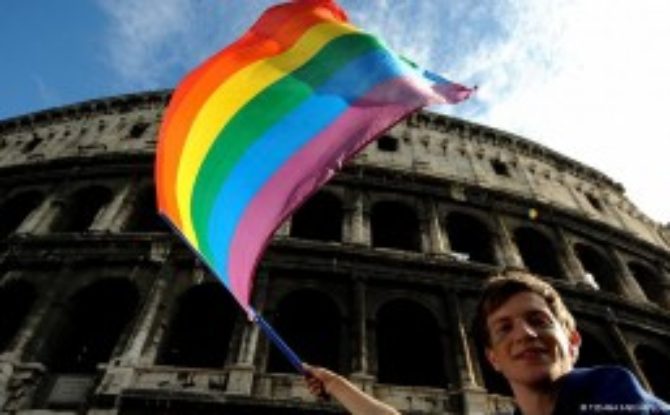
When the Italian parliament this week gave the green light to same-sex couples – becoming the last western European country to do so – the Trevi fountain in Rome was lit up in rainbow colours to celebrate, hailing the move as a major step forward for LGBT rights.

But for Italian families living abroad, the spectre of discrimination against gay couples lives on in restrictive adoption laws which can lead to gay parents having no legal rights over their children by a largely conservative, Catholic and sometimes hostile court system.

Current legislation gives same-sex couples the right to share a surname, draw on their partner’s pension when they die and inherit each other’s assets in the same way as married people.

But it has been fiercely criticised for not providing full equality for gay couples, particularly in terms of adoption rights. While adoption has not been ruled out, family judges will decide on a case-by-case basis.international surrogacy

It means that families who have already adopted abroad will have to go through lengthy court procedures to have their adoption recognised in Italy.

Among them are Giovanni and Marco, two Italian dads living abroad who say they can never return home for fear of the state viewing them as strangers to their adopted children.

“The adoption [of our children] is not recognised by the Italian state, so we could be legally treated as strangers to each other,” they told the Telegraph.

“Whenever we cross the Italian border the parental responsibility over our children falls in a legal grey area. We travel with the contact details of the British Foreign Office and the Adoption Order in case anyone starts questioning ‘why the mother is not travelling with the children?'”

Carolina Girardelli, an Italian lawyer specialising in international adoption, said: “Children [adopted abroad] have no rights as Italian citizens [if their parents are gay].

“You can ask a family judge to recognise your adoption papers but in Italy we have the Church, and a lot of Catholic judges. If one of them is against gay unions, you could lose the case.”

by Mauro Galluzo, May 15, 2016 – telegraph.co.uk

Click here to read the entire article.

Gay Parents Adoption – New Possibilities

Gay parents adoption used to be unheard of.

While certain countries still struggle with the concept of our families being equal to all others, in America, the foundation for gay parents adopting has been set and the legal protections for these families are available and critical to creating security in these family structures.  There are several means by which gay parents adoption can occur. I will review the most common: private adoption, public adoption and second or step parent adoption.

Private Adoption – There are several reasons that parents looking to adopt a child may look into private adoption, sometimes referred to as domestic adoption. The availability of children is higher than most people expect.  In the most recent year for which accurate data exists, there were over 18,000 domestic non-relative adoptions of newborns within the United States. Although the number of people placing their children for adoption has fallen dramatically since the 1970s due to the stigma of single-parenthood thankfully decreasing, there are still many birth parents making the painful but loving choice to look for a family for their biological child.

The adoption of the child can be done in one of two ways. The first is to engage an agency to walk you through the process and to help you with paperwork and the emotional upheaval that such a big life decision will inevitably bring. The benefits to involving an agency are numerous; for example, having your own ‘Adoption Specialist’ who will help you communicate with the various other professionals who need to be involved in the process such as social workers, physicians and lawyers. Financial assistance may be available to help cover legal fees, and agencies often do not charge to process the adoption.

lesbian family law

drawing of a happy couple of lesbians and adopted child

The second is a private arrangement whereby a birth mother and prospective parents arrange the adoption between themselves. They will have to hire lawyers and meet the legal requirements of adoption such as age, ability to care for the child and other important aspects. Parents who want to adopt are able to ‘advertise’ for a birth mother, and mothers who have chosen adoption for their child are able to do the same for an adoptive family.

Public Adoption – Foster children are in the legal custody of a commissioner of a social services district. That district may give responsibility for the care of the child to a voluntary authorized agency. When a child is in foster care, decisions must be made regarding the long-range permanency plan for the child. If the social services district decides that it would not be in the child’s best interests to return home and that the child should be adopted, steps must be taken to legally free the child for adoption.

There are three ways a child can become legally free for gay parents adoption: 1) the birth parents can sign a voluntary surrender agreement; 2) the social services district responsible for the child can bring a case in court asking the judge to terminate the parental rights of the birth parents; or 3) if both birth parents are deceased, or one parent is deceased and there is no other parent whose consent to the adoption is required, the child is automatically free for adoption.  Read more at the NY State Office of Children and Family Services, the source of this information.

Second or Step Parent Adoption – One increasingly popular methods for gay parents adoption is when one parent has a biologically related child of their own and their partner or spouse adopts that child.  If the couple is not married it is referred to as a “second parent adoption” and if they are married, it is referred to as a “step parent adoption.”   For both gay and lesbian couples, securing the legal rights of a non-biological parent is crucial to create the kind of emotional, and legal, security that most other families take for granted. The legality of both parents relationship to their child is often assumed. Parents are parents, regardless of the biological connection to your child.

While recent case law is catching up to our families, it is still lagging in the ability to create complete security without adoption, or a birth order from a competent jurisdiction.  Whichever path you choose to having your family, It is critical to speak with an attorney with experience in the field.  When you consider gay parent adoption, please consider me a resource. For more information on family estate planning, contact Anthony M. Brown at Time for Families and speak to a specialist family lawyer to secure your and your family’s future.

Contact Time For Families

Contact Form
* indicates required field

Italian couple win international second parent adoption case


Two gay Italian women have won the right to international second parent adoption, a legal first for the country. All previous verdicts in Italy in favour of lesbian women being legally recognized as the parents of their partner’s children are at the appeal stages.

In its judgment on Friday, Rome’s juvenile court said Marilena Grassadonia, president of the Rainbow Families association, could adopt her wife’s twin boys via international second parent adoption. In turn, her partner adopted Grassadonia’s son. All three were conceived by artificial insemination.

In March, a man won his request to adopt his partner’s child, but rights watchers believed the ruling may have slipped through the net due to an administrative error, with the office of the prosecutor in charge of the case failing to file an appeal in time.adoption

Grassadonia was a vocal campaigner in Italy during the heated debate earlier this year over a contested civil unions bill.

The text, adopted by parliament’s upper house after a clause allowing gay couples second parent adoption was removed, will be examined by the lower house from 9 May.

Italy’s prime minister Matteo Renzi has said he will resort to a confidence vote on the government, if necessary, to make the bill law.

While they wait for a change in the law, courts have been finding in favour of gay couples since 2014 on the basis of current legislation that favours “emotional continuity” for children.

The Guardian – April 30, 2016

Click here to read the entire article.