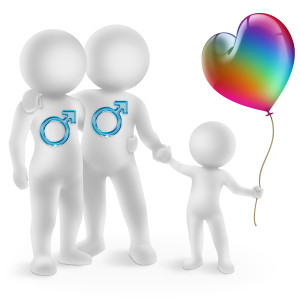
Gay custody battles force law to define what a parent is

A spate of gay custody battles are forcing the law to reconsider what constitutes a parent, with one particular case in New York set to have major implications for many more LGBTI couples.

The New York Court of Appeals is to decide whether the ex-girlfriend of a child’s biological mother should have legal parenting rights – despite having never adopted the child in question, or been married to the biological mother in one a several gay custody battles that could define LGBT family law in New York and around the country.

Brooke Barone claims she acted as the child’s ‘Mamma B’ when her girlfriend Elizabeth Cleland gave birth after artificial insemination. But when the couple split up, Cleland reportedly denied Barone visitation rights to the child – which is what Barone is now fighting for in court. Cleland claims she does not feel safe leaving her child with Barone.

lesbian family law

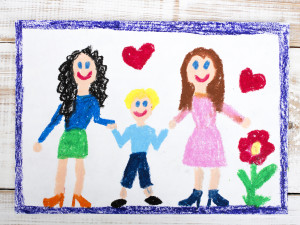
drawing of a happy couple of lesbians and adopted child

Tangled gay custody battles

The argument against awarding parental rights outside of biology, marriage or adoption centers on the potential for opening up bogus parenting claims. These, lawmakers argue, could come from friends, nannies, or even abusive partners seeking to gain control and cause distress.

However, those in favor of broadening the definition of a parent point out heterosexual men have been recognized as parents without genetic or adoptive connections, in order to compel child support payments.

The legalization of same-sex marriage in the US has thrust the tangled legalities of same-sex families into the spotlight, with several similar cases currently being fought in other US states, including another typically gay-friendly state, Massachusetts. And in Canada, the premier of Ontario has pledged to change the law so that both parents in an LGBTI couple are immediately entered onto the birth certificate, hopefully avoiding gay custody battles. This is a huge change to the province’s current law, where a non-biological parent in a same-sex couple is forced to begin the lengthy and costly adoption process in order to be legally recognized.

Speaking to The Wall Street Journal, Columbia Law professor Suzanne Goldberg said that ‘It’s only an accident of law that leads one of those parents to be unrecognized [in these cases].’

New York decision to set precedent

Even when a partner has adopted the child, however, a biological parent looking to disavow their former partner of parentage has legal recourse – as a recent case involving a lesbian couple in Alabama showed. The Alabama courts were eventually obliged by the US Supreme Court to find in favor of the adoptive parent, however.

Click here to read the entire article.

GayStarNews.com – June 5, 2016 by Laura Chubb

Gay Family Values

In 2016 it seems almost archaic to write about gay family values, but the truth is that many in this country still do not understand exactly what they are.


First, let’s unpack the term, “family values,” because its modern day origin sheds light on the journey our understanding of the term has made over approximately the last 30 years. Many credit the rise of “family values” with the birth of the religious right.  The religious right stemmed from a failed presidential bid by conservative evangelical Pat Robertson in 1988.  Pat Robertson and Southern Baptist pastor Jerry Falwell maintained one of the most successful movements deriving from a losing campaign, which was the “religious right.”  Family values was the buzzword for any number of anti-gay, anti-women, racially motivated campaigns to keep right wing, mostly Republican politicians in office by driving wedges between the electorate to maintain political control.  With this background, gay family values were absolutely unheard of.Gay dads

Gay family values have a much richer and historic past. Gay people have been having families, raising children and living lives of value since the beginning of recorded history.  The very same qualities espoused to be superior, or correct, by the religious right are the same values that gay parents teach their children and gay children teach their parents.  And it is interesting that these values, when interpreted for political reasons, tend to be based in religion.  This is particularly interesting when you consider that Jerry Falwell’s father was a bootlegger and an agnostic and his grandfather was an atheist, yet he managed to be “valuable.”

While in law school, I did my summer internship at Lambda Legal, the nation’s foremost LGBT impact litigation organization.  I was fortunate enough to work on a case called Lawrence v. Texas.  This landmark gay rights case decriminalized gay sex, which was literally a criminal offence. Prior to its decriminalization, it was used to deny employment, take children from fit parents and serve to marginalize the LGBT community in many states. Lawrence v. Texas was seen by many as the foundation for marriage equality.  Ever since working at Lambda Legal, I knew that I wanted to work with couples and families to protect their interests, and their values.

I have had the privilege of being an attorney for the last 13 years working with gay families, unmarried couples and essentially anyone who falls outside the misnomer, “traditional,” as their family and trusts and estate lawyer. I have seen people go out of their way and spend sometimes unthinkable amounts of money to create the legal protections that most “traditional” couples and families take for granted.  Fighting to ensure the security of your family, in my estimation, is the definition of family value.

While basic estate plans and second or step parent adoptions are certainly critical, and a big part of ensuring the safety of children in these families, that is not the type of gay family values that I’m talking about.  It is the concept of putting your family’s interests above your own.  It is the simple joy of learning from your child about their understanding of the world.  And it is something far more universal than many who have not been exposed to family structures other than their own may not be able to comprehend.  When I meet other families that don’t look like mine, and they meet my family, the spark of possibility is lit for an exchange of information that is critical for value development.

adoption new york,new york adoption,new york state adoption, stepparent adoption process,adopting step children,co parent adoption,2nd parent adoption,second parent adoptions,gay adoption new york,gay couple adoption, gay couples adoptingI count my blessings every day that my son Nicholas, a six and a half year old with the soul of my departed father, is growing up in New York City, where every language is spoken and where every culture is practiced. I am grateful that my daughters have parents who love them and who share with them the possibilities of life that their parents shared with them.  The truth about gay family values is that there is no such thing.  Family values are born from love and respect, not only between family members, but among the different families that exist all over the world.  Those values are exclusive to no particular group.

My son asked my husband and me the other night when we could go to Paris. My first thought was, “when you get a job,” but after reality set in, I started to think what it would really be like to really show him other cultures.  What an absolute honor it would be to share the world with Nicholas and to see it through his eyes.  There really is no better way to understand family values than to see them at work in other families.  So until we get to Paris, you can look for us tooling around the West Village of New York City.  You can’t miss us.  We’ll be the ones with the values!

For more information about creating and protecting your family, contact Anthony M. Brown at Time for Families.

Same-sex unions are not enough, say exiled Italian gay parents

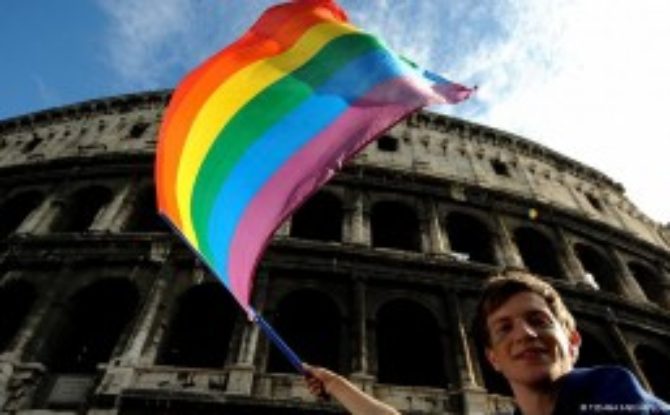
When the Italian parliament this week gave the green light to same-sex couples – becoming the last western European country to do so – the Trevi fountain in Rome was lit up in rainbow colours to celebrate, hailing the move as a major step forward for LGBT rights.

But for Italian families living abroad, the spectre of discrimination against gay couples lives on in restrictive adoption laws which can lead to gay parents having no legal rights over their children by a largely conservative, Catholic and sometimes hostile court system.

Current legislation gives same-sex couples the right to share a surname, draw on their partner’s pension when they die and inherit each other’s assets in the same way as married people.

But it has been fiercely criticised for not providing full equality for gay couples, particularly in terms of adoption rights. While adoption has not been ruled out, family judges will decide on a case-by-case basis.international surrogacy

It means that families who have already adopted abroad will have to go through lengthy court procedures to have their adoption recognised in Italy.

Among them are Giovanni and Marco, two Italian dads living abroad who say they can never return home for fear of the state viewing them as strangers to their adopted children.

“The adoption [of our children] is not recognised by the Italian state, so we could be legally treated as strangers to each other,” they told the Telegraph.

“Whenever we cross the Italian border the parental responsibility over our children falls in a legal grey area. We travel with the contact details of the British Foreign Office and the Adoption Order in case anyone starts questioning ‘why the mother is not travelling with the children?'”

Carolina Girardelli, an Italian lawyer specialising in international adoption, said: “Children [adopted abroad] have no rights as Italian citizens [if their parents are gay].

“You can ask a family judge to recognise your adoption papers but in Italy we have the Church, and a lot of Catholic judges. If one of them is against gay unions, you could lose the case.”

by Mauro Galluzo, May 15, 2016 – telegraph.co.uk

Click here to read the entire article.

Gay Parents Adoption – New Possibilities

Gay parents adoption used to be unheard of.

While certain countries still struggle with the concept of our families being equal to all others, in America, the foundation for gay parents adopting has been set and the legal protections for these families are available and critical to creating security in these family structures.  There are several means by which gay parents adoption can occur. I will review the most common: private adoption, public adoption and second or step parent adoption.

Private Adoption – There are several reasons that parents looking to adopt a child may look into private adoption, sometimes referred to as domestic adoption. The availability of children is higher than most people expect.  In the most recent year for which accurate data exists, there were over 18,000 domestic non-relative adoptions of newborns within the United States. Although the number of people placing their children for adoption has fallen dramatically since the 1970s due to the stigma of single-parenthood thankfully decreasing, there are still many birth parents making the painful but loving choice to look for a family for their biological child.

The adoption of the child can be done in one of two ways. The first is to engage an agency to walk you through the process and to help you with paperwork and the emotional upheaval that such a big life decision will inevitably bring. The benefits to involving an agency are numerous; for example, having your own ‘Adoption Specialist’ who will help you communicate with the various other professionals who need to be involved in the process such as social workers, physicians and lawyers. Financial assistance may be available to help cover legal fees, and agencies often do not charge to process the adoption.

lesbian family law

drawing of a happy couple of lesbians and adopted child

The second is a private arrangement whereby a birth mother and prospective parents arrange the adoption between themselves. They will have to hire lawyers and meet the legal requirements of adoption such as age, ability to care for the child and other important aspects. Parents who want to adopt are able to ‘advertise’ for a birth mother, and mothers who have chosen adoption for their child are able to do the same for an adoptive family.

Public Adoption – Foster children are in the legal custody of a commissioner of a social services district. That district may give responsibility for the care of the child to a voluntary authorized agency. When a child is in foster care, decisions must be made regarding the long-range permanency plan for the child. If the social services district decides that it would not be in the child’s best interests to return home and that the child should be adopted, steps must be taken to legally free the child for adoption.

There are three ways a child can become legally free for gay parents adoption: 1) the birth parents can sign a voluntary surrender agreement; 2) the social services district responsible for the child can bring a case in court asking the judge to terminate the parental rights of the birth parents; or 3) if both birth parents are deceased, or one parent is deceased and there is no other parent whose consent to the adoption is required, the child is automatically free for adoption.  Read more at the NY State Office of Children and Family Services, the source of this information.

Second or Step Parent Adoption – One increasingly popular methods for gay parents adoption is when one parent has a biologically related child of their own and their partner or spouse adopts that child.  If the couple is not married it is referred to as a “second parent adoption” and if they are married, it is referred to as a “step parent adoption.”   For both gay and lesbian couples, securing the legal rights of a non-biological parent is crucial to create the kind of emotional, and legal, security that most other families take for granted. The legality of both parents relationship to their child is often assumed. Parents are parents, regardless of the biological connection to your child.

While recent case law is catching up to our families, it is still lagging in the ability to create complete security without adoption, or a birth order from a competent jurisdiction.  Whichever path you choose to having your family, It is critical to speak with an attorney with experience in the field.  When you consider gay parent adoption, please consider me a resource. For more information on family estate planning, contact Anthony M. Brown at Time for Families and speak to a specialist family lawyer to secure your and your family’s future.

Contact Time For Families

Contact Form
* indicates required field

Children’s Books To Help Discuss Gender and Being Different With Your Kids

Some time ago, our blogger Stephen Stratton wrote an excellent article entitled “How to Talk About Gender and Trans People With Your Kids.”

We are republishing Stephen’s list of good children’s books dealing with being different, gender, and trans people. Reading them with your kids could be a great starting point for conversations in your family about these topics.

In Stephen’s words, “When we start to break it down, the easiest way to talk to your children about trans people is just to make space to talk about gender, early and often. The more we as a community normalize openness and honesty around gender and trans experience, the more space we make in the world for families like mine to feel safe, welcome and celebrated.”

I Am Jazz – Jessica Herthel

The story of a transgender child based on the real-life experience of Jazz Jennings, who has become a spokesperson for transkids everywhere

“This is an essential tool for parents and teachers to share with children whether those kids identify as trans or not. I wish I had had a book like this when I was a kid struggling with gender identity questions. I found it deeply moving in its simplicity and honesty.” — Laverne Cox (who plays Sophia in “Orange Is the New Black”)

From the time she was two years old, Jazz knew that she had a girl’s brain in a boy’s body. She loved pink and dressing up as a mermaid and didn’t feel like herself in boys’ clothing. This confused her family, until they took her to a doctor who said that Jazz was transgender and that she was born that way. Jazz’s story is based on her real-life experience and she tells it in a simple, clear way that will be appreciated by picture book readers, their parents, and teachers.

My Princess Boy – Cheryl Kilodavis

Dyson loves pink, sparkly things. Sometimes he wears dresses. Sometimes he wears jeans. He likes to wear his princess tiara, even when climbing trees. He’s a Princess Boy.

Inspired by the author’s son, and by her own initial struggles to understand, this is a heart-warming book about unconditional love and one remarkable family. It is also a call for tolerance and an end to bullying and judgments. The world is a brighter place when we accept everyone for who they are.

10,000 Dresses – Marcus Ewert

Every night, Bailey dreams about magical dresses: dresses made of crystals and rainbows, dresses made of flowers, dresses made of windows … Unfortunately, when Bailey’s awake, no one wants to hear about these beautiful dreams. Quite the contrary. “You’re a BOY!” Mother and Father tell Bailey. “You shouldn’t be thinking about dresses at all.” Then Bailey meets Laurel, an older girl who is touched and inspired by Bailey’s imagination and courage. In friendship, the two of them begin making dresses together. And Bailey’s dreams come true!

This gorgeous picture book — a modern fairy tale about becoming the person you feel you are inside — will delight people of all ages.

Red: A Crayon’s Story – Michael Hall

A blue crayon mistakenly labeled as “red” suffers an identity crisis in the new picture book by the New York Times-bestselling creator of “My Heart Is Like a Zoo” and “It’s an Orange Aardvark!” Funny, insightful, and colorful, “Red: A Crayon’s Story,” by Michael Hall, is about being true to your inner self and following your own path despite obstacles that may come your way. “Red” will appeal to fans of Lois Ehlers, Eric Carle, and “The Day the Crayons Quit,” and makes a great gift for readers of any age!

Red has a bright red label, but he is, in fact, blue. His teacher tries to help him be red (let’s draw strawberries!), his mother tries to help him be red by sending him out on a playdate with a yellow classmate (go draw a nice orange!), and the scissors try to help him be red by snipping his label so that he has room to breathe. But Red is miserable. He just can’t be red, no matter how hard he tries! Finally, a brand-new friend offers a brand-new perspective, and Red discovers what readers have known all along. He’s blue! This funny, heartwarming, colorful picture book about finding the courage to be true to your inner self can be read on multiple levels, and it offers something for everyone!

Jacob’s New Dress – Sarah Hoffman

Jacob loves playing dress-up, when he can be anything he wants to be. Some kids at school say he can’t wear “girl” clothes, but Jacob wants to wear a dress to school. Can he convince his parents to let him wear what he wants? This heartwarming story speaks to the unique challenges faced by boys who don’t identify with traditional gender roles.

Meet Polkadot (The Polkadot Series Book 1) – Talcott Broached

Have you been looking for a story with which to begin and/or continue meaningful and accurate conversations about gender identity?

Perhaps you wish to have dialogues that center and normalize transgender identities but you feel worried you may not have accurate information?

Maybe you ARE trans or you have a child/family member who is trans and you are ready for a book that honors transgender experiences rather than sensationalizes transgender lives and bodies?

Meet Polkadot is the first in a series of books that introduces readers to our main character Polkadot, a non-binary, transgender child. This book is an accessible introduction and primer to the the diversity of gender identity, the importance of allyship, and the realness of kids like Polkadot.

Gayswithkids.com – April 25, 2016

Click here to read the entire article.

Two Moms Talk About Second Parent Adoption

Not all LGBT parents in the U.S. can put both parents’ names on their children’s birth certificate.  Second Parent adoption can help.

And even if they can, many lawyers still advise that gay couples go through a second parent adoption as a means to protect their parental rights to their children.

Brandy and Susan from The Next Family discuss their second parent adoption experience so other LGBT parents can gain some insight.

The moms explain the importance of second parent adoption by providing the example of traveling internationally to countries that don’t recognize same-sex marriage or families. By going through the process, step parent adoptions give both parents the same rights to their children thus protecting them in the U.S., overseas, and even in custody cases.second parent adoption

“And at the end of the day, I think it’s wise to do it,” Brandy said.

Though she does share her displeasure with the entire process that LGBT parents have to go through that straight parents do not:

“We fight so hard for our LGBT rights and we’ve gotten to this point and this place in our country…and [step parent adoptions] sort of takes you back. Like, really?”

Brandy and Susan explain the process that their family went through when it came to their step parent adoption. It involved finding a good lawyer, filling out an adoption application, and speaking with a social worker.

When speaking about the social worker experience, Brandy said, “They were asking us sort of ridiculous, in my opinion, parenting questions.” She also adds that you should prepare yourself for this experience which may be uncomfortable: “I think it was really insulting to me that they were asking her these questions and me these questions and I had had this child and we had together made this decision together to have this child.”

Following the social worker meeting, families will have to go to court to complete the adoption process.

For Susan’s court date, the judge asked her, “Why should I grant you this right to adopt this child?” Susan said she responded quite awkwardly with, “Well, I’m kind of doing a lot of mother things.” She was happy though with how the judge responded, “You’re the mother and that’s why I’m doing it.” Susan said she could tell that the judge thought that the entire process was also a “silly precursor” to establish her parental rights.

Click here to read the entire article.

By Alex Temblador – TheNextFamily.com – April 15, 2016

Coca-Cola Will Offer More Inclusive Parental Leave, Including Surrogacy

Citing the influence of its millennial employees and the need to promote gender equality at work, Coca-Cola on Monday announced a far more inclusive paid parental leave policy.


Previously, Coke only gave six to eight weeks paid parental leave to female employees who gave birth. But starting in January, all new parents at Coke — including dads, adoptive and foster parents — will be entitled to six weeks off upon the arrival of their kids. Birth mothers will also be entitled to an additional six to eight weeks leave. The new benefit is not available to unionized Coke workers. Overall 40,000 employees are eligible, out of 60,000 in the U.S.2nd parent adoption, second parent adoption, second parent adoptions, second parent adoption new york

“Fostering an inclusive workplace means valuing all parents – no matter their gender or sexual orientation,” Ceree Eberly, Coke’s chief people officer, said in an announcement on the company’s website. “We think the most successful way to structure benefits to help working families is to make them gender-neutral and encourage both moms and dads to play an active role in their family lives.”

The company, which took in $44 billion in revenue last year, said the policy was “championed” by a formal group of millennial employees who had been asked to come up with ideas for attracting and retaining younger workers. By 2020, Coke expects more than half of its workforce will be of the “millennial generation,” born between 1981 and 1997.

HuffingtonPost.com, April 18, 2016, by Emily Peck

Click here to read the entire article.

Adoption For Gay Couples is Still the Best Answer – The Message of Matter of Kelly S. v. Farah M.

Does this case render adoption for gay couples as unnecessary or is it simply an affirmation of another state’s more progressive parentage laws?

There has never been a stronger case for adoption for gay couples than Matter of Kelly S. v. Farah M.  I reported this week about a case out of the Second Department Appellate Division in New York affirming a Suffolk County Family Court decision granting visitation to a non-biological lesbian mother. At first glance, this appears to create new law in New York, doing away with previous NY law holding that a non-biological mother does not have standing to seek custody or visitation.  But on further inspection, its true message is that the only way to avoid costly and bitter court battles is through adoption for gay couples.
adoption for gay couples

Facts of the case – Kelly Steagall and Farah Martin met and entered into a relationship in 2000 and became registered domestic partners in California in 2004. They were legally married there in 2008.  Ms. Martin conceived two children through artificial insemination who were born in March of 2007 and April of 2009.  The couple used the same known donor for each child and, instead of using a doctor or fertility clinic to assist with the insemination, they privately inseminated at home.  After moving to New York in 2012, the couple separated in 2013 and Kelly moved to Arizona.  Kelly filed a visitation petition in Suffolk County New York in 2014.

Ms. Martin objected to Ms. Steagall’s status as a legal parent stating that New York law did not support her position and, in what the court saw a self-serving move, sued the known donor to establish that he was the other “true” parent.

What the court said – Appellate division Judge Roman, in her affirmation of the lower Family Court’s ruling, stated that because the couple was in a registered domestic partnership and subsequent marriage in California when the children were born, California law, which is far more progressive that New York family law, should govern and therefore, Ms. Steagall’s parentage could be recognized under California law.

New York Law – In New York County, Surrogate Judge Kristin Booth Glen, in a case entitled In the Matter of Sebastian, discusses the issue of establishing parental rights for a non-biological parent specifically.  The case involves married lesbian couple who used an anonymous sperm donor to have a child. Glen concludes, when discussing the non-biological mother’s relationship with the child that, “the only remedy available here that would accord the parties full and unassailable protection is a second-parent adoption pursuant to New York Domestic Relations Law (“DRL”) § 111 et seq.”  Glen further states, “that a judicial order of adoption in one state must be afforded full faith and credit in every state, and that there can be no “public Policy” exception to that mandatory recognition…”.

This case essentially relies on a marital presumption of parentage. In California, a registered domestic partnership at the time was viewed for all intents and purposes as a marriage.  While it is true that many states have what is called a “martial presumption of parentage,” it is applied differently in different states.  In New York State, there is specific case law that holds that the marital presumption of parentage does not apply to same-sex couples.  That case is called “Matter of Paczkowski v. Paczkowski.”  In that case, the appellate division of the Second Department of New York, the same court that decided the Matter of Kelly S. v. Farah M., held that the “presumption of legitimacy… is one of a biological relationship, not a legal status.”

In essence, the court says that a marriage does not create a legal right between a non-biological parent and a child.  While it may be an indication of intent to be a parent, as would a non-biological parent’s name on a birth certificate, the only way to actually create the legal relationship that guarantees the security that all same-sex families need, is through adoption for gay couples, and in some states, a parentage order.  Unfortunately, New York currently does not have the capacity to issue a parentage order but there is legislation in committee in Albany that may change that.

How does this case affect Gay couples? – The take away from this case may not be what many of us in the LGBT legal community want, particularly in New York. While the language in the decision is expansive and is certainly heading in the right direction, it does not change the law in New York.  Had Kelly Steagall and Farah Martin lived in New York, conceived and gave birth to their children in New York, the outcome of this case could have been vastly different and Kelly Steagall would still, under current New York law, have had to fight in the courts for visitation to the children she had helped to raise since their birth.  No one factors into their family equation to emotional and financial costs of fighting to see the children to whom they area  parent, nor should they.  But the reality of the situation is much more nuanced.  If you are a New York resident, second or step parent adoption for gay couples is the best and only way to ensure that the emotional and financial costs of litigation can be avoided.

Anthony M. Brown, head of Nontraditional Family and Estates division of Albert W. Chianese & Associations, has extensive experience in helping same-sex couples through the adoption process, having gone through the process himself. If you have yet to create a legal relationship with your child or children, call 212-953-6447 or email Anthony at Anthony@timeforfamilies.com.
NY Appeals court: Divorcing lesbian mother has parental rights

A state appeals court has upheld a Suffolk Family Court decision finding that two women who are divorcing are the legal parents of their children, including the one who did not give birth to them.

The unanimous decision for the Appeals court, Appellate Division’s Second Department, written by Justice Sheri Roman, finds that Kelly Steagall, 47, now of Arizona, has the right to seek visitation of the children born during her marriage to Farah Martin, 40, who grew up in Nesconset.

As in last year’s ruling by Suffolk Family Court Judge Deborah Poulos, Roman noted that the issue is affected by many factors, including the validity of California law in New York, whether a sperm donor who was a friend to the couple has any parental responsibilities and how the two women raised the children when they were together.

Steagall and Martin had three kids together. Steagall gave birth to the first one, and Martin carried the other two.

The couple later moved to Long Island and then separated. Martin went to Family Court seeking to deny Steagall’s parental rights to the younger two children, arguing that because Steagall never adopted them, an informal artificial insemination process left the children’s legal parentage in doubt.

Roman’s decision said that makes no difference.marriage equality

“The parties made an informed, mutual decision to conceive the subject children via artificial insemination and to raise them together, first while in a registered domestic partnership in California and, later, while legally married in that state,” Roman wrote. “Additionally, the children were given [Steagall’s] surname, [Steagall] was named as a parent on each birth certificate and the parties raised the children from the time of their births … until the parties separated.”

Steagall said she is grateful for the decision, but worries the protracted legal battle and her inability to see her children regularly has damaged her relationship with them.

“There was borderline parental alienation going on, and I feel that’s still going on,” she said. “My kids will barely speak to me on the phone.”

Steagall’s appellate attorney, Christopher Chimeri of Hauppauge, said the ruling now enables Steagall to have a fair fight for visitation. He said courts are going to see more such cases.

“The law is, in effect, catching up to how families are formed and maintained,” he said.

by Andrew Smith, April 8, 2016 – newyorknewsday.com

Click here to read the entire article.

Kiwi dads speak out from Mexico – Their Story

Meet Lachlan, Kelly and Blake: the newborns who are about to find themselves at the center of an international legal storm.

The “triplings” were born to surrogate mums in Mexico, in an arrangement with their Auckland parents, David and Nicky Beard, and an Argentinian egg donor.

Kiwi dads, the Beards have now decided to publicly identify themselves on Stuff, to raise awareness of their battle. They believe they were the last gay couple allowed to use international surrogates to give birth to their children, as Mexico tightens its IVF laws to bring them in line with most other nations.

David Beard, 41, the biological dad, is a prominent lawyer and the owner of Auckland law firm LegalStreet. His husband Nicky Leonard Beard, 32, is originally from Ireland. The couple issued a simple plea early on Tuesday morning: “David, Nicky, Lachlan, Blake and Kelly simply want to come home to their family.”

international surrogacy

Speaking openly early on Tuesday, David Beard shared his emotions at becoming a father.

“I cannot describe the feeling. It was beautiful. It was instant love and caring, like a lion with its cubs, I looked at them and could not believe that they had come from me.

“I looked at their eyes and their faces and I cried. I only cry when I am happy – which is weird in itself! They are beautiful, and no matter how smelly the nappies are, they are still beautiful.”

The couple desperately wanted to get their children home from Villahermosa. They were pleading for help from friends and family around the world but, most of all, from the New Zealand and Mexican governments.

Click here to read the entire article.

by JONATHAN MILNE, NICOLE LAWTON AND ANNA BURNS-FRANCIS – Stuff.co.nz March 29, 2016