
Same-Sex Couples and Their Children Speak Out: ‘My Family Is Just as Good as Anyone Else’s’

First comes love, then comes marriage—same sex couples and everyone knows what happens after that.

Children are the expected outcome of matrimony. Now that gay marriages are legal, the kids of their unions are subject to even more scrutiny, on top of the years of criticism from socially conservative groups like Focus on the Family and Americans for Truth About Homosexuality.

But according to a recent study in the Journal of Developmental and Behavioral Pediatrics, the kids are more than just all right; many of them are thriving. While the study focused on the biological children of lesbian households, there’s been tons of research—73 studies, meticulously reviewed by other social scientists—proving that stable same-sex partnerships, just like heterosexual ones, produce physically and emotionally healthy kids. The Root spoke to four same-gender families about the three factors they believe fuel their success.

Family Planning

According to LGBTQ-advocacy organizations like the Family Equality Council, successful gay families are often especially deliberate about planning for children. And many of those families are multiracial, with white parents raising kids of color. Gary Gates, retired research director of the Williams Institute, UCLA School of Law, a research center focused on sexual orientation and gender-identity law and policy, found that among white long-term couples raising children under age 18, 17 percent of single-sex couples have at least one nonwhite child, compared with 3 percent of different-gendered couples. In fact, single-sex white couples are more than five times more likely than their different-gendered counterparts to be raising nonwhite children.more gay couples are embracing surrogacy

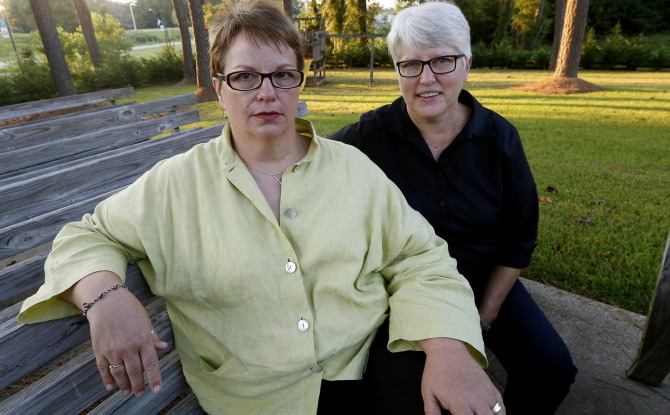
Race mattered not for white-and-Latino couple Eva Smith, 44, and Liz Fuentes, 46, of South Orange, N.J., who are using pseudonyms to protect their African-American children’s privacy. Parenting was an essential part of becoming a family, as was careful planning.

“As a woman, [wanting children] was almost innate for me,” says Smith, who has been with Fuentes for 20 years. “I wanted to be a mom, and there are so many children out there who need loving families—we weren’t concerned with the genetics.”

Ten years ago, the couple began the adoption process of their two black sons, Peter and Adam, both age 10. After completing nearby New York’s rigorous process of workshops designed to prepare parents for adoption, which includes extensive background checks, a home study and home inspection, Smith and Fuentes were matched twice by the state with foster children they eventually adopted. The family have since relocated from the busy streets of Brooklyn, N.Y., to the quieter New Jersey suburbs to give their children the best possible quality of life and access to competitive schools that could address the boys’ developmental delays.

Sometimes a child’s geographic upbringing can be both a help and a hindrance. Growing up in rural Maine, for instance, gave Family Equality Council Co-Interim Executive Director Brent Wright, who is white, a quiet life, but left his desire to be a father “a dream deferred” because he’d never seen any gay families. As his community evolved and changed, so did his prospects for parenthood. He and his husband, Sandis, who have been together for 25 years and live in Andover, Mass., with their two black daughters, went forward with adoption after months of classes and meetings with clergy, mentors with social services experience and people of color.

“[We] had a really good grounding in the importance of cultural respect and understanding what it means to transracially adopt,” says Wright. Their girls, Olivia and Noelle, are 7 and 2 and participate in gymnastics, theater and ballet.
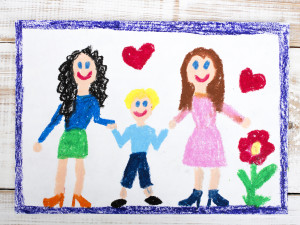
lesbian family law

drawing of a happy couple of lesbians and adopted child

Honest Conversations

Though today’s climate for LGBTQ families is stronger than in years past, parents must prepare themselves and their children for the realities of intolerance and hatred of all kinds. Yvonne and Rebecca Johnson, both 33, are a black lesbian couple raising their sons, Raphael, 12, and George, 14, who are Yvonne’s biological children. They live in Columbus, Ga., where their closest neighbor has a Confederate flag proudly on display. (The family’s names have been changed to prevent personal and professional backlash in their conservative hometown.)

“When the kids were young, we explained to them that people might say or do hurtful things [because of our family],” says Yvonne Johnson.

George, a ninth-grader with a passion for acting, is grateful for the confidence instilled by such conversations.

by Tamika Anderson, May 17, 2016 – TheRoot.com

Click here to read the entire article.
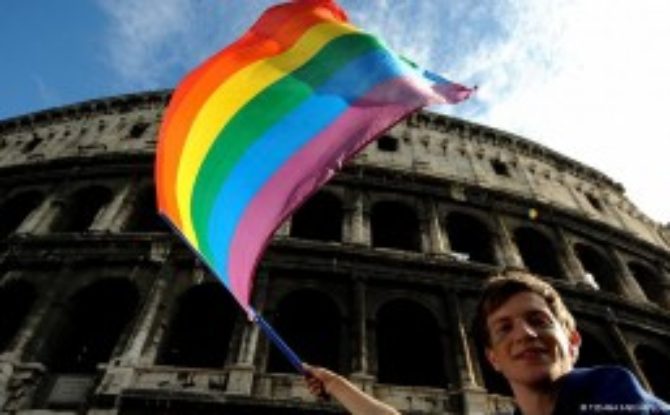
Same-sex unions are not enough, say exiled Italian gay parents

When the Italian parliament this week gave the green light to same-sex couples – becoming the last western European country to do so – the Trevi fountain in Rome was lit up in rainbow colours to celebrate, hailing the move as a major step forward for LGBT rights.

But for Italian families living abroad, the spectre of discrimination against gay couples lives on in restrictive adoption laws which can lead to gay parents having no legal rights over their children by a largely conservative, Catholic and sometimes hostile court system.

Current legislation gives same-sex couples the right to share a surname, draw on their partner’s pension when they die and inherit each other’s assets in the same way as married people.

But it has been fiercely criticised for not providing full equality for gay couples, particularly in terms of adoption rights. While adoption has not been ruled out, family judges will decide on a case-by-case basis.international surrogacy

It means that families who have already adopted abroad will have to go through lengthy court procedures to have their adoption recognised in Italy.

Among them are Giovanni and Marco, two Italian dads living abroad who say they can never return home for fear of the state viewing them as strangers to their adopted children.

“The adoption [of our children] is not recognised by the Italian state, so we could be legally treated as strangers to each other,” they told the Telegraph.

“Whenever we cross the Italian border the parental responsibility over our children falls in a legal grey area. We travel with the contact details of the British Foreign Office and the Adoption Order in case anyone starts questioning ‘why the mother is not travelling with the children?'”

Carolina Girardelli, an Italian lawyer specialising in international adoption, said: “Children [adopted abroad] have no rights as Italian citizens [if their parents are gay].

“You can ask a family judge to recognise your adoption papers but in Italy we have the Church, and a lot of Catholic judges. If one of them is against gay unions, you could lose the case.”

by Mauro Galluzo, May 15, 2016 – telegraph.co.uk

Click here to read the entire article.

Gay Parents Adoption – New Possibilities

Gay parents adoption used to be unheard of.

While certain countries still struggle with the concept of our families being equal to all others, in America, the foundation for gay parents adopting has been set and the legal protections for these families are available and critical to creating security in these family structures.  There are several means by which gay parents adoption can occur. I will review the most common: private adoption, public adoption and second or step parent adoption.

Private Adoption – There are several reasons that parents looking to adopt a child may look into private adoption, sometimes referred to as domestic adoption. The availability of children is higher than most people expect.  In the most recent year for which accurate data exists, there were over 18,000 domestic non-relative adoptions of newborns within the United States. Although the number of people placing their children for adoption has fallen dramatically since the 1970s due to the stigma of single-parenthood thankfully decreasing, there are still many birth parents making the painful but loving choice to look for a family for their biological child.

The adoption of the child can be done in one of two ways. The first is to engage an agency to walk you through the process and to help you with paperwork and the emotional upheaval that such a big life decision will inevitably bring. The benefits to involving an agency are numerous; for example, having your own ‘Adoption Specialist’ who will help you communicate with the various other professionals who need to be involved in the process such as social workers, physicians and lawyers. Financial assistance may be available to help cover legal fees, and agencies often do not charge to process the adoption.

lesbian family law

drawing of a happy couple of lesbians and adopted child

The second is a private arrangement whereby a birth mother and prospective parents arrange the adoption between themselves. They will have to hire lawyers and meet the legal requirements of adoption such as age, ability to care for the child and other important aspects. Parents who want to adopt are able to ‘advertise’ for a birth mother, and mothers who have chosen adoption for their child are able to do the same for an adoptive family.

Public Adoption – Foster children are in the legal custody of a commissioner of a social services district. That district may give responsibility for the care of the child to a voluntary authorized agency. When a child is in foster care, decisions must be made regarding the long-range permanency plan for the child. If the social services district decides that it would not be in the child’s best interests to return home and that the child should be adopted, steps must be taken to legally free the child for adoption.

There are three ways a child can become legally free for gay parents adoption: 1) the birth parents can sign a voluntary surrender agreement; 2) the social services district responsible for the child can bring a case in court asking the judge to terminate the parental rights of the birth parents; or 3) if both birth parents are deceased, or one parent is deceased and there is no other parent whose consent to the adoption is required, the child is automatically free for adoption.  Read more at the NY State Office of Children and Family Services, the source of this information.

Second or Step Parent Adoption – One increasingly popular methods for gay parents adoption is when one parent has a biologically related child of their own and their partner or spouse adopts that child.  If the couple is not married it is referred to as a “second parent adoption” and if they are married, it is referred to as a “step parent adoption.”   For both gay and lesbian couples, securing the legal rights of a non-biological parent is crucial to create the kind of emotional, and legal, security that most other families take for granted. The legality of both parents relationship to their child is often assumed. Parents are parents, regardless of the biological connection to your child.

While recent case law is catching up to our families, it is still lagging in the ability to create complete security without adoption, or a birth order from a competent jurisdiction.  Whichever path you choose to having your family, It is critical to speak with an attorney with experience in the field.  When you consider gay parent adoption, please consider me a resource. For more information on family estate planning, contact Anthony M. Brown at Time for Families and speak to a specialist family lawyer to secure your and your family’s future.

Contact Time For Families

Contact Form
* indicates required field

Adopting in the US has more heartache than you’d imagine

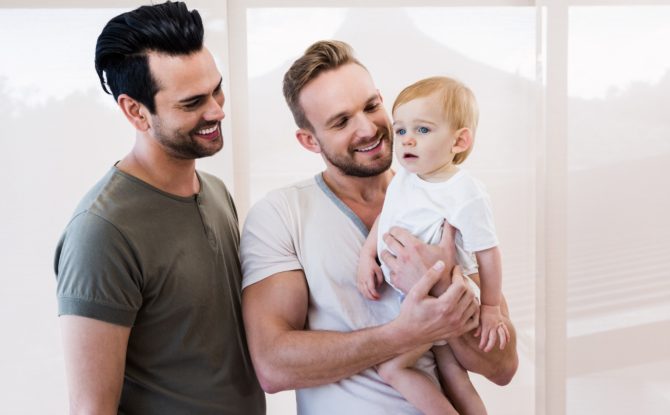
Mike Anderson and his husband, Jeff Binder, endured a difficult adoption of daughter Annika, and missed out on a second child.

Kidz Bop” children’s music producer Mike Anderson, 42, and his husband, TV’s “Damages” and Broadway actor Jeff Binder, 45, longed to start a family, but adopting a child in the US proved to be more difficult than they ever imagined. Here, Mike tells The Post’s Jane Ridley about their epic adoption missions, which resulted in both joy and heartache.

Blowing out the candle on her birthday cupcake last Saturday, our beautiful daughter Annika clapped her hands with delight.

My husband, Jeff, and I could hardly believe it’s been four years since she officially became ours at 2 days old — especially since adopting her was a nerve-racking roller coaster of emotions.

Jeff and I first discussed having kids before we got married in December 2008. For me, part of coming to terms with being gay had been mourning the loss of my chance to have children. When Jeff suggested we do the same as our friends who had adopted or hired surrogates, I came to see how realistic it was. Being dads was an exciting prospect.

But it wasn’t until we’d moved from Inwood to Rhinebeck, NY, that we researched the subject properly, and rejected the idea of surrogacy because of the cost — about $120,000. We started down the adoption route in August 2011. We wanted a newborn, and we thought our chances were better domestically.

For many couples, it takes years to bring a baby home, but for us, it happened pretty fast. We hired Manhattan attorney Suzanne Nichols and were approved by the New York State Adoption Service in February 2012.

Next, we hired an adoption facilitator named Heidi, who helped draft our ad. “Broadway actor and children’s music producer yearn for miracle baby,” it read. It was Hallmark cheesy, but Heidi told us it would appeal to the demographic we were targeting.

We placed the ad in the PennySaver in so-called “adoption-friendly” states like Arizona, Indiana, Pennsylvania, Florida and Wyoming. There, the birth mother has less time to change her mind. In states such as New York, the window is as long as 45 days after giving birth.

Heidi answered all the calls we got on an 800 number and, if she thought they were legit, I did the follow-up. She told us to treat every potential mother as The One, even if you’re juggling more than one at the same time.new york adoption, new york state adoption, adoption New York

They were all hard-luck stories, including an older mom who got pregnant by her friend’s son. Then along came Stephanie*, a 32-year-old mother from Lafayette, La., reaching out on behalf of her daughter, Deana*. The 14-year-old had hidden her pregnancy for seven months after meeting a boy at a party. Most of our dealings were done through Stephanie — we spoke to Deana occasionally but she was quiet and didn’t say much. “We want to give up the baby for adoption,” Stephanie assured us over the phone several times. “Deana just can’t be raising a baby at this point.”

There are strict rules about what you can and can’t pay for when you’re adopting. You can provide the mother with money toward groceries, transportation and housing. But, to be honest, we felt like Stephanie played us a little because she thought we were wealthy.

We ended up buying the family a $4,000 trailer to live in because they were moving to Cocoa, Fla., as well as their monthly land-rent of $900 and a $2,500 truck. Groceries were about $120 a week, and we hired a doula to assist with the birth for about $2,000. Stephanie even called and said, “Deana wants a kitten. Will you buy her one?” Our lawyer advised us not to because it could get us into trouble. In total, the whole adoption process cost us $60,000.

I had a strong feeling that it was all going to fall apart, but we pressed ahead.

Meanwhile, we’d found another birth mom, a 16-year-old from Germantown, Md., who was due three months after Deana. We figured that, if everything worked out, we’d pretty much have the equivalent of twins.

Click here to read the entire article.
May 12, 2016 by Jane Ridley, New York Post

Family Time With Frank, John and Zachary

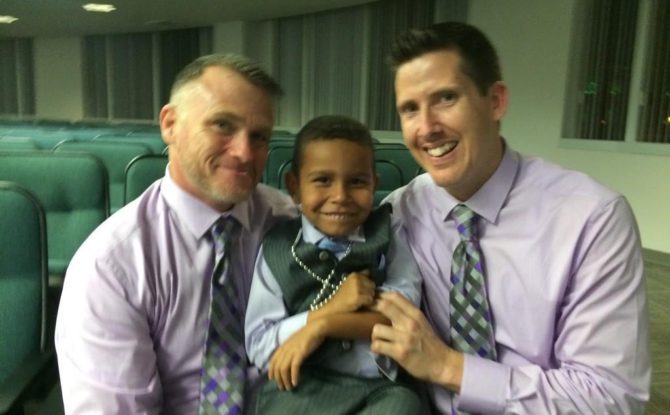
John and Frank live in Oakland Park with their four-year-old son, Zachary. In 2012, the couple fostered Zachary right out of the hospital after he was born and then 18 months later, Frank adopted him as a single father and they became a gay family.

John is from San Francisco. He recently graduated from college and works in human resources. Frank is from New York. He is a registered nurse at Broward General Medical Center and a former New York firefighter. In fact, he was one of the initial responders on 9/11. The couple met eight years ago playing softball.

The two got married in Broward County just after midnight on Jan. 6.2nd parent adoption, second parent adoption, second parent adoptions, second parent adoption new york

In addition to the legal benefits, a huge motivating factor for the couple getting married was so John could join Frank as Zachary’s legal father on his son’s birth certificate. In many cases, unmarried gay couples were not allowed to adopt in Florida, with single fathers having to pass off their significant other as a “roommate”.

“(Before) If something happened to Frank, I wouldn’t have (had) a place to live and I would (have) lost Zachary,” John said.  Meet this gay family!

Visit gayswithkids.com.

Mississippi Same-Sex Adoption Ban Unconstitutional

Mississippi Same-Sex Adoption Ban Unconstitutional: The Supreme Court “foreclosed litigation over laws interfering with the right to marry and ‘rights and responsibilities intertwined with marriage,’” a federal judge ruled Thursday.

WASHINGTON — A federal judge in Mississippi on Thursday afternoon halted enforcement of the state’s ban on same-sex couples adopting children.

Citing the U.S. Supreme Court’s 2015 decision ending bans on same-sex couples’ marriages, U.S. District Court Judge Daniel P. Jordan III granted a preliminary injunction against the state’s Department of Human Services in a case filed this past August.gay rights, lgbt adoption rights, adoption rights, gay adoption rights, gay adoption new york

Of the Supreme Court’s decision, Jordan wrote, “[T]he majority opinion foreclosed litigation over laws interfering with the right to marry and ‘rights and responsibilities intertwined with marriage.’”

Jordan concluded on Thursday: “The majority of the United States Supreme Court dictates the law of the land, and lower courts are bound to follow it. In this case, that means that [the adoption ban] violates the Equal Protection Clause of the United States Constitution.”

The case was brought by same-sex couples seeking to adopt through the foster care system or private adoptions, as well as by the Campaign for Southern Equality and the Family Equality Council. They snagged Roberta Kaplan as their lead attorney in the challenge — the lawyer who represented Edie Windsor in her successful challenge to the Defense of Marriage Act and then Mississippi same-sex couples who successfully challenged the state’s same-sex marriage ban.

While Jordan did grant their requested preliminary injunction, he also granted the requests made by many of the defendants to be removed from the lawsuit. Jordan granted requests to dismiss the complaint against Mississippi Gov. Phil Bryant, Attorney General Jim Hood, and several judges — finding that they were not the appropriate parties to be sued by the couples and groups.

Buzzfeed.com, by Chris Gender – March 31, 2016

Parent Adoption – Is it Right for Your family?

The “parent adoption” process is also referred to as Second Parent or Step Parent Adoption. Here is what you need and what you need to know!

When one partner or spouse in a relationship adopts the biological child of their parent or spouse that is referred to as a “Parent Adoption.” If the parties are unmarried, it is called a Second Parent Adoption.  When the parties are married, it is called a Step Parent Adoption.  While gay couples across the country enjoy equal marriage rights, the laws for New York State adoption are still muddled, and it’s advisable for most same-sex couples to petition for a second or step parent adoption to build that legal relationship between non biological parent and child. If there is another biological parent involved, or if a couple uses a known sperm donor, their consent will be required for the adoption to move forward.  If, however, the child is the product of an anonymous sperm donation, then no consent is required.2nd parent adoption, second parent adoption, second parent adoptions, second parent adoption new york

New York State Adoption Step by Step

In a nutshell, you need to compile a lot of paperwork and have a good family lawyer, preferably one that specializes in adoptions for same-sex couples. Here is a rundown of what you will need:

  • The completed intake from your attorney. This is a general questionnaire that includes information for both parents and the child.
  • The original birth certificate for the child. A copy will not suffice. You will, however, get a new original birth certificate after the adoption which will add the name of the adoptive parent if it is not already on the original birth certificate.
  • A letter from the employer of the petitioning parent, and in some counties the biological parent, stating their position and salary. If you are not currently employed, they will need your last year’s tax returns.
  • A letter from the doctor of both parents stating that they are in general good health.
  • A letter from the child’s pediatrician stating that he or she is in general good health.
  • A completed form 1-D (a more elaborate medical assessment) by the child’s pediatrician
  • In cases of a surrogacy, you will need copies of your carrier and donor agreement.
  • In cases of artificial insemination, in vitro fertilization and surrogacy, a letter verifying insemination.
  • If married, a copy of your marriage license.
  • Previous divorce decrees if either parent has been previously married.
  • If either parent has ever been arrested or convicted of a crime, the details and disposition records for any offense must be submitted.
  • A list of every residence the petitioning parent has lived at for the past 28 years, including months and years associated with every address.
  • Financial information, including the value of your home, any owned real estate, stocks and bonds, life insurance information and any sources of income other than employment.
  • The petitioning parent must be fingerprinted for a criminal background check
  • A home study, which is generally arranged for once your lawyer has been retained.

Keep in mind that this process may vary slightly from state to state and county to county, so it’s important to find an attorney familiar with the legal details in your specific location. While the New York State parent adoption process may seem harrowing, keep in mind that your adoption attorney is there to help you, advise you and even help keep you organized every step of the way.  Read more about the process here.

Anthony M. Brown, head of Nontraditional Family and Estates division of Albert W. Chianese & Associations, has extensive experience in helping same-sex couples through the adoption process, having gone through the process himself. If you have yet to create a legal relationship with your child or children, call 212-953-6447 or email Anthony at Anthony@timeforfamilies.com.

Supreme Court Restores Visitation Rights to Lesbian Adoptive Mother

WASHINGTON — In a pair of unsigned opinions, the Supreme Court on Monday restored the rights of a lesbian adoptive mother who had split with her partner and reversed a murder conviction tainted by prosecutorial misconduct.


The adoption ruling reversed one by the Alabama Supreme Court, which had refused to recognize the woman’s adoptions of three children, which had been granted by a Georgia court in 2007.

The woman, identified in court papers as V.L., said she was overjoyed.

“I have been my children’s mother in every way for their whole lives,” she said in a statement. “I thought that adopting them meant that we would be able to be together always. When the Alabama court said my adoption was invalid and I wasn’t their mother, I didn’t think I could go on.”

The United States Supreme Court’s opinion, which was unsigned and had no noted dissents, said the Alabama court had violated the Constitution’s “full faith and credit” clause. “A state may not disregard the judgment of a sister state because it disagrees with the reasoning underlying the judgment or deems it to be wrong on the merits,” the opinion said.

Supreme Court

The two women in the case, V.L. v. E.L., No. 15-648, were in a committed relationship that started in 1995 and lasted about 17 years. They shared a last name.

One of them, identified in court papers as E.L., gave birth to a child in 2002 and to twins in 2004, both times by insemination from an anonymous donor. They raised the children together in Alabama until they broke up in 2011, and the adoptive mother, V.L., continued to see the children for a time afterward.

When a dispute about the visits arose, V.L. turned to an Alabama court, which granted her visitation rights based on the Georgia adoption judgment. The Alabama Supreme Court reversed that, saying in an unsigned opinion that the Georgia judgment was not entitled to the “full faith and credit” ordinarily required by the Constitution “to the public acts, records and judicial proceedings of every other state.”

The Alabama Supreme Court reasoned that the Georgia court had misunderstood Georgia law in allowing the adoption, saying that “Georgia law makes no provision for a nonspouse to adopt a child without first terminating the parental rights of the current parents.”

by Adam Liptak – New York Times, March 7, 2016

Click here to read the entire article.
 

Gay Family Planning: Options For Your Family

For thousands of New York couples each year gay family planning is a daunting and intricate process. If you are part of a same sex couple, there are extra complications as you must decide what route to go down in order to have or adopt a child.

Gay family planning options include adoption, a surrogate NYC carrier, pregnancy by donated sperm, or IVF. Here we cover the basics for each of these options to help you consider the right option for your family:

Adoption

There are over 130 adoption agencies in New York State, and each of the 58 social services unit districts has an adoption unit. There are no fees for adopting children who have special needs or are in custody of the local social services commissioner, although there may be fees for adopting those children in the legal guardianship of local voluntary agencies. The fees are based on the adoptive family’s income, however, and help may be available in the form of grants or fee waivers, so don’t let finances put you off from looking into this as an option to start your family.

gay adoption

After deciding on an agency, the application forms must be completed. Information is taken about your current family, your background and the type of child you feel you would be able to give the best life to. Criminal history checks will also be made, with particular attention paid to whether someone in the prospective adoptive family’s home has previous mistreated or neglected a child. A criminal record does not necessarily mean that you will be refused for adoption, as it depends on several factors including the type of crime committed.

Within four months of submitting the application, a home study is started and carried out on the prospective adoptive family. This is a series of meetings, training sessions and interviews that enables the family and social services to ascertain the readiness of the family to adopt, and any issues that they may need help with. After the home study has been completed the caseworker writes a summary about the family, which the adoptive couple can also add comments to. Training is also required to cover some areas that are specific to adoptive parenting, such as the needs of foster children and what kind of child they would be most suited to as a parent.

Once the study and summary are complete, the work then begins to match the family with a child. There is no set process for this as it is individual according to the child’s situation and needs. The Family Adoption Registry provides information about waiting children, and adoptive parents can ask for more information about children they are interested in, in exchange for a copy of the home study. The process goes from there and hopefully ends with a child or children finding a loving home with their new parents!

Pregnancy via sperm donor

Lesbian couples have many options in their own gay family planning. Sperm donors may be someone known to the couple or, alternatively, screened samples from a sperm bank. Donors can be anonymous or known, and even with anonymous donors there is usually information available about the donor’s height, hair colour, eye colour, education level and nationality. Ensuring that you use an approved fertility clinic is essential in order to avoid potential diseases that can be transferred through sperm. If you are using a known donor, insist on having him medically pre-screened before insemination and it is a very good idea to consult with an attorney familiar with known sperm donation.

Traditional Surrogate

gay surrogacy

Traditional surrogacy involves the sperm of the intended ‘adoptive’ parent fertilizing the egg of the traditional surrogate, so the child will be biologically related to both parties. Surrogacy contracts in NYC are not legally binding as they are declared ‘contrary to public policy’. This means that you cannot pay someone to carry a baby for you, or create a contract that mandates that the traditional surrogate mother has to give the child to the intended parents, (IPs) upon delivery. Surrogates, whether traditional or gestational, cannot accept money apart from expenses and medical fees directly related to the pregnancy, and heavy fines are levied for anyone involved in a surrogacy agreement – $500 for those involved and up to $10,000 for anyone found to be arranging such contracts (which are void and unenforceable in NYC).

Despite this, surrogacy has continued to be a pathway to family life that many gay male couples choose to take, and there are agencies that help to match potential parents with potential surrogates who live in other, surrogacy-friendly States. When needed, New Yorkers are able to complete second or step parent adoptions in New York to finalize parental rights for a child that has been delivered through a surrogate from another State.

Gestational Surrogate

The difference between gestational and traditional surrogacy is that the baby resulting from gestational surrogacy is not related to the surrogate mother. An egg and sperm create an embryo which is then transferred to the surrogate via IVF. For a male same sex couple, both partners can contribute sperm so that each have an equal chance of being biologically related to the child; they would also need a female third party to donate the egg.

Having the options of different pathways for gay family planning (adoption, surrogacy or pregnancy via donor sperm) can be reassuring to a couple looking to have children, but it can also be overwhelming when trying to decide what is best for you. For a reputable and trustworthy attorney in New York who specializes in helping same sex couples have families, call Anthony M. Brown, head of Nontraditional Family and Estates division of Albert W. Chianese & Associations, at 212-953-6447 or email questions to Brown@awclawyer.com.

Contact Time For Families

Contact Form
* indicates required field

Congo to Let 150 Adopted Children Leave Country After Two-Year Wait

KINSHASA — Democratic Republic of Congo will allow some 150 children adopted by foreign parents, mostly Americans, to leave the country after spending more than two years in legal limbo, the interior ministry said on Monday.

In 2013, Congo imposed a moratorium on exit visas to children adopted by foreign parents, citing fears that the children could be abused or trafficked. The government has also voiced concerns about adoptions by gay couples.

Congo became a favored international adoption destination in recent years because it has more than 4 million orphaned children, according to the U.N. children’s agency UNICEF, as well as lax regulation.

The central African nation is mineral-rich but deeply impoverished. It has suffered through two civil wars and armed groups continue to plague its eastern region.

Between 2010 and 2013, U.S. adoptions from Congo rose 645 percent, the U.S. Department of State said.   international

Interior ministry spokesman Claude Pero Luwara said an inter-ministerial commission had approved the exit visas. In November, the commission signed off on exit visas for about 70 children adopted by European, Canadian and American families.

Congo’s government has come under intense pressure from those countries’ governments to lift the suspension.

“The dossiers that were released … it was mostly American children,” Luwara said, adding that the commission will consider about 900 more foreign adoption cases and plans to complete its work next month.

Parliament is expected to take up a bill this year to lift the moratorium and regulate foreign adoptions.

New York Times, February 22, 2016 by Reuters

Click here to read the entire article.