
Second Parent Adoption Necessity: Securing Parentage in Uncertain Times

Second parent adoption necessity has become the primary topic of discussion for me both at work and in my private life. 

Is there a second parent adoption necessity?  Everyone wants to know whether their family is safe.  Since January 2017, I have received more calls from parents who have not gone through the second parent adoption process for whatever reason and are now concerned that their children may be the ones who suffer from the lack of clear and incontrovertible parentage; a parentage that second parent adoption provides.

Why do I have to adopt my own child?  Many gay and lesbian parents are asking this question when attempting to understand the second parent adoption necessity.  In New York, married lesbian couples who have used anonymous sperm donors are allowed to be listed as a parent on their child’s birth certificate.  Gay couples who have children with the help of a surrogate mother may have petitioned for and received a pre or post-birth order declaring them the legal parents of their children.  They may also be on their children’s birth certificate.  So why is second parent adoption a necessity?second parent adoption necessity

The answer to this question is perhaps the most confounding that I have had to provide clients and friends.  If you can guarantee that your relationship will never end in divorce or dissolution and that, if it does, both individuals will prioritize the best interests of the child first and foremost, then perhaps you can get by without a second parent adoption.  But the reality of a relationship ending is never certain and, unfortunately, the non-genetically related parent is vulnerable to what may be costly and emotionally terrifying consequences.  While the few cases we have seen that have addressed the issue of the validity of a pre or post-birth order have ultimately upheld those orders, those cases cost the litigants tens or hundreds of thousands of dollars.  This is because every jurisdiction has different laws around parentage, some more friendly than others.

With a second parent adoption, there is no question about the parentage rights of a non-genetically related parent.  Even with recent New York case law protecting non-adoptive lesbian parents, there remains questions about what rights other than the standing to sue for custody and visitation exist without adoption.  Federal social security benefits attach to “natural or adopted” children.  Inheritance rights attach to “natural or adopted” children.  Without adoption, future clarification will be needed to accurately assess when parentage exists.

Assisted Reproductive Technology and Gay Families – Sometimes it feels  like we are all just waiting for the law to catch up to how gay and lesbian couples have their families.  One recent decision from Brooklyn, Kings County Family Court to be precise, describes this issue masterfully and concludes that second parent adoption is the one way to ensure that couples are protected as state courts and legislatures grapple with assisted reproductive technology (ART) issues.

While the court in this decision confirms that a parental relationship exists in most cases with or without the adoption, it also holds that married gay and lesbian couples are entitled to second parent adoptions to expel any doubt about parentage and to protect families, particularly when they travel throughout the country and around the world.  The good news is that in many states, New York included, a marriage is not a prerequisite for a second parent adoption.

Whether you are a lesbian couple with a known donor or an anonymous donor, or whether you are a gay couple with a surrogate mother and a pre or post-birth order, the second parent adoption necessity is very real.  Second parent adoption is the right choice to make to protect your family from any future uncertainties.

For more information, email me at anthony@timeforfamilies.com.

South Dakota Allows State-Funded Adoption Agencies to Turn Away Same-Sex Couples

Religious liberty means different things to different people. To James Madison, it meant freedom from religious persecution—and, specifically, from taxes used to fund specific religious sects.

To Thomas Jefferson, it meant freedom of worship, safeguarded by a strict separation of church and state. And to South Dakota Republican Gov. Dennis Daugaard, it means the freedom of state-funded agencies to refuse to let same-sex couples foster or adoption children.new york adoption, new york state adoption, adoption New York

On Friday evening, Daugaard signed SB 149 into law, granting publicly funded adoption agencies a license to discriminate. The law permits any “child-placement agency” in the state—including those that receive taxpayer money—to discriminate on the basis of “any sincerely-held religious belief or moral conviction.” Republican legislators designed the law to let these agencies turn away same-sex couples who hope to foster or adopt; its Senate sponsor, Republican Sen. Alan Solano, co-wrote the bill with Catholic Social Services, a vigorously anti-gay religious adoption agency that will not place children with same-sex couples. But the measure actually extends far beyond LGBTQ discrimination: It will also allow agencies to discriminate against single and divorced people, couples who engage in premarital sex, interfaith couples, and anyone else whose behavior or identity violates an agency’s “religious belief or moral conviction.”

More than 300 children are currently awaiting adoption in South Dakota, a number that SB 149 may well increase. Many of these children were removed from neglectful or abusive homes; SB 149 reduces the odds that they will find families to take them in. Adoption and foster care agencies may now turn away qualified individuals for reasons that are utterly immaterial to the wellbeing of children. The upshot of the bill is that more kids are likely to be left without homes and families.

by Mark Joseph Stern, Slate.com – March 13, 2017

Click here to read the entire article.

For first time, NY judge grants custody of boy to 3 parents in ‘unique’ case

A Long Island judge recently awarded custody of a 10-year-old boy to 3 parents in a “unique” case growing out of the state’s expanded parenting and same-sex marriage laws.

Suffolk County, NY — The child was conceived by parents “Michael M.” and “Audria,” whose full names  were not provided in court documents to protect the child’s privacy.

Audria was the best friend of Michael M.’s wife, the New York Law Journal reported.three parent custody

At the time of the baby’s birth, Audria and Michael M.’s wife, “Dawn M.,” were romantically involved. When the baby was born, Michael M. allowed both women raise the child as joint mothers, Judge H. Patrick Leis III wrote in his decision.

Michael M. remained romantically involved with both women until a 2011 divorce from Dawn M., the Law Journal reported.

Audria and Michael M. had joint custody of the boy prior to the judge’s ruling. Now, the boy lives with Dawn M. and Audria.

“Tri-custody is the logical evolution of the Court of Appeals decision in Brooke S.B. (expanding parental rights in same-sex families) and the passage of the Marriage Equality Act and DRL [Domestic Relations Law] SS10-a which permits same-sex couples to marry in New York,” Leis wrote in his decision.

He then took issue with the father who contested his ex-wife’s request to share in custody.

“No one told these three people to create this unique relationship,” the judge wrote. “Nor did anyone tell (Michael M.) to conceive a child with his wife’s best friend or to raise that child knowing two women as his mother.”

by Douglas Dowty, Syracuse.com – March 13, 2017

Click here to read the entire article.

Supreme Court Won’t Hear Major Case on Transgender Rights

The Supreme Court announced on Monday that it would not hear a major case on transgender rights after all, acting after the Trump administration changed the federal government’s position on whether public schools must allow transgender youths to use bathrooms that match their gender identities.

WASHINGTON — In a one-sentence order, the Supreme Court vacated an appeals court decision in favor of a Virginia transgender boy, Gavin Grimm, and sent the case back for further consideration in light of the new guidance from the administration.

The Supreme Court had agreed in October to hear the case, and the justices were scheduled to hear arguments this month. The case would have been the court’s first encounter with transgender rights, and it would probably have been one of the biggest decisions of a fairly sleepy term.Transgender

Proponents of transgender rights said they were disappointed that the court had not taken the chance to decide a pressing national issue.

“Thousands of transgender students across the country will have to wait even longer for a final decision from our nation’s highest court affirming their basic rights,” said Sarah Warbelow, the legal director of the Human Rights Campaign.

Kerri Kupec, a lawyer with Alliance Defending Freedom, a conservative Christian group, welcomed Monday’s development.

“The first duty of school districts is to protect the bodily privacy rights of all of the students who attend their schools and to respect the rights of parents who understandably don’t want their children exposed in intimate changing areas like locker rooms and showers,” she said.

There are other cases on transgender rights in lower courts, including a challenge to a North Carolina law that, in government buildings, requires transgender people to use bathrooms that correspond with the gender listed on their birth certificates. The law has drawn protests, boycotts and lawsuits.

The question in the Virginia case was whether Mr. Grimm could use the boys’ bathroom in his high school. The Obama administration said yes, relying on its interpretation of a federal regulation under a 1972 law, Title IX, that bans discrimination “on the basis of sex” in schools that receive federal money.

The Department of Education said in 2015 that schools “generally must treat transgender students consistent with their gender identity.” Last year, the department went further, saying that schools could lose federal money if they discriminated against transgender students. The Trump administration withdrew that guidance last month.

Mr. Grimm attends Gloucester High School in southeastern Virginia. For a time, school administrators allowed him to use the boys’ bathroom, but the local school board later adopted a policy that required students to use the bathrooms and locker rooms for their “corresponding biological genders.” The board added that “students with gender identity issues” would be allowed to use private bathrooms.

New York Times, by Adam Liptak, March 6, 2017

Click here to read the entire article.

South Dakota Senate advances protections for adoption agencies that turn away gay couples

The South Dakota Senate on Wednesday advanced a bill that would protect religious or faith-based foster care and adoption agencies that deny child placement to same-sex couples and single parents.

PIERRE — On a 22-12 vote, South Dakota legislators approved Senate Bill 149, which would ensure that religious or faith-based adoption and foster care groups could continue to benefit from state funds and that they wouldn’t face retribution if they denied placement to a parent or couple that doesn’t meet their requirements.

The measure’s sponsor Sen. Alan Solano, R-Rapid City, said he brought the bill to ensure that groups with “sincerely held” religious views are able to place children with traditional families or with other parents that they deem appropriate. He said the bill would help maintain the status quo in that private adoption groups in the state could continue to utilize certain faith-based requirements when selecting prospective parents.gay adoption

“I worry that with out these protections that these boards are going to say we’re done doing child placement,” Solano said.

He said other cities and states have brought restrictions on private adoption agencies that require they drop placement standards based on religion or sexual orientation or risk losing state funding for the services or other programs.

Currently, more than a dozen private adoption agencies operate in the state and if they don’t contract with the state, they are able to turn away single parents, LGBTQ people or non-religious people. Six other organizations currently receive state funds and as a result must comply with state and federal standards that bar them from imposing restrictions based on religion, sexual orientation, marital status, race or gender identity.

Opponents of the bill, including civil rights groups and LGBT advocacy organizations have said the bill’s passage would lead to discrimination at the taxpayer’s expense and could land the state in court.

“This bill could prevent LGBT couples, interfaith couples, divorced people and many otherwise qualified, loving families from adopting children under the guise of religious liberty – all on the taxpayer’s dime,” said Libby Skarin, policy director for the American Civil Liberties Union of South Dakota. “Everyone has the right to their beliefs and to act on them, but that right doesn’t give anyone, including the government, a license to harm others.”

by Dana Ferguson, Argus Leader, 2/22/2017

Click here to read the entire article.

Florist Discriminated Against Gay Couple, Washington Supreme Court Rules

A florist who refused to sell flowers for a same-sex wedding cannot claim religious belief as a defense under the state’s anti-discrimination laws, Washington’s high court said Thursday, in a case that has been watched around the nation by religious and civil rights groups.

SEATTLE — The unanimous ruling by the nine-member state Supreme Court, which a lawyer for the florist said would be appealed to the United States Supreme Court, addressed sweeping questions about public accommodation, artistic expression and free speech.Discrimination

But at its heart was a very human story about Arlene’s Flowers in the small city of Richland, in southeast Washington, and what happened there in 2013 when Robert Ingersoll and Curt Freed started planning their wedding. The shop’s owner, Barronelle Stutzman, knew that Mr. Ingersoll and Mr. Freed were gay and had sold them flowers for years, but then refused to provide flowers for their wedding. Her Christian faith, which defined marriage as between a man and a woman, created a line, she said, that she could not cross.

But in affirming a lower court’s finding, the Supreme Court said flatly that it agreed with the couple — flowers were not really the point.

The case, the court said in its 59-page decision, “is no more about access to flowers than civil rights cases in the 1960s were about access to sandwiches.” And laws, the decision said, can have legitimate social goals. “Public accommodations laws do not simply guarantee access to goods or services,” it said. “Instead, they serve a broader societal purpose: eradicating barriers to the equal treatment of all citizens.”

National gay rights groups hailed the decision as another plank of protection for same-sex couples and marriage equality.

“People should also never use their personal religious beliefs as a free pass to violate the law or the basic civil rights of others,” Sarah Warbelow, the legal director at the Human Rights Campaign, which advocates for lesbian, gay, bisexual, transgender and queer civil rights, said in a statement.

by Kirk Johnson, New York Times – February 16, 2017

Click here to read the entire article.

Vague anti same-sex marriage bills begin final steps through Virginia GA

Today, in a Virginia Senate General Laws committee hearing, HB 2025, authored by Del. Freitas (R- 30) by a vote of 8-7.

Before the bill was passed it was amended to match its Virginia Senate counter part, SB 1324. This senate version, submitted by Sen. Carrico, is an exact copy of a bill he submitted last year – that legislation passed the House and Senate and was vetoed by McAuliffe weeks later.

Both bills, known as a solemnization bills,  aim to shield any “person” from punishment from the state, civil or otherwise, if they deny services in a same-sex marriage. It defines a “person” as a “religious organization, organization supervised or controlled by or operated in connection with a religious organization, individual employed by a religious organization while acting in the scope of his paid or volunteer employment, successor, representative, agent, agency, or instrumentality of any of the foregoing or clergy member or minister.”adoption for gay couples

In layman’s terms, it aims to protect pastors and other faith leaders in churches from civil or criminal punishment if they deny services to same-sex couples. However the bill has also been interpreted by some activists to include other faith-based organizations like church- run schools or hospitals, giving them the ability to refuse visitation rights by same-sex couples, or deny the children of same-sex parents in parochial programs.

The bill was amended and passed without comment and the vote was along party lines with no surprises.

Sen. Carrico’s bill now heads to the House General Laws Committee where it is set to similarly be passed with little debate or issue.

Gov. McAuliffe has promised to veto this bill along with any other bill which could negatively impact LGBTQ Virginians.

by Brad Kutner, February 13, 2107

Click here to read the entire article.

Artificial insemination parenting bill draws LGBT criticism

Two Tennessee lawmakers want to do away with a 40-year-old state law granting legitimacy to children conceived through artificial insemination. Critics say the bill is aimed at gay couples and their children.

NASHVILLE, Tenn. — The bill would remove a single sentence applying to child custody when artificial insemination is involved, one that’s been interpreted to make no distinction between same-sex and heterosexual couples.

But opponents warn that changing the law could prevent both same-sex parents from appearing on the children’s birth certificates, affecting their ability to make parenting decisions ranging from medical care to education.

“It would affect lesbian couples in particular, because if you have two women who are married and one is the birth mother, the other one is presumed to be parent in Tennessee,” said Chris Sanders, the executive director of the Tennessee Equality Project.anonymous sperm donors

Ever since the 2015 same-sex marriage ruling, Tennessee laws with gender-specific terms have been interpreted as applying to either gender of married couples. But that would change under another Republican bill that is seeking to eliminate gender-neutral interpretations of “mother,” ”father,” ”husband,” and “wife.” 

“Clearly, the legislative intention behind both these bills is to stop lesbian couples from having the same automatic recognition of their parent-child relationships that opposite-sex couples have,” Julia Tate-Keith, a Murfreesboro attorney specializing in adoption and surrogacy issues, said in a legal memo.

State Rep. Terri Lynn Weaver, the sponsor of the artificial insemination bill, in a Facebook post denied that her bill is aimed at same-sex marriage, and argued it would not de-legitimize children because another state law addresses parentage without asking about the method of conception.

“The remaining law that will now govern the situation does not have the government inquiring into the means by which the couple’s child came into existence or whose sperm, the husband’s or a donor’s, was used,” Weaver wrote in the post.

Weaver said there would be no change under her legislation for heterosexual couples. “A child born to a married woman will be considered the child of her husband,” she said in a statement.

But that part of the code refers to circumstances when “a man is rebuttably presumed to be the father of a child.” Tate-Keith said that that language does not carry the same gender-neutral interpretation as other parts of state law.

Sanders said that heterosexual couples would have to go through more legal steps if the bill becomes law.

“Straight couples will lose the presumption of paternity,” Sanders said. “It will require them to go to court.”

“What if you didn’t tell your family and friends you were getting fertility treatment?” he said. “It just creates more hardship, more hoops to jump through.”

By ERIK SCHELZIG Associated Press, February 13, 2017

Click here to read the entire article.

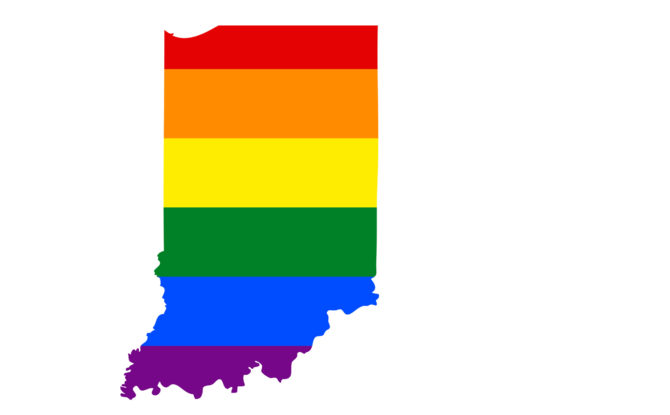
Indiana Birth certificate battle moves to 7th Circuit

Despite a change in state leadership, Indiana will continue fighting over birth certificates in a move that is being seen as part of a larger ongoing resistance to same-sex marriage.

Indiana has appealed the ruling in Henderson v. Adams, 17-1141, which allowed married non-birth mothers to be listed as a parent on the child’s birth certificate. The Pence administration refused to recognize these women as parents and twice tried to convince the district court to limit the scope of the state’s parenthood statutes.

Although a new governor has been installed, the state is turning to the 7th Circuit Court of Appeals but has not yet submitted a brief stating what issue it wants the appellate panel to address. Neither Gov. Eric Holcomb nor Indiana Attorney General Curtis Hill responded to phone and email messages seeking comment.gay parents adopting, same sex paretners

“I had been hopeful that with a new attorney general and a new governor we would see a change in the state’s handling of this matter,” said Karen Celestino-Horseman, one of attorneys representing the couples in Henderson.

The plaintiffs in Henderson, a group of married lesbian couples, challenged Indiana’s stance that non-birth mothers are not parents because they are not biologically related to the children. Their primary argument was that they were being treated differently from similarly situated heterosexual couples who had undergone artificial insemination. The men in those marriages were still listed as the father on the birth certificate even though they didn’t share a biological connection with the offspring.

Judge Tanya Walton Pratt of the U.S. District Court for the Southern District of Indiana overturned the state’s parenthood statutes, finding they violate the Equal Protection and Due Process clauses of the 14th Amendment.

The state subsequently filed a motion asking the court to modify and clarify the ruling. Walton Pratt denied the motion to amend the judgment but granted the state’s request to clarify how the judgment should be applied, pointing out “the Order means what it says and says what it means.”

The IndianaLawyer.com, by Marilyn Odendahl, February 8, 2017

Click here to read the entire article.

The LGBT Trump Disconnect

The LGBT Trump disconnect is real and attention must be paid to what appears to be the beginning of a not so veiled assault on LGBT rights in America.

First, I must say that there is an LGBT Trump disconnect.  Since I wrote my first piece about LGBT family rights in the Trump presidency, a lot has changed.  I have heard from many people, and I myself wanted to believe, that Trump wouldn’t touch the LGBT gains that we have made during the Obama years.  But his actions have proven different.  His appointments, activity in state courts and the often unintelligible rhetoric we have become accustomed, all suggest that we may not be as safe as some thought we were.

The Appointment Problem – My greatest fears about Trump’s appointments center around the Department of Justice (DOJ), and more specifically, around the civil rights division of the that agency.  First, the long and telling history of Jefferson Beauregard Sessions, the Republican Senator from Alabama who President Trump has tapped to lead the DOJ, is troubling for many more that just LGBT Americans.  According to The Washington Post, Jeff Sessions has claimed to be a civil rights champion, yet he has overstated his experience and, in some cases, lied altogether about his involvement.  Sessions has spent the majority of his career attempting to undermine LGBT equality, the details of which are numerous and troubling.

But the worst of this story is that President Trump has chosen John M. Gore to head the DOJ’s Civil Right s division.  Mr. Gore, prior to this nomination, was in the process of defending North Carolina’s odious trans-bathroom bill.  Prior to that, he defended Republican efforts to gerrymander congressional districts in violation of the civil rights of minority Americans.       This is not only putting the fox in charge of the hen house, but the hens in this analogy are real people who have had their civil rights violated in what should be the most fundamental right this country possesses – the right to vote.  How can they now trust that their best interests will be defended by a person who, up to now, has made a career out of challenging these fundamental rights?

The Visibility Problem – One of the first signs that there might be a distance between Trump’s “accepting” rhetoric toward the LGBT community during the campaign and what he plans to do as president appeared, or rather disappeared, within the first hour after he was sworn in.  The official White House website, www.whitehouse.gov, removed the LGBT rights page which had been there throughout Obama’s last term, and before.  No explanation was given, however, the pro-Trump Twittersphere rejoiced.LGBT Trump

In an equally expedient manner, all data regarding climate change was removed as well from the whitehouse.gov site.  As most LGBT Americans are not one issue voters, this deletion concerned me as much as the LGBT page being removed.  “Out of sight, out of mind,” seems to be the rule of law now.

The Marriage Issue – I referred earlier to things having changed since I wrote LGBT Family Rights in a Trump Presidency.  At that time, the Supreme Court of Texas had declined to re-hear a case which would abolish benefits that the City of Houston provides to same-sex married couples. Literally on Trump’s inauguration day, the Supreme Court of Texas changed its mind, under GOP pressure.  The Republican Governor of Texas himself wrote a brief to the court asking them to reconsider, essentially arguing that the Obergefell Supreme Court marriage decision does not apply to Texas.  In that brief, the Governor wrote of the “Federal Tyranny” of the courts and that Obergefell does not require that same-sex married couples and different-sex married couples receive equal treatment under the law.

In my previous article, I was originally at a loss for identifying a case with a fact pattern that would make it to the Supreme Court which would have the effect of etching away at the Obergefell marriage decision.  This Texas case may be just that.  It would undoubtedly take time to make it to the Supreme Court, and who knows what its makeup will be then.  But the anti-marriage movement’s argument is in development and may take the same amount of time to get its legs.  The Arkansas Supreme Court issued a decision based on the above mentioned logic denying same-sex couples that right to be listed on their children’s birth certificates.  The issue is now before us and we cannot afford to stop paying attention.

After attending the Women’s March in Washington this last weekend, I left with a renewed sense of hope and possibility.  Hundreds of thousands of people made the impossible seem possible.  The greatest lesson that I took from my experience there was that no matter how generous I may have felt before in giving President Trump a chance to govern, I cannot forget, nor should any of us, that he won the election by dividing the country and making it clear that some people were simply not welcome.  Those are not “alternate facts.”  Those are the facts.  

This is the LGBT Trump disconnect.  I fear now that my beloved LGBT community has taken its place among women, black people, brown people, Muslim people and immigrant communities that were so vilified during the election and may have no voice in the Trump administration.  I hope that the LGBT Trump disconnect is a myth, but if past is prologue, we have no option other than to pay attention, remain engaged and share our feelings with everyone we can. 

For more information, visit www.timeforfamilies.com, or email me at Anthony@timeforfamilies.com.  

 

Update – 1/30/2017 – As of Friday, January 27, 2017, the Trump administration has reacted to outrage regarding the removal of climate change information from the Environmental Protection Agency’s website by restoring that information on to the EPA website.  All LGBT information remains missing from the whitehouse.gov site.


Update – 2/23/2017 – As of Thursday, February 23, 2017, the Trump administration rescinded protections for transgendered students in public schools.