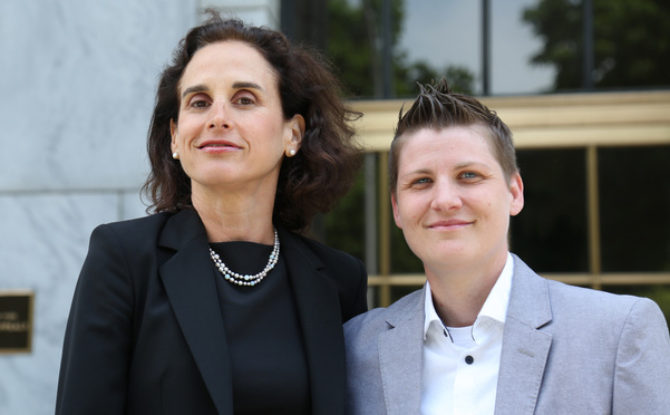

The LGBT Trump Disconnect

The LGBT Trump disconnect is real and attention must be paid to what appears to be the beginning of a not so veiled assault on LGBT rights in America.

First, I must say that there is an LGBT Trump disconnect.  Since I wrote my first piece about LGBT family rights in the Trump presidency, a lot has changed.  I have heard from many people, and I myself wanted to believe, that Trump wouldn’t touch the LGBT gains that we have made during the Obama years.  But his actions have proven different.  His appointments, activity in state courts and the often unintelligible rhetoric we have become accustomed, all suggest that we may not be as safe as some thought we were.

The Appointment Problem – My greatest fears about Trump’s appointments center around the Department of Justice (DOJ), and more specifically, around the civil rights division of the that agency.  First, the long and telling history of Jefferson Beauregard Sessions, the Republican Senator from Alabama who President Trump has tapped to lead the DOJ, is troubling for many more that just LGBT Americans.  According to The Washington Post, Jeff Sessions has claimed to be a civil rights champion, yet he has overstated his experience and, in some cases, lied altogether about his involvement.  Sessions has spent the majority of his career attempting to undermine LGBT equality, the details of which are numerous and troubling.

But the worst of this story is that President Trump has chosen John M. Gore to head the DOJ’s Civil Right s division.  Mr. Gore, prior to this nomination, was in the process of defending North Carolina’s odious trans-bathroom bill.  Prior to that, he defended Republican efforts to gerrymander congressional districts in violation of the civil rights of minority Americans.       This is not only putting the fox in charge of the hen house, but the hens in this analogy are real people who have had their civil rights violated in what should be the most fundamental right this country possesses – the right to vote.  How can they now trust that their best interests will be defended by a person who, up to now, has made a career out of challenging these fundamental rights?

The Visibility Problem – One of the first signs that there might be a distance between Trump’s “accepting” rhetoric toward the LGBT community during the campaign and what he plans to do as president appeared, or rather disappeared, within the first hour after he was sworn in.  The official White House website, www.whitehouse.gov, removed the LGBT rights page which had been there throughout Obama’s last term, and before.  No explanation was given, however, the pro-Trump Twittersphere rejoiced.LGBT Trump

In an equally expedient manner, all data regarding climate change was removed as well from the whitehouse.gov site.  As most LGBT Americans are not one issue voters, this deletion concerned me as much as the LGBT page being removed.  “Out of sight, out of mind,” seems to be the rule of law now.

The Marriage Issue – I referred earlier to things having changed since I wrote LGBT Family Rights in a Trump Presidency.  At that time, the Supreme Court of Texas had declined to re-hear a case which would abolish benefits that the City of Houston provides to same-sex married couples. Literally on Trump’s inauguration day, the Supreme Court of Texas changed its mind, under GOP pressure.  The Republican Governor of Texas himself wrote a brief to the court asking them to reconsider, essentially arguing that the Obergefell Supreme Court marriage decision does not apply to Texas.  In that brief, the Governor wrote of the “Federal Tyranny” of the courts and that Obergefell does not require that same-sex married couples and different-sex married couples receive equal treatment under the law.

In my previous article, I was originally at a loss for identifying a case with a fact pattern that would make it to the Supreme Court which would have the effect of etching away at the Obergefell marriage decision.  This Texas case may be just that.  It would undoubtedly take time to make it to the Supreme Court, and who knows what its makeup will be then.  But the anti-marriage movement’s argument is in development and may take the same amount of time to get its legs.  The Arkansas Supreme Court issued a decision based on the above mentioned logic denying same-sex couples that right to be listed on their children’s birth certificates.  The issue is now before us and we cannot afford to stop paying attention.

After attending the Women’s March in Washington this last weekend, I left with a renewed sense of hope and possibility.  Hundreds of thousands of people made the impossible seem possible.  The greatest lesson that I took from my experience there was that no matter how generous I may have felt before in giving President Trump a chance to govern, I cannot forget, nor should any of us, that he won the election by dividing the country and making it clear that some people were simply not welcome.  Those are not “alternate facts.”  Those are the facts.  

This is the LGBT Trump disconnect.  I fear now that my beloved LGBT community has taken its place among women, black people, brown people, Muslim people and immigrant communities that were so vilified during the election and may have no voice in the Trump administration.  I hope that the LGBT Trump disconnect is a myth, but if past is prologue, we have no option other than to pay attention, remain engaged and share our feelings with everyone we can. 

For more information, visit www.timeforfamilies.com, or email me at Anthony@timeforfamilies.com.  


Update – 1/30/2017 – As of Friday, January 27, 2017, the Trump administration has reacted to outrage regarding the removal of climate change information from the Environmental Protection Agency’s website by restoring that information on to the EPA website.  All LGBT information remains missing from the whitehouse.gov site.


Update – 2/23/2017 – As of Thursday, February 23, 2017, the Trump administration rescinded protections for transgendered students in public schools.

Do I need a Will ? – Essential Estate Planning

Do I need a Will ? “I don’t own anything.”  “It’s too complicated.”  “I’m too young to think about a Will.”  I have heard all of these reasons and more for not adequately preparing an estate plan.

“Do I need a Will ?” is a very important question and this article will shed light on your Will’s importance and what happens if you don’t have one. While it may trigger unwanted emotions, having your “affairs” in order is the best gift you can give to your family and friends.

What happens if you do not have a Will? For the family and friends of those who have died without indicating their wishes for the disposition of their assets after death, not having a Last Will and Testament can be a nightmare.  State law determines where assets go when someone dies without a Will and the state doesn’t always get it right.  If you are married, your spouse receives your estate.  If you are married with children, most states direct half of your assets to your spouse and the other half to be divided among your children.  This may or may not be appropriate depending on an individual’s wishes and the ages of their children.estate planning trust, estate planning gay estate planning, lgbt estate planning, glbt estate planning, Wills, trusts, gay family law

If you do not have children, the state will look to your closest living legal relative as a recipient of your estate. This is where it gets tricky.  In most cases, a surviving parent is next in the line of succession, then siblings and their children.  If you do not have siblings, nieces or nephews, then the court will look out to your aunts, uncles and cousins.  The reality of this scenario is that someone who you may have never met, or had a relationship with may be the beneficiary of your estate if you do not plan carefully.

How does a Will work? A Last Will and Testament is the foundation for all Estate Plans and it passes only probate assets, or assets that are owned    in one person’s name without a designated beneficiary.  Examples of probate assets include land, homes, cars, personal belongings and bank accounts.  A Will does not cover non-probate assets.  A non-probate asset is something that is owned jointly or an asset with a designated beneficiary.  Examples of non-probate assets include jointly held real property, a joint bank account, a life insurance policy with a designated beneficiary and an IRA, 401(k) or other investment account with a designated beneficiary.  You may also name a “TOD” (transfer on death) designation for a bank account you own solely in your name.

The above described assets pass outside a Will, the benefit of which is a faster and easier transfer of someone’s money or property when they die. If, however, you are single and there is no appropriate person to name as a designated beneficiary, it is imperative that you have a Will to pass your property where you want it to go upon your death.

What else does a Will do? A Last Will and Testament, in most states, is the only document that will allow you to name a guardian for children if something happens to both legal parents.  If you have young children, it is critical that you have a Will to state who you want to care for them if anything were to happen to both parents.  A Will also allows you to name an executor.  An executor is the person who will be in charge of marshalling your assets, identifying your debts and ultimately paying them off and making a final distribution according to your wishes as written in the Will.  If you die without a Will, your closest living legal relative will be the first choice for an executor.  Only you know whether this would be appropriate or not.

What happens after I die? If you die with a Will, the executor named in your Will petitions the probate or surrogates court in the county where you lived to receive authorization letters from the court.  This process is called “probate” and it ensures that a Will has been drafted and executed correctly, as well as managing the asset distribution.  Authorization letters will allow you to set up a bank account in the estate’s name and start paying any bills that are due.  If an executor must spend their own money to start a probate proceeding, it will be reimbursed prior to any distribution of assets.

Each state is different and will have a different time line and fee structure, so it is imperative that you meet with an attorney in your area to discuss the process in detail. If you find yourself asking, “Do I need a Will ?,” now you know better how to answer that all important question.
For more information, visit www.timeforfamilies.com or email me at Anthony@timeforfamilies.com.

Conscious Surrogacy – Making the Best Decisions For Your Family

Is there such a thing as conscious surrogacy? Yes, and those considering surrogacy will be confronted with some serious ethical questions.

Conscious surrogacy is a process. It is critical to understand some of the questions, and dilemmas, that you will face if you choose surrogacy to help you have your family.  If you are prepared to answer these questions before your surrogacy journey, and if you are comfortable with your answers, then you are ready to have these conversations with a potential surrogate mother.

What are some of the questions that you will face on your conscious surrogacy journey?

Do I want a single embryo or double embryo transfer? Do I want twins?  One of the first questions you will have to consider is whether you want to try and have twins with your surrogate mother.  Many choose this option for economic reasons.  If you know that you want more than one child, consecutive surrogacy journeys may not be an option.  But there is much more to consider.

conscious surrogacy

Twin pregnancies are much harder on the surrogate mother.  It can mean doctor ordered bed rest for your surrogate and more doctors’ visits, particularly in the third trimester.  Twin pregnancies also bring a higher risk of complications for the surrogate, such as preterm labor, and hypertension.

Twins arrive earlier. A normal singleton pregnancy is 40 weeks.  Most twins arrive early, at or before 36 weeks, which means that one or both of the children may require an extended hospital stay in the NICU (neonatal intensive care unit.)  Some doctors state that in 50% of twin pregnancies, a NICU stay is required.  This by itself may give parents pause about choosing a double embryo transfer.  Studies show that consecutive singleton births result in better medical outcomes than a single twin birth.  With all the information, you can make a conscious decision.

Do I want PGD or PGS? Preimplantation genetic diagnosis or screening is now being offered by most IVF facilities.  PGD or PGS allows a parent to view the genetic material of their child before an embryo is implanted in a surrogate mother’s womb.  PGD/S can show whether a child has any genetic disorders, the sex of the child and other genetic traits that may complicate a pregnancy.  While infertile couples who use IVF (in vitro fertilization), or anyone with a preexisting genetic condition,  may be familiar with PGD/S, couples or individuals who have their families with the assistance of a surrogate mother will most definitely be asked whether they want the information that PGD/S provides.

Knowing whether there is a genetic complication prior to embryo implantation may be in the best interests of all parties, however, choosing the sex of your child before it is born ventures into an ethical quagmire. Most families do not have this information and, while the technology exists, you must ask whether you want the information that it can provide.  The mental and physical health of your surrogate mother must be a priority in making this decision.

Do I want to selectively reduce if complications arise? Perhaps the most important questions you will confront is whether or not to selectively reduce, or abort, an embryo or fetus if there is a danger to the surrogate mother or to the child.  In reality, no state will enforce a gestational carrier contract which requires selective reduction.  The surrogate mother will always have the final say.  But you must know what you want first before you can discuss it with your surrogate.

While abortion is one of the most controversial topics in American society, it is routinely a part of conversations that intended parents have with their surrogate mothers. Surrogacy agreements attempt to cover all possible outcomes and obstacles that can arise during a surrogate pregnancy.  The most important aspect of this topic is being able to communicate your beliefs and desires with your surrogate.

There are many more issues that intended parents will face. Conscious surrogacy is about understanding the major decisions surrounding these issues and being able to come to a place of peace with each one, first with yourself, then with your surrogate mother.  Respecting her autonomy during the pregnancy will take you a long way toward reaching this goal.  Maintaining open and honest communication with your surrogate mother will also help to ensure that the journey is successful for all involved.

For more information about surrogacy, please visit https://timeforfamilies.com or email me at Anthony@timeforfamilies.com.

LGBT Family Rights in a Trump Presidency

Many are asking, “Will there be LGBT family rights in a Trump presidency?” While there certainly is cause for concern about the direction of our country, there are also certain realities that are reassuring.

I never thought I would be writing about LGBT family rights in a Trump presidency. But I also never received as many concerned calls from previous and prospective clients asking whether their marriages would be invalidated, or whether their second or step parent adoptions would be overturned.  These serious questions have led me to write about what I see as LGBT family rights in a Trump Presidency.

First, there is strong precedent holding that when a marriage is validly performed, it will be respected and honored under the law. This means that those LGBT Americans who are already married should not have to worry about a new Supreme Court taking their marriages away from them.LGBT family rights in a Trump presidency

For those who are not married but may wish to in the future, the question is a bit more nuanced. Shannon Minter, the legal director of NCLR, the National Center for Lesbian Rights, and one of the smartest legal minds in our community, said in a recent press release, “it is also highly unlikely that the fundamental right of same-sex couples to marry will be challenged or that the Supreme Court would revisit its 2015 holding that same-sex couples have that fundamental right.”  Mr. Minter is basing this belief on the long held tradition of the court to honor its previous decisions, a term called stare decisis.

The question many legal scholars are asking is whether a newly conservative Supreme Court will ultimately hear a case challenging the right of LGBT couples to marry and overturn the Obergefell marriage decision. While unlikely, it is possible. We can only wait to see who Trump appoints to the Supreme Court.

The most moving calls that I have received in the past days have been from people either in the process of having their families or plan to have families in the near future. They are deeply concerned about the security of their families.  I recently wrote about New York’s changing family law and how second and step parent adoption are now critical to create unassailable family protections, particularly for non-genetically related parents.  These specific forms of adoption are state based and largely shielded from Federal meddling.  That said, if you have a child and have not gone through the adoption process, it is strongly recommended that you do so now rather than later, when our Federal judicial system may be less friendly to LGBT families.

Among LGBT lawyers, one issue of great concern regards transgender Americans and obtaining accurate gender markers on federally issued identification, such as passports. While there is a transgender rights case which the Supreme Court has agreed to hear, we do not yet know whether a ninth more conservative justice will be appointed in time to hear it.

My husband reminded me that politics is cyclical. We have bounced between conservative and liberal presidents and congresses many time before, however, we have never before been faced with a president who based his entire campaign on dividing America by fearful and bigoted rhetoric.  We have never before had a President who, during his campaign, threatened to ban all Muslims from the country, or “lock up” his presidential opponent or degrade women as objects of his own control and pleasure.

Now more than ever it is time to be proactive. Many of us have experienced the shock and sadness associated with the loss of what we had hoped would be a liberal president in the White House.  We are entering uncharted territory.  LGBT family rights in a Trump Presidency will undoubtedly take some hits, but we are a strong, resilient and loving community.  And we have the tools to protect our families.   Don’t fail to use them!

By Anthony m. Brown, Esq.  November 11, 2016 – For more information, visit www.timeforfamilies.com or email Anthony at anthony@timeforfamilies.com.

New York’s Changing Family Law

New York’s changing family law finally appears to be catching up to the realities of LGBT families, at least incrementally.

A series of decisions from various New York courts is informing New York’s changing family law in ways never before imagined. Currently, in Manhattan, a court is struggling with how best to protect a child born in Ethiopia, which would only allow a single mother to adopt, now that his lesbian parents have split up.  Another recent decision out of the Kings County Family Court is one of the first to acknowledge the complexities of how we create our families, and offers sage advice as to how best we can protect them.


This new line of cases comes hot on the heels of the New York Court of Appeals case known as The Matter of Brooke S.B., which I have written about extensively.  Up until this decision, many lesbian parents who had not adopted the biological children of their partners or spouses were considered legal strangers to the children that they had raised since birth.  They were blocked by the court from seeking custody and visitation when their relationships faltered.  The Matter of Brooke S.B brings New York’s changing family law in line with many other states which recognize “de facto” parents for the purpose of custody and visitation and prioritizes the best interests of the child in making these critical decisions.

The court in Brooke S.B. was careful not to expand the definition of parentage beyond the facts of each specific case, which means that we will be seeing more and more litigation attempting to address situations that do not fall squarely in the fact pattern of Brooke S.B., like the current case in Manhattan.

In a move to address confusion created by a 2013 decision from Kings County Surrogates Court, where Judge Margarita Lopez Torres denied a lesbian couple a step parent adoption because she held that a marital presumption of parentage existed when a  child is born to a married couple, Brooklyn Family Court has offered its opinion.  New York’s Appellate division, Second Department held the opposite of Lopez Torres (Paczkowski v. Paczkowski, — N.Y.S.3d —- (2015)), creating much confusion for the LGBT community.  Brooklyn Family Court Judicial Hearing Officer (JHO) Harold Ross, in a decision titled The Matter of L., et. al, held that as long as uncertainty exists for LGBT couples who create their families with assisted reproductive technology (ART), then second parent adoptions are the best way to secure those families from this uncertainty.

The bottom line of New York’s changing family law is that with each new case that tests the limits of the court’s definition of family, hundreds of thousands, if not millions, of dollars will be spent to “make new law,” when there already exists a remedy that is affordable and is respected across the country and around the world, second and step parent adoption.  The process may be time consuming but the benefit is priceless and I believe that JHO Ross understood this and made New York’s changing family law easier for us all to grasp.

For more information, please email anthony@timeforfamilies.com.

Ethical Surrogacy – Making the Right Choices

Ethical surrogacy is, and must be, the goal of an intended parent (IP) who is looking to have a family with the assistance of a surrogate mother.

Because of the different parties involved and the roles that they play, there must be a guiding, ethical roadmap for intended parents to follow to ensure that everyone has a successful and positive experience, an ethical surrogacy. Up until very recently, no such roadmap existed for intended parents.  Doctors have such guidelines in the ASRM (American Society of Reproductive Medicine) Recommendations for Practices Utilizing Gestational Carriers.  Attorneys also have such guidance in numerous articles and section committees dedicated to issues surrounding surrogacy.

Respect Ethics Honest Integrity Signpost Meaning Good Qualities

Now there is a place where intended parents can go to review best practices and baseline protocols for ethical surrogacy, ensuring that each IP has the tools to create an ethical journey. Men Having Babies (MHB), a non-profit organization of which I am the board chairperson, recently introduced A Framework for Ethical Surrogacy for Intended Parents, available online in English, French, German, Spanish, Italian and Hebrew.  This comprehensive document is supported by several LGBT organizations in America and abroad.

What is Ethical Surrogacy?

MHB’s ethical surrogacy framework revolves around the notion that surrogacy can be a wonderful and fulfilling experience for all parties involved, even if the surrogate is compensated for her efforts, risk and inconvenience. While compensation is part of the process, the act itself is not commercial because the IPs are not buying anything, particularly a child, which is a claim made by some anti-surrogacy activists.  A surrogate efforts should be compensated, even if the journey does not result in a pregnancy or in the case of a miscarriage.

How can Ethical Surrogacy be Achieved?

Regulation is the key to achieving ethical surrogacy. Having laws in place that require independent representation for all parties ( in their home languages), ensuring that all parties are vetted medically and psychologically, limiting compensation so as not to create irresistible incentives for participation and making surrogacy legal in each state and in each country so IPs and surrogate mothers do not have extraordinary distances between them, all work together to create an ethical surrogacy environment.

Reasonable and appropriate legislation should be enacted to allow perspective parents, donors and surrogates enter into legally enforceable agreements for surrogacy arrangements without having to cross state lines or country borders. This fosters more successful and fulfilling relationships between surrogate mothers and IPs.  Steps must also be taken to limit any medical risks that donors and surrogates face in the surrogacy process.

Baseline Protocols for Providers

Several baseline protocols should be implemented by service providers to ensure an ethical surrogacy experience including, but not limited to: informed consent from all parties, medical screening, social and psychological screening, independent legal representation (with language interpretation is required) before any treatments begin, medical insurance review from the surrogate mother and an agreement regarding contact during and after the surrogacy journey.

Best Practices

Best practices are suggestions for “above and beyond” thinking that is required of IPs because so much of the integrity of the journey depends on them. Among these suggestions is the creation of a long term vision about your family.  Who will be the biological parent?  How many journeys do you anticipate? What will the relationships be during and after the surrogacy?  How will you explain your family make-up to your child?  These questions are just a few of those that need to be asked and answered in the surrogacy process.

Above all, the autonomy of your surrogate mother must be respected and supported. While it may be your child that she is carrying, it is her pregnancy.  Insuring that she knows that you, as IPs, understand this distinction is critical to supporting her autonomy.  Her family and community will also play a role in her pregnancy, so getting to know her circle of support is a wonderful way of bolstering that support, making the journey a happy and healthy one for your surrogate mother.

While the MHB Framework for Ethical Surrogacy for Intended Parents goes deeper into the specifics of making your journey an ethical one, this article is designed to begin a conversation about the quality and success of your surrogacy journey.  After all, your family is worth it!  For more information, go to timeforfamilies.com or email Anthony at Anthony@timeforfamilies.com.

Unmarried Estate Planning Information

While America has transformed in its understanding of marriage equality over the last five years, unmarried estate planning is still vital for those who, by choice, remain unmarried.

Unmarried estate planning was the bulk of my practice prior to marriage equality. In 2010, I published a law review article on estate planning for unmarried couples discussing just this material.  Finding the loopholes that would provide protection for unmarried couples is an art form and many today who are unmarried by choice, must know these rules and regulations that may negatively affect them without proper planning.

What unmarried couples must know – The law protects married couples in a way that is truly unique.  While some argue against making marriage the benchmark for protection, it nevertheless remains the standard in America.  Without proper planning, a surviving unmarried partner can face a number of pitfalls that could have been prevented with careful planning.  The main categories of awareness center on death, property, health care and asset transfer.tips for estate planning

Death – When an unmarried person dies, their Will is the operative document for distribution of assets upon their death.  If that unmarried person dies without a Will, the state in which they live will decide through the law of intestacy who receives from their estate.  Blood relatives are given priority.  In many states, New York included, if an unmarried person dies with a Will, their closest living legal relatives are also required to consent to the probate of the decedent’s Will.  The emotional and financial costs of these notification provisions can run high depending on the legal family of the decedent.

To best prepare for these issues, maximize your non-probate assets, or assets that are titled solely in the name of the one unmarried partner.   Create “POD,” or payable on death, designations for your bank accounts so they don’t have to go through probate.  Place real property titled in one unmarried partner’s name into a trust, which removes it from probate.  Also, verify all of your non-probate asset designations, such as life insurance beneficiaries, IRA beneficiaries and 401(k) beneficiaries.  These assets will pass directly to whomever you designate, as long as you make a designation.  If you do not, those assets pass into your estate and must go through the probate process.

Real property – You cannot discuss unmarried estate planning without talking about real property ownership.  If there is one legal owner of a house or apartment, then upon death the property will pass either through the Will of the decedent unmarried partner, or through a trust if they were savvy enough to create one.  If you purchase the property together, make sure to hold the title as Joint Tenants With Right of Survivorship.  This will ensure that the property passes to the surviving joint owner without having to go through a probate or an administration proceeding to pass to the surviving partner.

Health Care – One of the most important aspects of unmarried estate planning is addressing one another’s health care needs.  Each partner should have a carefully crafted Medical Power of Attorney, or Health Care Proxy, and a Living Will.  These documents will ensure that your individual wishes are met given an end of life situation and that your partner will make the medical decisions necessary if you cannot.

Asset Transfer – One of the real benefits of marriage is the unlimited transfer of assets between spouses, both during life and after death.  If an unmarried partner wanted to add their partner’s name to the deed of a home or apartment, they would have to file a gift tax return for half the value of the property.  If, however, they were married and did the same transaction, no gift tax return would be required.  Likewise, gifting of over $14,000.00 to any one person who is not your spouse in a calendar year also requires the filing of a gift tax return.

For more information about unmarried estate planning, please visit www.timeforfamilies.com or email me at Anthony@timeforfamilies.com.

New York Family Law, Matter of Brooke S.B.

Late August 2016 marked a turning point for New York family law and how it defines parents, particularly lesbian parents.

What the court decided – Up until this decision, many lesbian parents who had not adopted the biological children or their partners or spouses were considered legal strangers to the children that many of them had raised since birth.  Under previous New York family law, these non-biological and non-adoptive parents could not seek the legal system’s assistance in gaining custody, or even visitation, to the children who they helped to raise.

All that changed last month with a court case known as In the Matter of Brooke S.B. v. Elizabeth A.  C.C.  In this landmark decision, the court overturned previous New York precedent that had torn families apart for decades and ruled that non-biological and non-adoptive parents did have standing to sue for custody and visitation in the New York family court system.  This brings New York family law in line with many other states which recognize “de facto” parents for the purpose of custody and visitation and prioritizes the best interests of the child in making these critical decisions.remarkable parenting

What this decision does not address? – The court was careful to base its decision on the specific facts of this case, which included one very important element: the fact that the couple agreed in advance to the conception of the child.  What this means is that if a lesbian couple has children but the non-biological or non-adoptive parent entered the picture after the conception of the child, then she would not fall under the definition of a “de facto” parent as stated in this case.  Also, if the non-biological, non-adoptive parent did not consent to the conception of the child by clear and convincing evidence, she would be forestalled from seeking custody or visitation.

It is also critical to note that the court did not explicitly state that the non-biological, non-adoption mother was a legal parent of a child born to her spouse or partner for all purposes, just that she could seek custody and visitation if she had consented to the conception.  This case also did not explicitly address the notion of the marital presumption of parentage, which a mid-level appellate court has held not to apply to same-sex couples.  This concept holds that the spouse of a married woman is automatically considered the legal parent of any child she gives birth to.

Does this mean I do not have to adopt my partner or spouse’s child? – I do not believe that the court meant for this decision to be a substitute for second or step adoption.  Adoption is the one clear pathway to legal parentage and parentage includes much more that custody and visitation.  Adoption also ensures that a parent’s relationship to their child would be respected across the country and around the world.

For instance, if you are the non-biological, non-adoptive parent and you have a better health care plan at work, this decision would not mandate that an employer must put the child on your health insurance. Second or step parent adoption would, however, ensure that that the child would be protected in this situation.

Brooke S.B. was also silent on whether a legal relationship between a non-biological or non-adoptive mother would be recognized for the purposes of estate administration. This means if a legal parent dies without a Will, their children automatically share in that parent’s estate if they are married, or inherit the estate completely if the decedent spouse is not married.  Finally, the legal and emotional statement of securing your family through adoption resonates beyond just the family unit.  It establishes your family in the community, in your child’s educational institutions and, most importantly, in the eyes of the children with whom you are creating a legal family.

Brooke S.B. also fails to address how gay men can protect their families through surrogacy.  Adoption is still the best way in New York to create legal families established through surrogacy.

Brooke S.B. will undoubtedly protect many families from the horror of being torn apart because one parent was not recognized as a real parent. For that, New York family laws will be better and stronger for all families.  But this decision is not all-encompassing and when it comes to the protection of your family, the establishment of comprehensive legal parentage by a non-biological parent is the ultimate goal.  To accomplish that, a second or step-parent adoption is essential.

For more information about New York family law and the ramifications of the Brooke S.B. decision, contact Anthony Brown at Anthony@timeforfamilies.com or visit www.timeforfamilies.com today.

Finding a Surrogate Mother – And Your Future

Finding a surrogate mother is the first step for couples who want to have a biologically related family through surrogacy.

Finding a surrogate mother is also one of the most profound journeys that a couple can embark upon. Before we look at the specifics of who makes a good surrogate mother and what red flags to look for, we need to understand the processes that require finding a surrogate mother.New York surrogacy

What is surrogacy? – There are essentially two types of surrogacy, traditional and gestational, and two ways to go about it, independent surrogacy and agency surrogacy.  Traditional surrogacy is when the woman who provides the egg is also the surrogate mother.  She has a biological relationship to the child she is bearing for the intended parents (IPs – the people who will be the legal parents of the child born through surrogacy).  Gestational surrogacy involves a separate egg donor who provides the egg through a clinic to the gestational surrogate mother.  The egg is implanted via in vitro fertilization and the surrogate mother does not have a biological relationship with the child she is bearing.

Independent surrogacy requires the intended parents to coordinate all aspects of the surrogacy journey. These aspects include:

  • Finding a surrogate mother and providing for compensation and expenses
  • Finding an egg donor
  • Locating and paying the bills of the clinic that will perform the IVF
  • Locating and paying for attorneys to:
    • Draft donor and surrogate agreements
    • Represent the egg donor, if necessary
    • Represent the surrogate mother
    • Establish parentage for the IPS
  • Providing support to all parties, psychological, emotional and financial

With agency surrogacy, the surrogacy agency, full-service or otherwise, takes on some or all of the tasks listed above. The fees for agency surrogacy are increased due to this extra work; however, some people prefer to have the work handled by professionals with experience in this ever changing area of law.

What to look for in a surrogate mother – Finding a surrogate mother that is right for your family is crucial to a successful and happy pregnancy and birth experience.  Most agencies will only consider candidates for surrogate motherhood who are married and have already had at least one child.  This should be your baseline as well if you are attempting independent surrogacy.  Married surrogates with their own children are preferred because they have a built in support system for the pregnancy and they have had the experience of giving birth.  You do not want your surrogate to have her first birth experience with a child that she will not be raising.

Other questions to ask when finding a surrogate mother are:

  • Why do you want to be a surrogate mother?
  • Do you know anyone who is, or has been, a surrogate mother?
  • How do you feel about being compensated?
  • Do you have a support system in place, i.e. are you comfortable sharing with your friends and family that you are being a surrogate mother?
  • How will you explain the child born through surrogacy to your children?

There is no “right” or “wrong” answer to these questions. They are designed to spark conversations that will allow you as the IPs to get a feel for the surrogate mother’s motivations and capability to carry someone else’s child. It will also give her an insight into who you, as IPs, are and if she wants to work with you. This unique relationship is a two-way street and it is critical to remember that your surrogate mother is not your employee, she is helping you have a family.

Pay attention to red flags – If any of the answers you get to the questions above cause you concern, please pay attention to that.  If you sense that financial gain is the only motivator for your surrogate mother, she probably is not the right person to carry your child.  If she has no support system to help her through the process, she would probably not be the best choice.

Finding a surrogate mother is one of the most important tasks that IPs face on their journey toward family. I strongly suggest taking a look at the Men Having Babies  Framework for Ethical Surrogacy for Intended Parents.  It was created with the input of seasoned surrogate mothers, to give IPs their own list of best practices to ensure that they, and their surrogate mother, are prepared for the journey ahead.  If you have any questions about this, or anything else surrogacy related, please contact me at Anthony@timeforfamilies.com.

Considering Known Sperm Donors

Lesbian couples are choosing known sperm donors in increasing numbers for a variety of very important reasons. Your choice now can make a big difference in your child’s life.

Known sperm donors are a much more viable option for lesbian couples today than they have ever been.  What greater decision can there be than the biological parent of your child? Choosing an anonymous sperm donor used to be the norm.  There are many reasons why known sperm donors are becoming the preference for lesbian couples and this article explores some of the most important ones.  But first, make sure you know the law.

One of the most cited reasons for choosing known sperm donors is to have a greater insight into the biology of your child. Having a known sperm donor’s medical history can be critical for mothers who have medical or genetic issues that they must consider before having a child.  An anonymous sperm donor file will provide some medical information, but a known donor can share his family medical history, which may be crucial for the health of your child.remarkable parenting

While medical considerations are one of the top reasons for having a known donor, knowing the emotional and social character of the donor is also an often overlooked consideration in many people’s path to parenthood.  No anonymous donor profile can show the complete picture of the person who may be the biological father of your child.

Legal considerations are also important reasons to choose between anonymous donors and known sperm donors. Anonymous donors surrender their parental rights to any children born with their genetic material upon deposit to a sperm bank or fertility clinic.  When you choose an anonymous donor, they may offer the option of allowing the child to contact them at age 18, but there is no question as to their lack of parental rights to that child.

Known sperm donors in many states, New York included, must surrender their parental rights to a child born with their genetic material after the birth of that child.  And if the mother is a single parent by choice, the known donor in many states may not surrender their parental rights at all.

In New York, as in most states, the best interest of a child is considered when allowing a genetic parent surrender their parental rights. If a known donor is surrendering his parental rights to the spouse or partner of the mother, then the court will authorize that surrender.  If, however, there is no other parent who will be assuming parental rights, the known donor cannot surrender their parental rights and will be able to sue for custody and visitation.  The mother will also be able to sue that known donor for child support.  This is the most important reason why single mothers by choice should use an anonymous donor.

One reason why lesbian moms are choosing known sperm donors is for the emotional health of their children later in life. Many studies show that the more a child knows about their biological background, be they adopted, a child through surrogacy or through known or anonymous sperm donation, the better adjusted they are as adults.  These same studies also show high satisfaction levels in the mothers who have chosen known sperm donors.

One other consideration in choosing a known sperm donor is where they live. If you envision a known donor as a parental figure in your child’s life with a more active role, the donor must be geographically able to fill that role.

Finally, many mothers choose between known and anonymous donors because of the degree of control they wish to have over their family formation. Choosing a known donor can be tricky and many mothers prefer to maintain the kind of parental control over their family that can only be experienced with an anonymous donor.

Whether you are considering known sperm donors to help you create your family or whether anonymous donors are right for you, the most important part of this decision is that you and your spouse or partner are comfortable with it and on the same page. And please make sure you know the law! For more information about known sperm donation and the legalities surrounding our families, contact Anthony@timeforfamilies.com or visit www.timeforfamilies.com today.