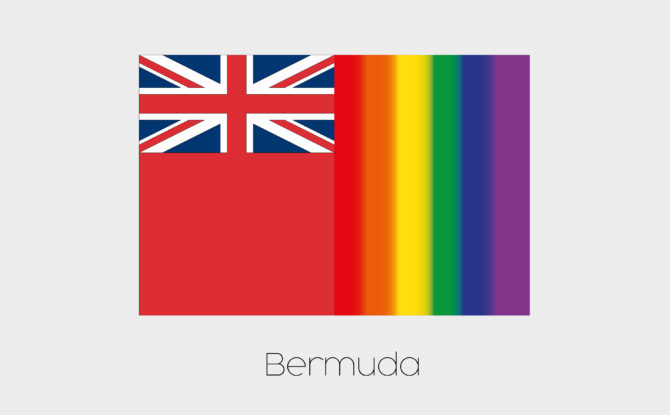
Bermuda Outlaws Gay Marriage, Less Than a Year After It Became Legal

Bermuda has forbidden same-sex marriage, only nine months after legalizing it, in what advocates for gay and lesbian rights called a disappointing setback.

Same-sex marriage became legal in Bermuda, a British overseas territory, in May as a result of a ruling by the island’s Supreme Court.

But the unions are unpopular with some voters.Bermuda

In 2016, Bermudians voted against same-sex marriage in a referendum, and after the court ruling in May, the territory’s legislature drafted a bill banning same-sex marriage but giving all couples legal recognition as domestic partners. Parliament adopted the Domestic Partnership Act in December, and on Wednesday the territory’s governor, John Rankin, signed it into law.

The British prime minister, Theresa May, said Britain was “seriously disappointed,” but the Foreign Office said on Thursday it would be inappropriate to block the measure.

Same-sex marriage became legal in England, Wales and Scotland in 2014, but it is not permitted in Northern Ireland. The issue has been divisive in Britain’s overseas territories, which control their own internal affairs but rely on Britain for defense and for representation in the international community.

by Mafen Specia, New York Times – February 8, 2018

Click here to read the entire article.

Is America Growing Less Tolerant on L.G.B.T.Q. Rights?

When my sister came out, there was an accordion trio on hand to perform the music of Sly and the Family Stone.

Debutantes in white dresses and boys with matching cummberbunds and bowties drank from the waters of a gurgling champagne fountain. The entire affair, staged in my parents’ old house in Devon, Pa., was an anachronism, to be sure — but as wingdings go, it was tons of fun. It was 1975.

When I came out, in 2002, there wasn’t any party. There were tense meetings with the affirmative action/equal opportunity officer at my place of work; there was a carefully worded statement sent to my colleagues explaining exactly what “transgender” was; there was a series of conversations with my friends, and my mother, and the people whom I loved best, many of whom — in spite of their brave pledges to stand by me — ended those conversations in tears.

That was then.

People who “come out” at debutante parties have been off my radar for a long time now, although apparently they’re still going strong in some quarters. As for L.G.B.T.Q. people, “coming out” has gotten safer in fits and starts, not only in the wake of the Obergefell decision but also in other ways: L.G.B.T.Q. people are now visible in a way that was inconceivable half a generation ago. Most of the people that I thought I had lost after my 2002 unveiling have, miraculously, been returned to me, the intervening years having brought not only forgiveness but also understanding. Since my coming out, our family has thrived, and in the wake of that progress, I have believed that just as the Rev. Dr. Martin Luther King Jr. predicted, the arc of the moral universe does indeed bend toward justice.

Until now.

Last week, GLAAD — the media advocacy group for L.G.B.T.Q. people (of which I was a national co-chairwoman from 2013 to 2017) — released the results of its latest “Accelerating Acceptance” survey at the World Economic Forum in Davos, Switzerland. While the biggest headlines from the forum focused on the fact that the president of the United States managed to get through an event on the world stage without shoving any prime ministers or calling anyone’s country an outhouse, the results of the poll, conducted by Harris, deserve attention as well. They are shocking.

For the first time since the poll began, support for L.G.B.T.Q. people has dropped, in all seven areas that the survey measured. They include “having an L.G.B.T. person at my place of worship” (24 percent of Americans are “very” or “somewhat” uncomfortable), seeing a same-sex couple holding hands (31 percent are uncomfortable) and “learning my child has an L.G.B.T. teacher at school” (37 percent are uncomfortable).

New York Times – by Jennifer Finney Boylan, January 29, 2018

Click here to read the entire article.

Known Donor Family Law New York – Protecting Lesbian Mothers

Known Donor Family Law New York is changing. 

Many lesbian couples look to known donor family law New York prior to choosing known donors to help them have their families.  In my legal practice, I have seen this number increase steadily over the last 10 years.  Reasons for choosing a known donor include giving children a link to their biological heritage, having access to specific medical histories and providing male influences in the lives of children born into these progressive families.

The law appears to be coalescing in favor of intended mothers and a recent Appellate Division case moves known donor family law in New York further in that direction.  Before discussing the new case, let me give you a brief history of existing known donor family law in New York.known donor family law New York
Existing Family Law Treatment

Brooklyn Family Court Judicial Hearing Officer (JHO) Harold Ross, in a decision titled The Matter of L., et. al, held that as long as uncertainty exists for LGBT couples who create their families with assisted reproductive technology (ART), with both anonymous and known donors, then second parent adoptions are the best way to secure those families from this uncertainty.

In the Matter of Brooke S.B. v. Elizabeth A.  C.C., a landmark decision released in August of 2016, the New York’s highest court overturned previous New York precedent that had torn families apart for decades and ruled that non-biological and non-adoptive parents did have standing to sue for custody and visitation in the New York family court system.  While this case did not specifically address the issue of a known donor’s rights to a child he helped come to be, it brought New York family law in line with many other states which recognize “de facto” parents for the purpose of custody and visitation and prioritizes the best interests of the child in making these critical decisions.

New Case Law 

This new known donor case, entitled In the Matter of Christopher YY v. Jessica ZZ and Nicole ZZ, New York’s Appellate Division, Third Department (whose jurisdiction covers matters derived in South Central New York State to North Eastern and Central Eastern Counties in New York) addressed the issue of a known donor who sought to have a paternity test ordered by a family court.  The family court agreed with the donor and ordered the testing.  The mothers filed an appeal and the result of that appeal was to overturn the lower family court’s decision to order paternity testing for two reasons, thus codifying new known donor family law in New York.

The first reason was the marital status of the mothers.  They were married when they planned on having the child and they had an informal agreement (one drafted and executed without the benefit of legal counsel) with their donor, something that all intended mothers should have with their known donor prior to insemination.  The court stated that there existed a “presumption of legitimacy of a child born to a married woman.”  Even if this presumption exists, the court must conduct a “best interests of the child” analysis before any paternity testing can be ordered.

known sperm donorsThe key question is whether the paternity testing is in the best interests of a child.  The court determined that the presumption existed regardless of the gender of the parents, a huge statement of support for lesbian couples across New York.  However, that presumption can be “rebutted” by a donor in certain circumstances.  The court looked at the facts of this case, the existence of an agreement in which the donor stated that he would not seek paternity, and the lack of a significant relationship between the donor and the child after the child’s birth. 

To determine whether the presumption of parentage that the court established for the non-birth mother could be rebutted, they applied the concept of “equitable estoppel,” which bars a legal claim by a party if that claim is inconsistent with a prior position taken by them and relied upon by the other party.  In this case, the prior position was outlined in the known donor agreement he signed with the mothers, that he would not attempt to establish paternity,  and his lack of a relationship with the child after her birth.  Equitable estoppel prevented the known donor from proving to the court that the paternity testing was in the best interest of the child.

What does this case mean for Known Donor Family Law New York? 

This case is certainly a step in the right direction.  But these cases are fact specific and unless there is a legal instrument, such as a step or second parent adoption order, the possibility of taking a party to court will always be a financially and emotionally time-consuming specter over a family.  Another benefit of a step or second parent adoption is that is clearly and indisputably terminates the rights of a known donor, making a claim such as the one made by the donor in this case, a nullity.

Known Donor Family Law New York is moving in the right direction.  If you are considering a known donor, you must also consider how best to secure your family from unwanted paternity or visitation suits.  For answers to your questions, please  visit www.timeforfamilies.com  or email Anthony at anthony@timeforfamilies.com.
Lesbian couple sues for son’s US citizenship

A same-sex couple is suing the US government alleging discrimination because one of their children was not granted American citizenship.

US citizen Allison Blixt and her Italian wife Stefania Zaccari had two babies in London, England.

The spouses each carried one child to term using their own eggs and an unknown sperm donor.citizenship

American citizenship was granted to Ms Blixt’s son, Massimiliano, but not to Ms Zaccari’s boy, says the lawsuit.

The US Department of State has not commented on the allegations.

According to the agency’s website, “at least one biological parent must have been a US citizen when the child was born” for a child to qualify for birthright citizenship.

Ms Blixt and Ms Zaccari are listed on both children’s birth certificates, and English law recognises them as the boys’ parents, according to their lawsuit filed in Washington DC.

The court filing says the US consulate denied citizenship to Ms Zaccari’s child, Lucas, now two years old, on the grounds that he was not a blood relation and that he was born “out of wedlock”.

However, lawyers for Ms Zaccari and Illinois-born Ms Blixt say they were legally married in their adopted home of England before their sons’ births.

The lawsuit says that at the US consulate “Stefania and Allison were asked a series of invasive and legally irrelevant questions about how their children were conceived and born”.

The decision violates the Immigration and Nationality Act establishing that “babies born abroad are US citizens at birth when one of the child’s parents is a married United States citizen”, says the court filing.

After a law against same-sex marriage was overturned in the US in 2013, same-sex couples were allowed – like heterosexual couples – to bring their foreign spouses into America.

But the same ruling did not cover the children of same-sex couples, and legal advocates say this is discriminatory.

Ms Blixt told the Washington Post that she declined the offer to become her son’s legal stepmother and bring him to the US as an immigrant.

BBC.com January 22,2018

Click here to read the entire article.

State Dept. sued for denying citizenship to same-sex couples’ children

Two binational same-sex couples on Monday filed federal lawsuits against the State Department after their children were denied U.S. citizenship.

Andrew Dvash-Banks, who was born in Santa Monica, Calif., and his husband, Elad Dvash-Banks, who was born in Israel, were married in Toronto in 2010. The two men decided to live in Canada because the Defense of Marriage Act that President Clinton signed in 1996 prevented Andrew Dvash-Banks from sponsoring Elad Dvash-Banks for immigration purposes.citizenship

A surrogate gave birth to the men’s twin boys — Aiden Dvash-Banks and Ethan Dvash-Banks — in Mississauga, Ontario, on Sept. 16, 2016.

Aiden Dvash-Banks was conceived with Andrew Dvash-Banks’ sperm, while Ethan Dvash-Banks was conceived with Elad Dvash-Banks’ sperm. Canada recognizes both men as their children’s parents.

The 2013 U.S. Supreme Court ruling in the Windsor case that struck down a portion of DOMA prompted the U.S. to legally recognize same-sex marriages performed outside the country. The U.S. Consulate in Toronto nevertheless denied the men’s request for a Consular Report of Birth Abroad — which certifies that a child who was born overseas was an American citizen at the time of their birth — and a U.S. passport for Ethan Dvash-Banks under Section 309 of the Immigration and Naturalization Act that specifically addresses “children born out of wedlock.”

“Focusing improperly on the biological relationship between each child and the parent who conceived him, the State Department then recognized Aiden’s citizenship and denied Ethan’s,” reads the lawsuit that Andrew Dvash-Banks filed in the U.S. District Court for the Central District of California.

The Dvash-Banks family moved to Los Angeles on June 24, 2017.

Andrew Dvash-Banks and Aiden Dvash-Banks are U.S. citizens, while Elad Dvash-Banks is a permanent resident. Ethan Dvash-Banks, who is also a plaintiff in the lawsuit, was able to enter the U.S. on a tourist visa that expired on Dec. 23, 2017.

“All of Andrew and Elad’s professional, personal and familial commitments are in constant jeopardy of being undone if the Department of Homeland Security deports Ethan,” reads the lawsuit.

Andrew Dvash-Banks and Elan Dvash-Banks have applied for a green card for Ethan Dvash-Banks in order “to minimize the risk of deportation proceedings and having to face the choice of staying together as a family or staying in this country.”

Washington Blade, by Michael Lavers, January 22, 2018

Click here to read the entire article.

Justice for All Means LGBT Families Too, Says Attorney Anthony Brown

Ask Anthony Brown, and he will tell you that in many ways, he’s had a maverick life. As an actor, as a lawyer, as a husband and a father.

Today, Anthony Brown’s work as an attorney helps LGBT clients navigate the tricky nuances of estate planning, wills and other legalities that keep worried families up at night. But the path to his current career was anything but straight.best interests of the child

Being gay is the least of it. When he arrived in New York in 1984, it was to attend Julliard to study acting. Just as he was about to graduate, Brown met the man who would one day become his husband, Gary Spino.

And, while he met with enough success to work as an actor, he had both bills to pay and time on his hands between jobs. On the road with a touring production of Romeo and Juliet, Brown discovered a massage table stashed behind a Coke machine and decided to make it — and massage — his next passion.

Serendipity struck once again when one of his massage clients turned out to be Tom Stoddard, one of the founders and guiding lights behind Lambda Legal, an organization doing much of the heavy legal lifting during the peak years of the AIDS crisis. “I was lucky enough to work with him during the last seven years of his life,” Brown says now. “He wrote New York’s anti-discrimination law protecting gays and lesbians, and he was a huge influence on me.”

Metrosource.com, By Kevin Phinney – January 12, 2018

Click here to read the entire article.

Contact Time For Families

Contact Form
* indicates required field

European court advisor: Same-sex couples entitled to residency rights

A legal advisor to the European Union’s highest court on Thursday said gay couples should receive the same residency rights that married couples have in the European Union.

The Associated Press reported European Court of Justice Advocate General Melchior Wathelet issued an opinion that he said is not about whether European Union countries should extend marriage rights to same-sex couples. Wathelet did say, however, they should extend spousal benefits in a way that does not infringe “on the rights of citizens of the (European) Union and their family members to move and reside freely within the territory of the member states.”European high court

Wathelet issued his opinion in the case of Adrian Coman, a Romanian citizen, and his American husband, Clay Hamilton.

Coman and Hamilton, who currently live in New York, legally married in Belgium in 2010. The Associated Press reported the men since 2012 has been asking the Romanian government to recognize his marriage.

Romania currently bans gays and lesbians from legally marrying, but it does not prohibit civil partnerships between same-sex or heterosexual couples. Opponents of marriage rights for same-sex couples in 2015 collected 3 million signatures in support of a referendum on whether to amend the country’s constitution to define marriage as between a man and a woman.

Romania’s Constitutional Court asked the European Court of Justice to weigh in on the men’s case.

The European Court of Justice is expected to rule later this year. The Associated Press reported the judges often “follow the reasoning laid out by advocates general,” even though the judges are not legally bound to Wathelet’s opinion.

Same-sex couples can legally marry in Ireland, the U.K. outside of Northern Ireland, France, Spain, Portugal, Belgium, the Netherlands, Luxembourg, Norway, Denmark, Sweden, Finland, Germany and Malta.

The Washington Blade, by Michael Lavers, January 12, 2018

Click here to read the entire article.

Landmark ruling recognizes marriage, trans rights in the Americas

The Inter-American Court of Human Rights on Tuesday issued a landmark ruling that recognizes same-sex marriage and transgender rights in the Western Hemisphere – the Americas.

Americas – The seven judges who issued the ruling stated governments “must recognize and guarantee all the rights that are derived from a family bond between people of the same sex.” Six of the seven judges also agreed that it is necessary for governments “to guarantee access to all existing forms of domestic legal systems, including the right to marriage, in order to ensure the protection of all the rights of families formed by same-sex couples without discrimination.”marital trust

The court issued its ruling after the Costa Rican government in 2016 asked for an advisory opinion on whether it has an obligation to extend property rights to same-sex couples and allow transgender people to change their name and gender marker on identity documents.

The ruling says the Costa Rican government must allow trans people to legally change their name and gender marker on official documents.

It does not specifically say how Costa Rica should extend marriage rights to same-sex couples. Costa Rican Vice President Ana Helena Chacón on Tuesday nevertheless told reporters during a press conference in the Costa Rican capital of San José that her government will do so.

“The Executive Branch will focus on studying the resolution in depth,” she said as La Nación, a Costa Rican newspaper, reported.

The Organization of American States created the Costa Rica-based court in 1979 in order to enforce provisions of the American Convention on Human Rights. Tuesday’s ruling is legally binding in Costa Rica and 19 other countries throughout the Western Hemisphere that currently recognize the convention.

Margarita Salas, a Costa Rican LGBT rights advocate who is a candidate for the country’s National Assembly — described the ruling to the Washington Blade as an “enormous advance in human rights for Costa Rica.”

“Now more than ever it is imperative that the National Assembly pass bills that make access to marriage equality and the recognition of gender identity a reality,” she said.

The Washington Blade, by Michael Lavers – January 9, 2018

Click here to read the entire article.

Colorado Supreme Court to weigh if one parent has the right to use frozen embryos if the other objects

During three emotional days of divorce talks, Drake and Mandy Rooks managed to agree on how to divide up almost every aspect of their old lives down to the last piece of furniture. Only one thing remained: the frozen embryos.

There were six of them, created from his sperm and her eggs, and they had been left over from when the couple had gone through in vitro fertilization some years earlier.

The couple had had three children using the technology, and Drake was done. He didn’t want any more children in general, and certainly not with Mandy. She felt differently. She had always imagined a large family and, given her trouble getting pregnant, she thought the embryos were her only hope for having more babies. She wanted them preserved.

The dispute is one of a number of embryo-custody battles that have landed in the courts over the past quarter-century, resolved by different judges in different states with no consistent pattern. Rulings sometimes have awarded the frozen contents to the parent who wanted to use them, while other times determining that they could be discarded.

On Tuesday, the Colorado Supreme Court will hear oral arguments in the Rookses’ case. Although several other cases have made their way to states’ high courts, legal experts say the issues here are different.donor conceived

“Constitution questions are front and center in a way that they have not been in the other cases,” said Harvard law professor Glenn Cohen. And if the judges decide the Rookses’ dispute on such grounds, that would allow it to be appealed to the U.S. Supreme Court – where a ruling would apply nationwide.

Cohen said the central issue focuses on how to balance one person’s constitutional right to procreate with another’s countervailing constitutional right to not procreate. The question parallels similar arguments used in other reproductive health cases, namely the Supreme Court’s landmark 1973 abortion decision in Roe v. Wade. If women have the right to not be forced to be a gestational parent, do men – or women – have the right not to be forced to be a genetic parent?

Absolutely, says Drake Rooks, 50. “It just seems like a guy should be able to decide whether he wants more children or not and with whom,” he said in an interview last week.

Mandy Rooks, who is 10 years his junior, flips the argument and comes to the opposite conclusion. “No one,” she said in an emailed statement, “has the right to tell me that I have to kill my offspring.”

By | The Washington Post – January 8, 2018

Click here to read the entire article.

India Supreme Court to reconsider controversial sodomy ruling

The India Supreme Court on Monday said it would reconsider its controversial 2013 ruling that recriminalized consensual same-sex sexual relations.

The Hindustan Times reported Chief Justice Dipak Misra and two other judges said the decision on Section 377 of the Indian Penal Code was based on what it described as “the perception of majority and concept of social morality.”Indian Supreme Court

“Concept of consensual sex may have more priority than a group right and may require more protection,” said the judges, according to the Hindustan Times. “A section of people or individual who exercise their choice should never live in a state of fear.”

The Delhi High Court in 2009 struck down the country’s colonial-era sodomy law. The Supreme Court’s 2013 ruling overturned it.

Indian lawmakers in late 2015 rejected a bill that would have repealed Section 377.

India is among the more than 70 countries around the world in which consensual same-sex sexual relations remain criminalized.

The Washington Blade by Michael Lavers, January 8, 2018

Click here to read the entire article.